Client Centred Home Care Explained for Daily Life
See what client centred home care means in Australia and how preferences, routines, communication and worker choice should shape everyday support.
It's 7.40 on a Tuesday morning and the doorbell rings. You're halfway through dressing, the kettle's boiled, and the radio is on the station you listen to every day. The support worker on the roster is someone you've never met. She's pleasant, she's early, and she wants to start with the shower, because the visit list says shower, then breakfast, then a quick tidy before she drives to the next house.
Nothing about that morning is unsafe. It just isn't yours. You wanted the shower at eight, toast rather than porridge, and the fifteen minutes after breakfast to sit with your sister's phone call. Small things, except they're the shape of your day.
Client centred home care is the practice of building support around that shape instead of around the roster. It's a phrase on a lot of Australian brochures, and a checkable way of working when it's done properly. The difference shows up in mornings, meals and who walks through the door.
Why the Person Receiving Care Sets the Pace
A worker who arrives at 7.30 while the person is still waking, starts the shower before the kettle has boiled and leaves before the morning phone call isn't delivering bad care. That worker is delivering care that belongs to someone else's timetable. The person ends up fitting around the run sheet: the shower when the roster says shower, the breakfast that fits the van, the outing squeezed between two other houses.
Client centred home care reverses the direction. Support gets built around the person's goals, daily routines, preferred services and support arrangements rather than delivered as a fixed package timed for the provider's convenience. In Australia that's the shift from provider-directed services to consumer-directed care, and it's now written into national policy rather than left to good intentions.
The morning test: can the person say what happens first, who does it, and which parts they'll do themselves? If the answer depends on the roster, the care is still provider centred.
What changed in Australian policy
The Australian Government's Aged Care Data and Digital Strategy 2024-2029 states the system should deliver "highest-quality person-centred care" and enable older people and their support networks to access services and take part in decisions about care and wellbeing. The strategy was informed by consultation with more than 600 organisations and individuals, which shows how much weight participation now carries in the reform agenda.
Disability support rests on the same foundations: culturally appropriate communication, a worker the participant has selected, and routines that change when needs change. Historically the alternative was task-focused or institutional care, where the visit list drove the day rather than the person living it. What replaced it is individual choice, shared decision-making and support that adapts.
For a household, all of that collapses into five sets of decisions: personal preferences, daily routines, communication, worker choice, and family and culture. Each one has a sound practice, a red flag, and a way to check it on the very first shift.
Preferences Routines and a Person Led Day
Use the table below as a working document before support starts, not as a poster for the office wall. Read each row with the person and write down the answer.
| Part of support | What the person decides | Sound practice | Red flag |
|---|---|---|---|
| Personal preferences | Privacy, gender of worker, food, faith and how much hands-on help | Worker explains, asks, and leaves tasks the person can do | Help is done to the person on a fixed task list |
| Daily routines | Wake time, meal timing, household jobs and order of the day | Roster follows the person's day and can change | Visits are set for the provider's convenience |
| Communication | Language, pace, who is told what, and consent to share with family | Steps are explained in a way the person understands | Family or worker decides without asking |
| Worker choice | Which profile to meet, whether to accept, and when to change | Profiles, a meeting before the first shift, and a real option to reject | Whoever is on the roster arrives unannounced |
| Family and culture | Family roles, religious practice, food and community context | Agreement records these, not only the spoken language | Matching stops at a shared language |
The first two rows are where most disputes start. A person decides whether a worker is in the bathroom, whether the door stays closed, whether help means a steadying hand or full assistance with washing. Gender of the worker often matters here. So does faith, particularly around prayer times, fasting or washing rituals. The worker's job is to explain each step, ask before helping, and leave the person to do the parts they can still manage.
Routines are the second flashpoint. Wake time, when medication is taken with food, whether the main meal lands at midday, and the order in which the house gets tidied. A 9am arrival for someone at their sharpest at 7am is a rostering problem, not a personality clash. If you want a longer look at why the order of the day matters so much, how routine builds stability is worth ten minutes before the first shift.
Communication sits underneath both. Some people understand English well but lose the thread when they're tired or in pain. Others want the worker to speak with their daughter rather than to them. Consent decides who gets told what, and it can change week to week.
Three hours in a client centred day
Picture the morning. The worker helps with the shower, then steps back while the person dries and dresses themselves, because that part is theirs. Breakfast is toast, cut the way they like it, taken at the kitchen table rather than in a chair by the bed. The visit ends with the pills checked against the health team's instructions and the front door locked, not with a form signed in a hurry.
Then midday. The clean follows the person's idea of clean: the bench cleared first, the bathroom last, the vacuum not run while the person is resting. The meal suits taste, culture and whatever the dietitian or GP has advised. A default menu of sandwiches and tea is how providers reveal they've stopped listening.
By afternoon, the choice belongs entirely to the person. An outing to the shops, a walk by the water, a visit to a friend, an appointment. The worker's role is travel, a prompt, or physical support where needed. The destination isn't the worker's decision.
When a shared language is not enough
Cultural matching gets treated as a language problem, and it isn't. Culturally suitable support also depends on family roles, religious practice, communication norms, food, trust and community context, as the NDIA market and cultural safety work sets out. The NDIA identifies "culturally thin markets", where First Nations participants may have few culturally safe options, particularly in regional and remote areas, and its market analysis reports significant gaps in First Nations and other culturally and linguistically diverse providers, plus limited support for culturally led service models.
That creates a contradiction worth naming. A participant can hold formal provider choice and still have very little real choice, because the workers available don't understand cultural obligations or the way they prefer to be assisted. The NDIA has begun a four-year cultural-safety initiative aimed at systems, workforce capability and participant experience. Until that changes everyday rostering, the practical work sits in the service agreement.
What the agreement should record
- Family involvement and consent: who gets updated, how often, and what stays private.
- Gender and culture: preferred worker gender, prayer and washing needs, food rules and religious dates.
- Communication style: language, pace, reading versus speaking, and whether a support person joins calls.
- How to change workers: the process, the notice, and how continuity is held while a new match is arranged.
Close the loop with one question. If the person can't say who is coming, when, and what they still decide themselves, the arrangement isn't client centred yet, whatever the brochure says.
Keeping Autonomy When Workers Are Scarce
Choice has a supply problem, and most marketing skips it. An NDIS Review workforce paper estimated the sector would need an additional 128,000 workers, around 40% growth, to meet demand, with shortages particularly persistent in regional and remote areas. The reported causes are unglamorous: travel costs, higher delivery costs, staff turnover, professional isolation and few providers nearby.
The picture below sets out the constraint and the design response side by side.
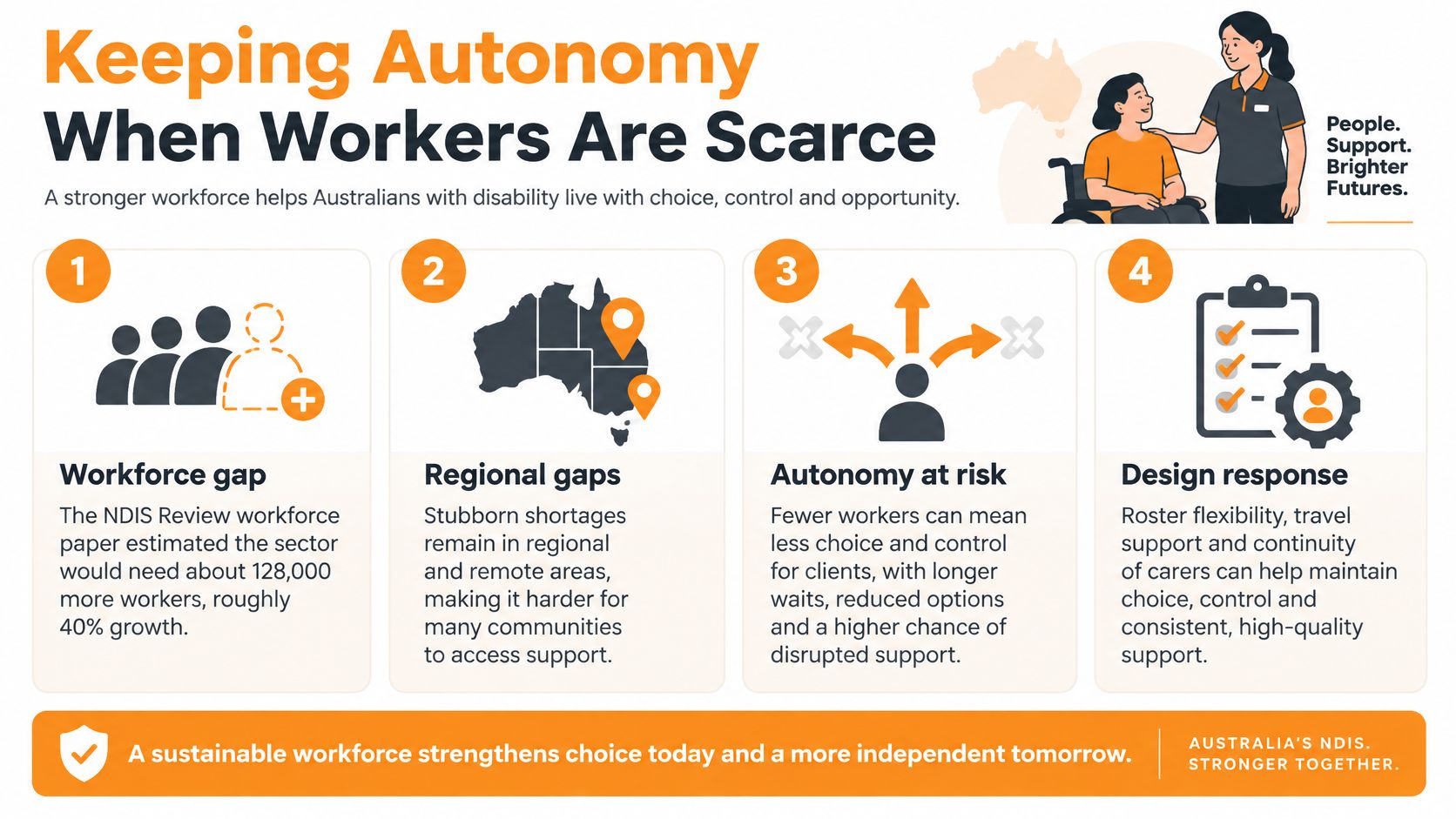
A shortage is where choice gets tested. When few workers speak your language in your postcode, or the one worker who understands your food rules and washing routine is on leave, the brochure promise gets measured against the roster. Client centred care works here as a method, the discipline that keeps the person leading while the match is imperfect. That discipline has to be written down, because goodwill evaporates on the morning someone calls in sick.
The fallback plan to insist on
- Split preferences into fixed and flexible. Gender, language and cultural practice go in the fixed column. Shared hobbies and a favourite television program can be flexible.
- Use an introduction or trial shift before a replacement becomes the regular worker.
- Name the leave and illness protocol. Who is told, how soon, and what the person can expect in the first 24 hours.
- Keep the right to refuse a fill-in without being left with no support at all. Refusal and abandonment shouldn't be the same option.
- Limit the number of different workers covering personal care. Continuity matters most where the body is involved.
Ask any provider this: if my worker is away tomorrow, who decides the replacement, and when will I know?
Continuity earns its place in the plan on practical grounds as much as ethical ones. Across the Scheme's longitudinal outcomes reporting, participants with steady support tend to report rising community and social participation and stronger choice and control the longer they are in the Scheme. Those are averages across a large program. They do not prove that someone in a thin market feels the same benefit, or that gains survive a rotating roster. Treat them as a direction of travel, then run your own check: count how many different workers came through the door last month, and whether you were told before each swap.
The same logic sits behind building independence at home: autonomy grows when support is steady enough to plan around. A person who never knows who is arriving stops planning the week. That is the quiet cost of a shortage, and a written fallback plan is how you keep it small.
Choice and Control Numbers Worth Watching
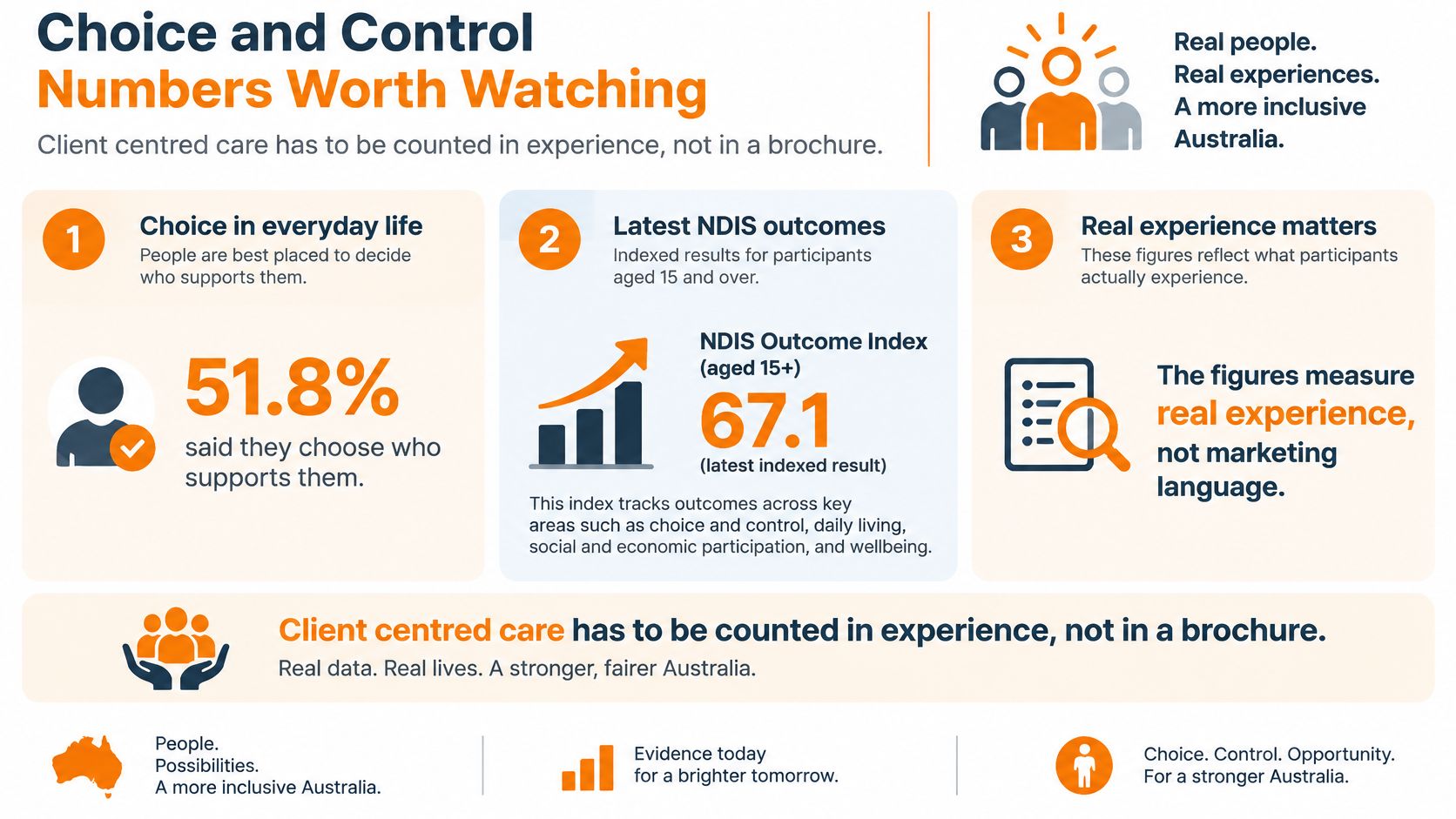
Client centred care has to be counted in what people experience. The latest NDIS longitudinal outcomes data puts the key measure at 51.8% of participants aged 15 and over reporting they choose who supports them, an increase of 3.9 percentage points. In the same dataset, 69.4% reported making more decisions than previously, a rise of 13.0 points.
| Measure | Group | Figure | Change |
|---|---|---|---|
| Chooses who supports them | Aged 15 and over | 51.8% | Up 3.9 percentage points |
| Makes more life decisions than before | Aged 15 and over | 69.4% | Up 13.0 percentage points |
| Scheme increased choice and control after two years | Aged 15 to 64 | A clear majority | Higher than at entry |
The third row is the longer test. Picking a worker once is relatively easy; still feeling in control after two years shows the arrangement is holding.
What those gaps mean at home
Sit with the first figure for a moment. Close to half of participants still don't report choosing the person who supports them. For personal care, meals and household help, that's the difference between a service and a roulette wheel. When the promised choice turns out to be whoever the roster had spare, choice has become scheduling.
The numbers justify a simple control loop that a participant or family can demand, and it earns its keep where workers are scarce:
- See several profiles before support begins, with enough detail to judge language, experience and manner.
- Accept or reject before the first shift. Meeting the preferred worker in advance turns a hope into a decision.
- Write preferences into the service agreement, including the ones that aren't about tasks: privacy, gender, food, faith and who gets told what.
- Review the match when something shifts. A new routine, a change in communication needs or a cultural requirement that wasn't understood the first time is a reason to revisit the match.
Measure the right thing: attendance tells you a worker arrived. Participant-reported choice of worker, decision-making and satisfaction tell you whether the support was usable.
That last distinction matters most in the intimate parts of the day. If a person doesn't trust the worker helping them shower, they'll skip the shower. If a meal doesn't respect religious or cultural rules, it goes uneaten. Support that's nominally available but feels unsafe or wrong doesn't get used, which is why counting attendance alone flatters a service that isn't working.
Claims Versus Practice in Home Support
Here's the warning worth carrying through the front door. An Australian study applied a person-centred framework to seven residential aged-care homes and found that only two of the seven met most indicators across the full framework, while the other five demonstrated only some elements. Residential care isn't home care. The finding still travels, because the peer-reviewed work on how well actions match the claims shows that adopting person-centred language guarantees nothing.
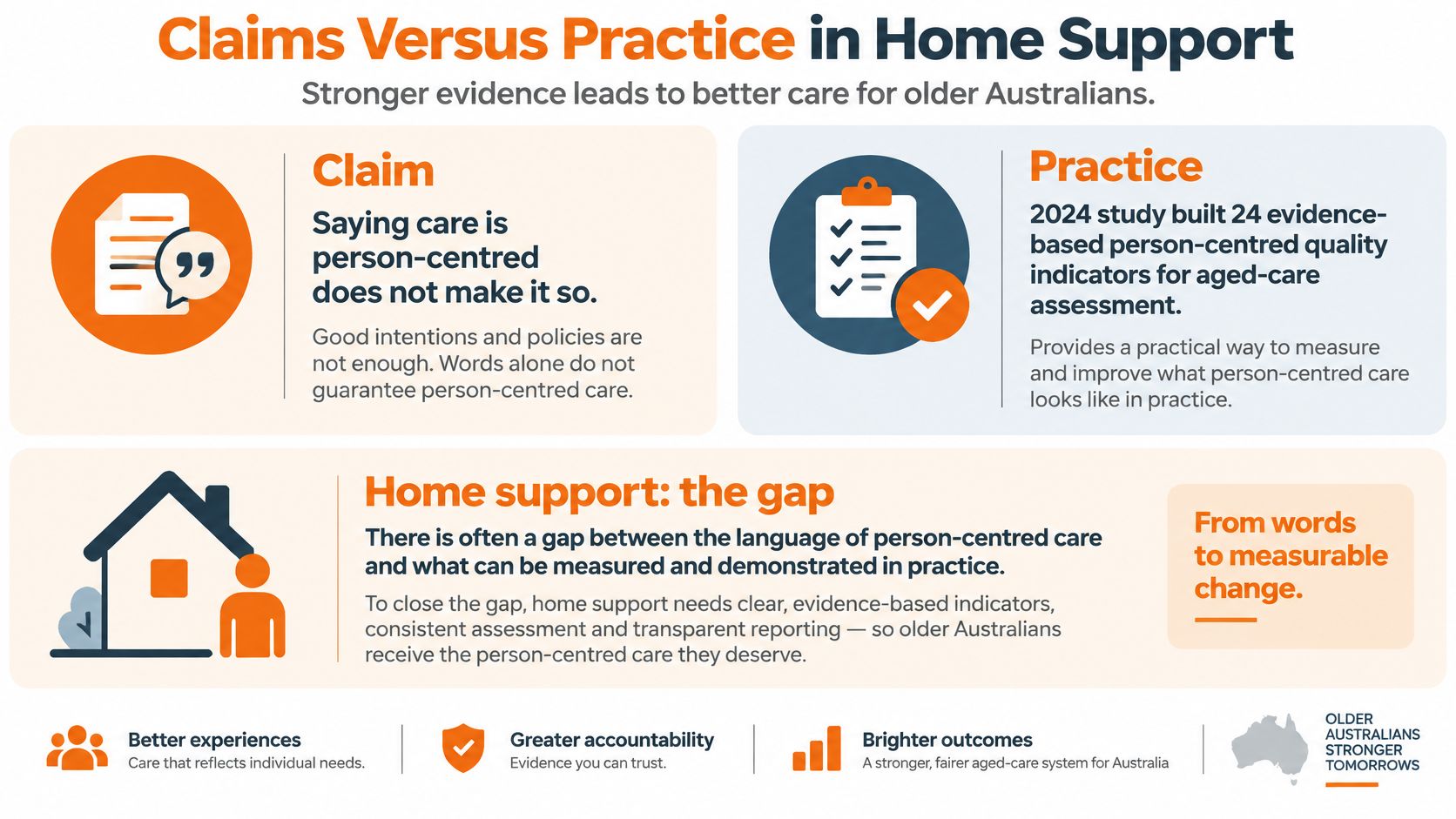
The alternative is measurement. A 2024 peer-reviewed study built 24 evidence-based person-centred quality indicators for Australian aged-care assessment services using the views of current and future service users. The highest-priority indicator was that the support-plan summary should accurately reflect a person's needs. Another top priority was clear information about whom to contact when care needs change. Participants also ranked dignity and respect during assessment bookings highly, along with being able to understand the assessor.
Three checks to run on your own plan
Read the plan back and correct it out loud if it's wrong. If the summary says "assist with showering" and, in practice, "steady my arm while I wash myself," the document is wrong and will mislead every new worker who reads it.
Know the name and number for a change. When hours, a worker or a routine needs to shift, the person should have a named contact, not a general enquiries line and a wait.
Expect bookings that treat the person as the decision-maker. Dignity during a booking call is a small signal of how the first shift will go.
Reading unused hours as a signal
Utilisation is often treated as a billing figure. Read it as a diagnostic instead. NDIS reporting states that higher plan utilisation is strongly associated with positive responses across all eight measured outcome domains after both one and two years in the Scheme, spanning daily living, choice and control, health and wellbeing, relationships, community participation, and work and learning, measured from a baseline assessment to a reassessment.
That link doesn't prove utilisation causes better outcomes. It does suggest unused supports can signal a barrier: an unsuitable worker match, a rigid roster, communication trouble, inaccessible transport, or a lack of trust in the person who turns up. So compare scheduled hours against delivered hours, record who cancelled, and check whether the misses cluster around personal care, community access or household tasks. Add continuity measures alongside them, such as the share of shifts delivered by the preferred worker and how long a replacement takes. A pattern found in a spreadsheet in March is easier to fix than a person who stops leaving the house in June.
Ask for a Match Before Support Starts
Pull the checks into one enquiry. Do this once, properly, and most of the problems above never start.
- Write the brief first. Goals, weekly routine, language, culture, interests and the supports needed, on one page. Take that page to every conversation.
- Ask to see worker profiles and meet the preferred worker before the first shift. Then ask who decides a replacement if that person is away tomorrow.
- Read the service agreement for costs under NDIS pricing rules, family contact only with consent, and a route to change worker without a gap in support.
- For a child, confirm that parents or carers stay closely involved and that routines or plans from the child's own health team are followed.
- Moving from another provider? Ask for the agreement and the new match to be ready before the old supports end, so no days are missed.
Enrichment Care, based in Surry Hills and arranging workers across Australia, runs an enquiry this way: it asks about goals, routine, language, culture, interests and the support needed, then matches on language, culture and personality. Personal care comes from a worker the participant has met and chosen. You can compare that process against the checks here by starting at find your support worker, including for people with high or complex needs and families arranging consistent support.
Don't start shifts until the person has met the worker and can say what they still decide. That sentence is the whole model in one line.
Enrichment Care arranges NDIS core supports across Australia, including personal care, meal preparation, household help, community participation and transport, and every match starts with a conversation about goals, routine, language, culture and interests. If the morning described at the top of this page isn't yours yet, visit Enrichment Care to see how worker matching, introductory meetings and consistent rostering work in practice, and ask what support looks like in your area.