NDIS Cancellation Policy: 7-Day and 2-Day Rules
See how the NDIS cancellation policy sets 7-day and 2-day notice, when a plan can be charged up to 100%, and what the agreement must say.
Disability support-worker services are short notice when cancelled with less than seven days' notice; non-disability-support-worker services are short notice with less than two clear business days' notice. A provider may claim up to 100% of the agreed fee only if the service agreement and the other claiming conditions allow it.
If you've woken up unwell before a personal-care shift, or a family emergency has changed your plans, the first worry is often whether the support can still be charged to your NDIS plan. The answer isn't one cancellation deadline for every booking. It depends on what support was scheduled, what your agreement says and whether the provider could replace the work.
Why a Missed Shift Can Still Be Claimed
A Tuesday personal-care shift is booked, but you become unwell on Monday and call to cancel. The NDIS cancellation policy works like two locks on one door: the pricing rules set the maximum that may be claimed, while your service agreement determines whether a cancellation fee is permitted for that booking. For disability support-worker services, the short-notice threshold is less than seven days. For non-disability-support-worker services, it's less than two clear business days.
A late cancellation isn't automatically a bill. The agreement must allow the fee, and the provider must have been unable to replace the work. Even then, any claim is subject to the applicable price limit and claiming requirements. The provider may also waive the fee or offer more favourable terms. A missed appointment can raise the same question as a cancellation: whether you attended, were at the agreed location, or could be reached within a reasonable time while the worker was travelling.
A useful distinction: The price rule sets a ceiling. It doesn't, on its own, give a provider permission to charge you.
Don't rely on an old cancellation template
Older NDIS Price Guide material used a different rule for some scheduled personal-care and community-access supports. Under that historical framework, notice given after 3:00 p.m. on the day before the support could attract a fee of up to 90% of the agreed price, up to 12 times per year for those supports. Notice before that time generally couldn't attract a cancellation fee, and participants weren't liable when a provider cancelled or failed to deliver the support unless the agreement documented another arrangement. Later pricing documents changed the disability support-worker wording from “7 business days” to “7 days”, so the historical NDIS Price Guide material shouldn't be copied into a new agreement without checking the applicable pricing rules.
That old 3:00 p.m. cutoff isn't a shortcut for working out today's notice period. Start by identifying the support on the booking, then read the matching notice rule and your agreement.
Notice Periods for Each Support Type
| Support situation | Short-notice threshold | Maximum claim | Extra condition |
|---|---|---|---|
| Disability support-worker service | Less than 7 days | Up to 100% of the agreed fee | Agreement allows it and the work couldn't be replaced |
| Non-disability support-worker service | Less than 2 clear business days | Up to 100% of the agreed fee | Agreement allows it and the work couldn't be replaced |
| No-show, not at the agreed place, or unreachable while the worker travels | Same threshold as the support type | Up to 100% of the agreed fee | Contact attempts while travelling must be reasonable |
| Program of supports | Ordinary short-notice rules don't apply | Not the standard cancellation claim | Follow the agreement's program terms |
The 2025–26 NDIS Pricing Arrangements and Price Limits distinguish between disability support-worker services, which use a less-than-seven-days threshold, and non-disability-support-worker services, which generally use less than two clear business days. They also explain that the same short-notice test can apply to a no-show, not being at the agreed location, or being unreachable within a reasonable time while the worker is travelling. A possible claim of up to 100% of the agreed fee is still conditional on the agreement, the provider's inability to replace the work, price limits and claiming requirements.
Count clear business days carefully
A clear business day is a full business day between the day you give notice and the day of the support. The day you send the cancellation doesn't count, and neither does the day the support was due. Weekends don't count as business days in this calculation.
For example, a message sent on Friday for a Monday appointment doesn't leave two clear business days. Saturday and Sunday aren't business days, and Monday is the service day. If you're unsure which day counts, check the dates against the agreement and ask the provider to explain its calculation in writing.
The service type matters as much as the calendar. A support worker providing personal care or community support may fall under the disability support-worker rule, while an appointment not delivered by a disability support worker may fall under the other rule. If a booking combines tasks, don't assume one generic cancellation sentence automatically classifies every part.
A program of supports is another reason not to rely on a single headline number. Its ordinary short-notice treatment differs, so the agreement's program terms matter. Providers may waive fees or offer more favourable cancellation terms than the pricing rules allow. Before regular shifts begin, make sure the written agreement identifies the support type, notice period, rescheduling process and any charge.
Cancellation Terms to Write into the Agreement
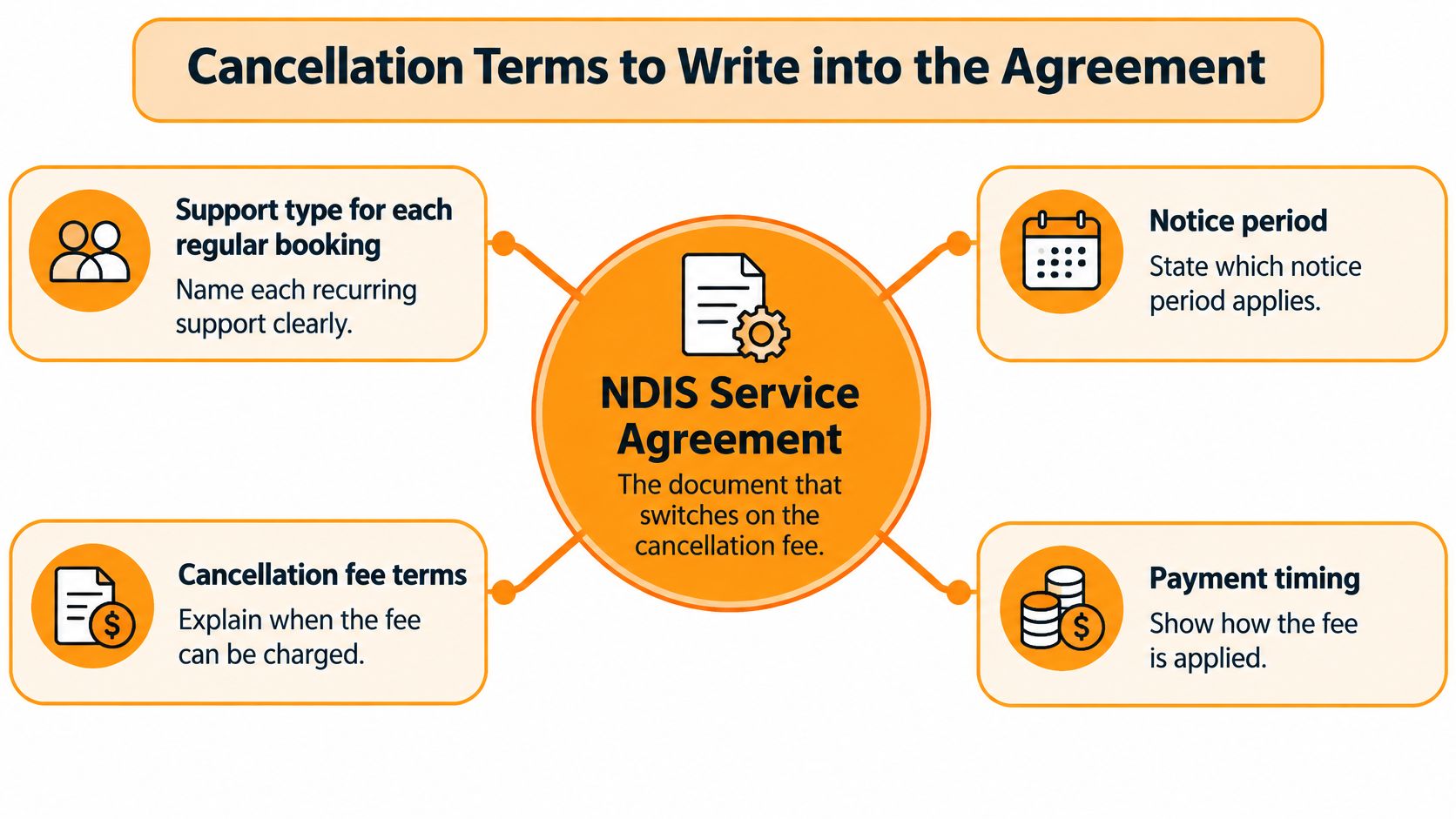
The pricing ceiling doesn't replace the contract between you and your provider. The agreement should make clear which cancellation terms apply to each support, how you give notice and what happens if either side needs to change a booking. The NDIS guidance on making a service agreement says the agreement should explain cancellation fees and what happens if the provider cancels, pauses or replaces a support.
Before you sign, check these terms
- Support type and notice period: List each regular booking clearly. Personal care, household assistance, community participation and transport shouldn't be hidden under a vague description if they're scheduled as distinct supports.
- How to cancel or reschedule: State whether you should call, text or use another channel, and explain how you'll be offered a replacement time. A named process helps both sides keep a clear record of when notice arrived.
- When a fee may apply: Explain which cancellations may be charged and make clear that any claim is conditional on the agreement and pricing rules. The charge should relate to the actual scheduled support, not operate as an unrestricted penalty.
- What happens if the provider cancels: Spell out what happens if the provider can't deliver a shift, pauses support or sends a replacement worker. The agreement should distinguish a provider cancellation from a participant cancellation.
- How exceptions are reviewed: Set out how the provider will consider hospitalisation, a family emergency, disability-related support needs or communication barriers. Record the notice, the reason given, the provider's response and whether redeployment was attempted.
For a mixed afternoon, ask the provider to name each scheduled support and explain how a cancellation would be assessed. A generic clause can leave you unsure whether the provider has applied the right notice rule to the right booking.
The explanation also needs to be accessible. If you prefer a particular language or format, ask for the cancellation terms to be provided that way and check that the deadline is clear. A signed page is not a substitute for understanding what to do when a shift needs to change.
Consistent rules can help prevent misunderstandings, while recorded exceptions allow the provider to respond to individual circumstances. Before the first shift, ask for an amendment if the notice period, fee or outcome when the provider cancels isn't written plainly.
Conditions a Provider Must Meet to Charge
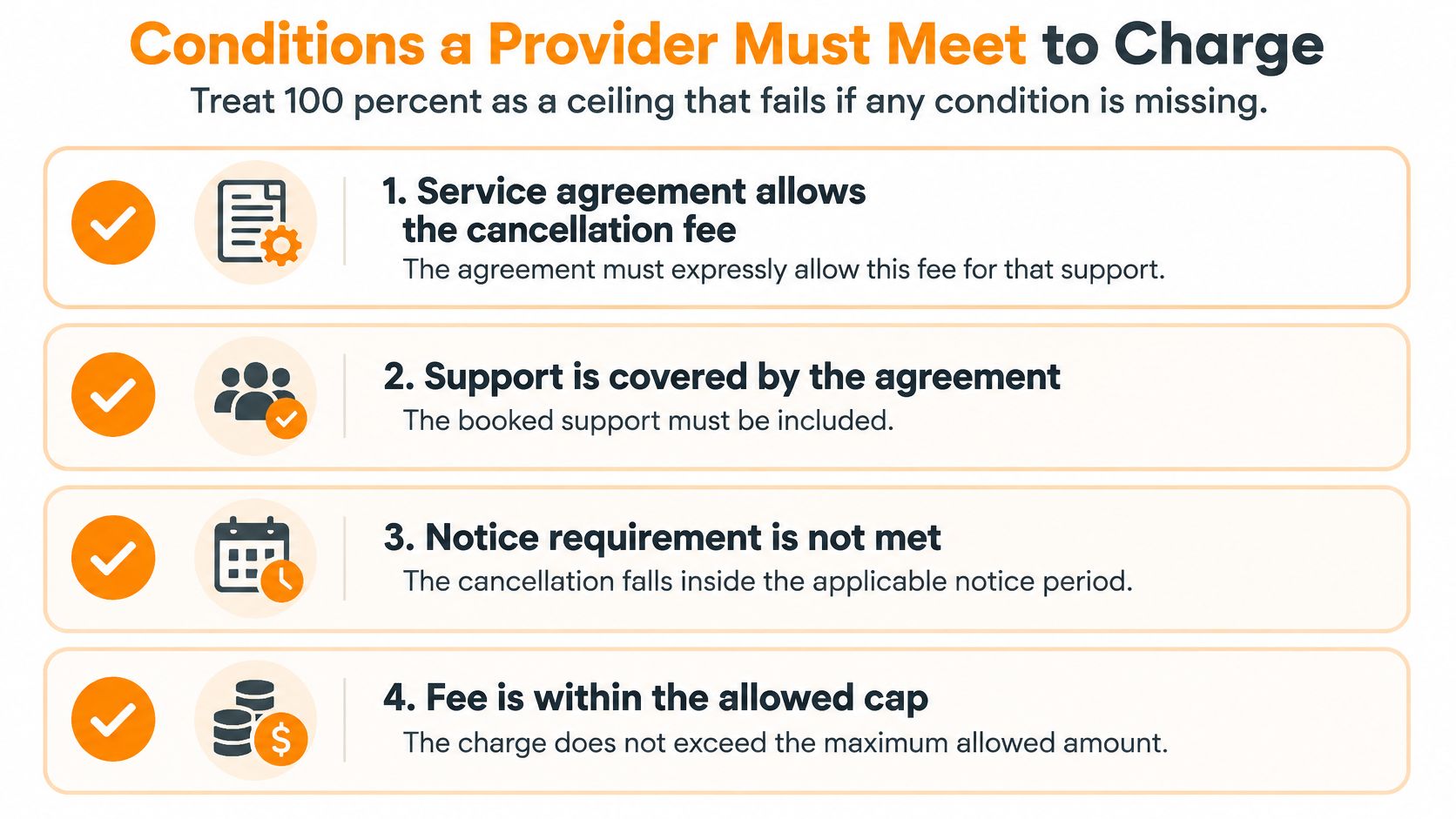
A provider cannot treat “up to 100%” as an automatic charge. The percentage is a ceiling. The provider still has to meet the conditions attached to the booking, and those conditions come from two places: the service agreement and the NDIS pricing rules. One sets what was agreed. The other sets what can be claimed. The notice rule for this support matters more than a headline percentage.
Check the claim in order
Start with the service agreement. Does it expressly allow a cancellation fee for this support? Next, check that the booked support is covered by the agreement and that the cancellation fell inside the applicable notice window. Then ask whether the provider could replace the work. Finally, compare the amount with the applicable 2026-27 NDIS price limits and the claiming requirements.
The NDIS Pricing Arrangements and Price Limits set different notice rules for disability support-worker services and non-disability-support-worker services. They allow a claim of up to 100% of the agreed fee only when the relevant conditions are met, including the service agreement. The same ceiling does not create a standard cancellation charge. A provider still has to connect the invoice to the booked support, the notice period and the attempt to redeploy the worker.
A no-show does not remove those conditions. If a provider says the worker arrived and could not reach you, the record should identify the scheduled support and document reasonable contact attempts. If the worker's time was filled with other work, ask how that affects the cancellation claim.
If an invoice doesn't look right
Use a simple challenge path:
- Compare the invoice with the agreement. Check the booked support, the cancellation clause and the fee shown.
- Ask for the calculation. Request the support item used, how the notice period was counted and whether the provider tried to redeploy the worker.
- Escalate if it remains unresolved. Raise the issue through the provider's complaints process. If it is still unresolved, use the NDIS complaints process.
Hospitalisation, a family emergency or difficulty communicating may not change the notice calculation by itself. Explain what happened and ask the provider to consider waiving the fee. Keep the request and the response in writing so the outcome is clear.
Question the claim if the agreement does not permit it, the work could have been replaced, or the provider used the wrong support item. A request for an explanation is a practical first step, not a refusal to pay a valid claim.
Mixed Shifts No-Shows and Edge Cases
The hardest cancellations to assess often involve a booking that combines tasks, a worker who arrives to find no one there, or a provider who cancels instead of the participant.
| Situation | Where it sits | Can the plan be charged? | First check |
|---|---|---|---|
| Personal care cancelled with 8 days' notice | Outside the 7-day window | No short-notice fee | Check that the agreement doesn't add a longer paid window |
| Personal care cancelled 3 days out | Inside 7 days | Up to 100% only if conditions are met | Whether the worker was redeployed |
| Non-support-worker appointment cancelled with 3 clear business days | Outside the 2-day window | No short-notice fee | Confirm it isn't a disability support-worker service |
| That appointment cancelled the afternoon before | Fewer than 2 clear business days | Possible if the other conditions are met | Count excludes the notice day and service day |
| Personal care plus transport in one afternoon | Classify each support item | Only the item that meets its own rule | Check that the agreement names each item |
| Nobody home and no answer while the worker travels | Treated as short notice | Possible if contact attempts are reasonable | Check the record of calls and travel |
| Provider cancels the shift | Provider didn't deliver | Participant isn't liable unless the agreement says otherwise | Read the provider-cancellation clause |
| Same-day hospital admission | Still inside the short-notice clock | Only if conditions are met; a waiver is allowed | Request an exception in writing |
Split mixed bookings by what was scheduled
Suppose an afternoon booking includes personal care, transport and a community activity. If you need to cancel, ask the provider to show how each booked support is described in the agreement and invoice. A single general sentence about “support” may not tell you which rule the provider applied. Check whether each item is named and whether the claim relates to the part of the booking that was affected.
The same care is needed when no one is home. If a worker arrives at the agreed location and can't reach you within a reasonable time while travelling, that situation may be treated as short notice. Keep a record of the communication so you can compare what happened with the provider's account.
The reverse situation is a provider cancelling your shift. If the provider didn't deliver the agreed support, the participant generally isn't liable for a fee unless the service agreement documents a different arrangement. Check the provider-cancellation clause rather than treating it as if you had cancelled.
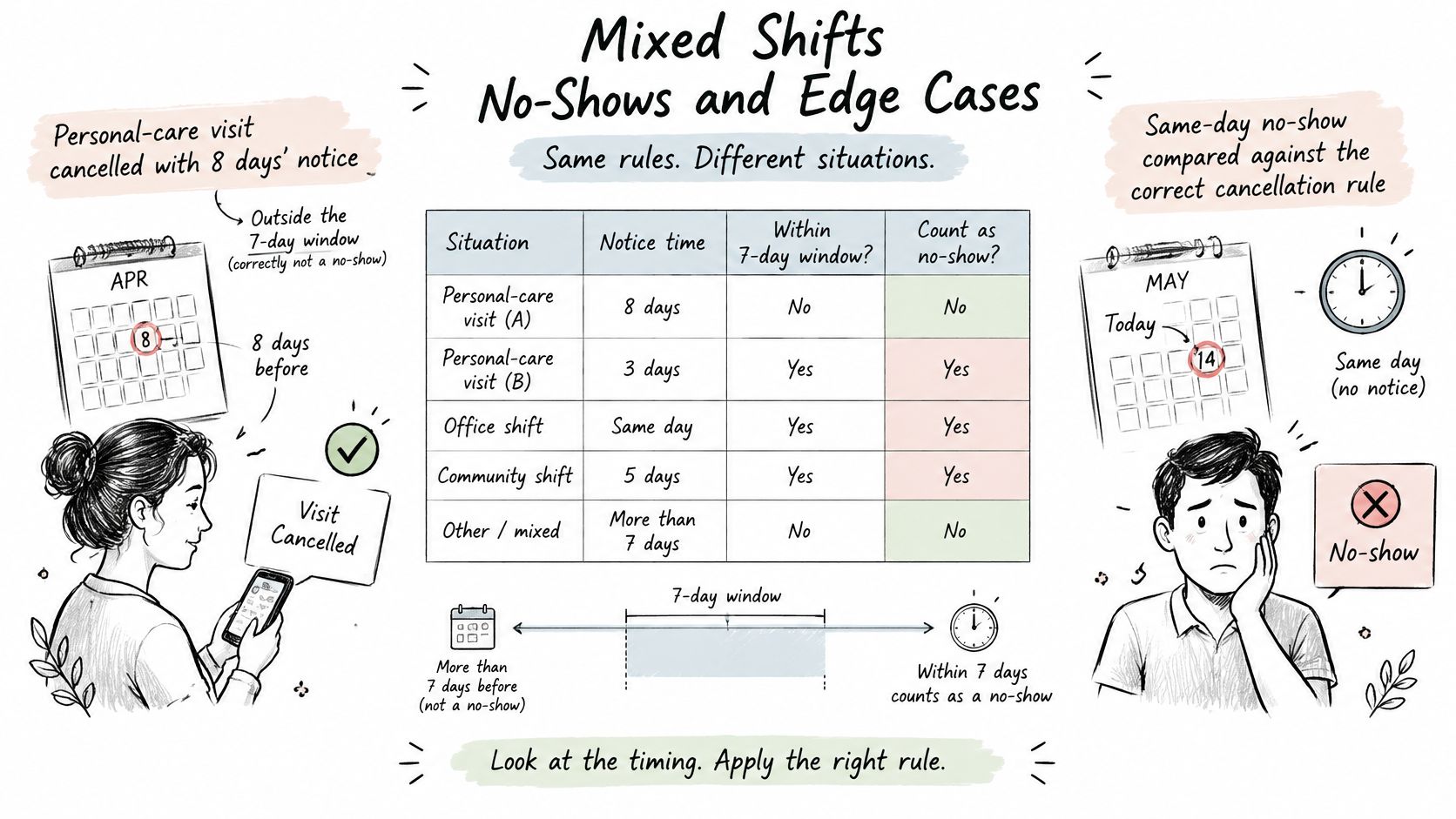
A hospital admission on the day of a shift can still fall inside the applicable notice period. That doesn't settle whether a fee should be charged: the agreement and other conditions still matter, and the provider may waive the charge. Explain the circumstances and request any exception in writing.
For supports arranged under a program of supports, use the program terms in the agreement rather than applying an ordinary shift cancellation assumption. Before paying or disputing an invoice, match the cancelled booking to the row that best describes it.
Stopping One Shift or Leaving the Provider
Cancelling Tuesday's shift changes one booking; ending the provider relationship changes the ongoing arrangement. The notice rule depends on which change you're making. A single shift follows the relevant cancellation terms, while ending services follows the notice period in your service agreement. Check whether the provider also requires a booking to be ended in the myplace portal.
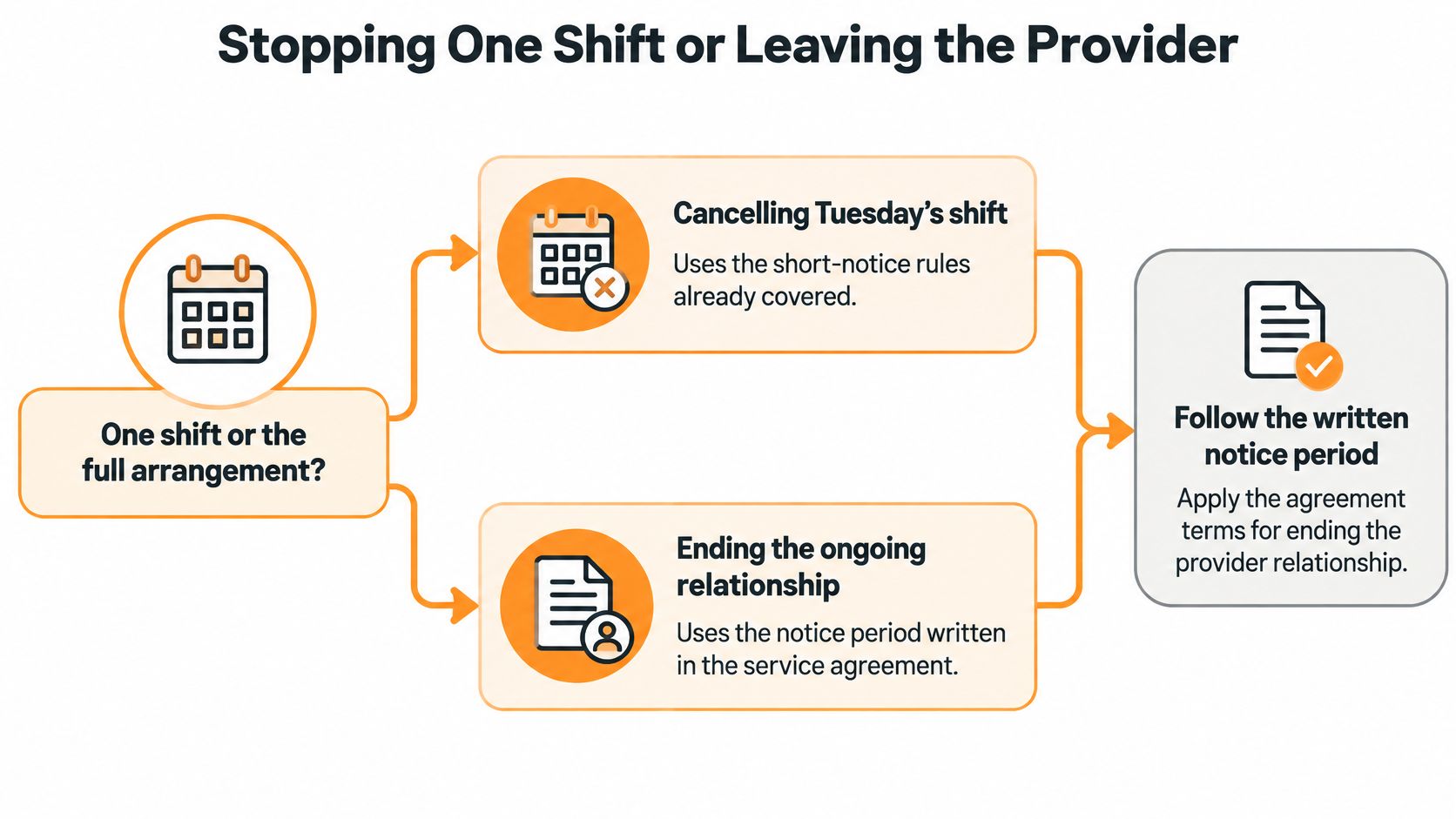
Choose the change that fits
- Routine cancellation: You're keeping the provider but changing one shift. Follow the agreement's cancellation or rescheduling process.
- Worker replacement: The provider suits you, but the worker doesn't. Ask if another worker can be arranged while the booking stays active.
- Temporary pause: A hospital stay or changed routine may call for a break. Agree on the pause dates in writing so future shifts aren't mistaken for missed appointments.
- Immediate stop for safety: If you don't feel safe, state in writing as soon as possible that you're stopping the arrangement and explain the concern.
- Planned provider change: Check the agreement's ending clause, give the required notice where possible, and see whether any booking also needs to be ended in the portal. Read about changing NDIS providers.
If the worker match is the problem, asking for a replacement may keep support available without ending the whole arrangement. If you need to stop immediately for safety, make that clear and keep a written record. A program of supports may have different written terms from an ordinary shift, so check those terms before pausing or ending it.
Enrichment Care helps people switch from their current provider, including through the service agreement. If you're unsure whether to request a different worker or end the arrangement, these questions to ask a support worker can help you consider whether the worker or support arrangement suits you.
Confirm the Policy Before Supports Begin
Before a regular support shift starts, check that the service agreement names the support, explains the applicable cancellation terms, and says what happens if either you or the provider cancels. The NDIS Pricing Arrangements set price limits and rules for claiming supports. They do not replace the agreement's terms for ending a booking or changing your provider.
Ask for unclear terms to be explained in plain language, and make sure the written agreement reflects what you have discussed. For help assessing whether a worker suits your needs and preferences, use these questions to ask a support worker.
Enrichment Care's service agreement sets out supports and costs under NDIS pricing rules. Read it before agreeing to regular shifts so you understand the arrangement. Enrichment Care can help people switch from their current provider, including through the service agreement.
If you have questions about how the terms apply to your support, submit an enquiry to Enrichment Care. A care advisor will call you back to talk it through, with no obligation.