What Services Does NDIS Cover? Core Supports Explained
Wondering what services does NDIS cover? See Core supports, price limits, reasonable and necessary rules and how to confirm your plan before booking.
The NDIS funds reasonable and necessary supports for eligible participants, and most everyday help sits in four Core support categories. Your individual plan, not a general service list, decides what is paid.
If personal care, cleaning and community outings are all described as covered, why can two participants ask for the same help and get different answers? Because there's a difference between what services does NDIS cover in general and what your plan will fund for your disability, your goals and your budget category. That gap is where most confusion starts, and it's also where a few clear checks can save you from an unpaid invoice.
Core Supports the NDIS Covers at a Glance
The NDIS covers supports that help you achieve personal goals, take part in daily life and build independence. For day to day help, start with Core supports. They're split into four categories, and each one funds a different kind of need.
The four Core categories in plain language
Assistance with Daily Life funds individual support for personal and household tasks at home or another suitable setting. Think personal care, help showering and dressing, cleaning, laundry and meal preparation when disability makes those tasks difficult.
Social and Community Participation funds help to take part in recreational, social, civic, educational and economic activities. That can include a support worker helping you attend a community group, a class, work or study, and building independence while you're there.
Transport helps with travel where disability prevents you from using public transport. Trips to appointments, education or work are the typical examples, but this category has tighter limits than the others.
Consumables covers everyday items linked to your disability needs. These are products you use regularly because of disability, rather than a worker's time.
| Core category | What it funds | Typical examples | Payments recorded, Jul-Dec 2024 |
|---|---|---|---|
| Assistance with Daily Life | Individual support for personal and household tasks at home or another suitable setting | Personal care, cleaning, meal preparation | $6.013 billion for 212,109 participants |
| Social and Community Participation | Recreational, social, civic, educational and economic activities | Community outings, classes, groups, attending work or study | $3.438 billion for 225,988 participants |
| Transport | Travel where disability prevents use of public transport | Trips to appointments, work, education | $15.2 million for 12,598 participants |
| Consumables | Everyday items linked to disability needs | Continence products and low cost disability related items used daily | Claimed within your flexible Core budget when included in your plan |
How widely these supports are used
Daily living help and community participation aren't small extras. The NDIS registered plan manager payments data for July to December 2024 recorded approximately $6.013 billion for Core, Daily Activities and $3.438 billion for Core, Community supports. Over the same period, 212,109 participants used daily activities supports and 225,988 used community supports, while Core, Transport payments reached $15.2 million for 12,598 participants.
Those figures matter for a practical reason. If thousands of participants use a category, providers, plan managers and support coordinators deal with it every day, so you can ask them direct questions about hours, tasks and rates. You're not asking for something unusual when you ask for showering support, help with meals or support to get to a group.
Practical rule: Find the category first, then book the service. If you can't name the category, you can't yet know whether your plan will pay.
At Enrichment Care, we provide NDIS core supports to participants across Australia, including personal care, community participation, life skills development, NDIS cleaning, meal preparation, and travel and transport. Each of those maps to a Core category, but the mapping still needs to be checked against your plan. A cleaning shift belongs under Daily Life. A supported outing belongs under Community Participation. Getting that match right at the start prevents claims being rejected later.
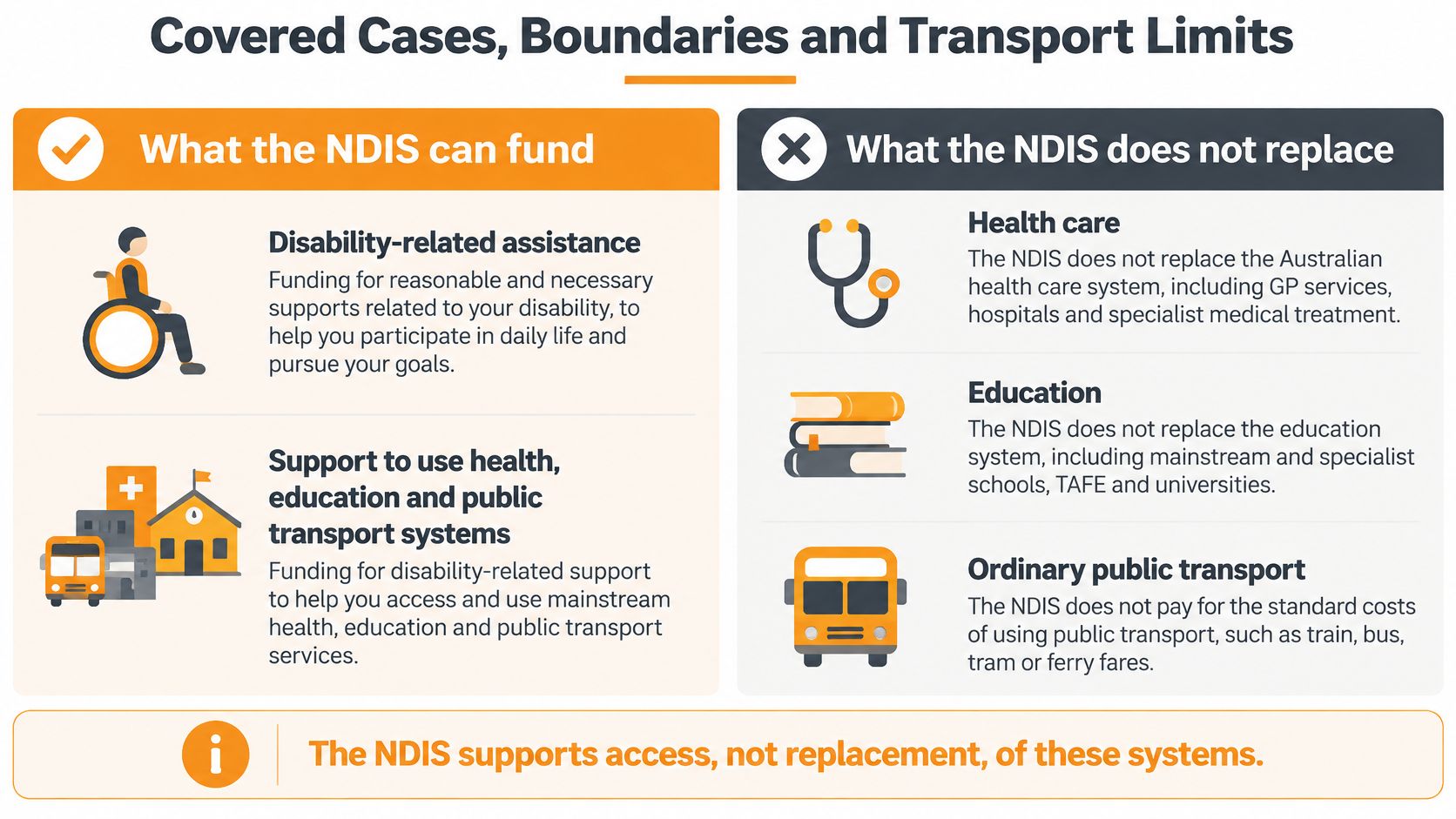
One more boundary shapes everything else. The NDIS doesn't replace mainstream health care, education or ordinary public transport. It can fund disability related assistance that helps you access those systems and live more independently. Keep that distinction in mind whenever you're unsure about a request.
Capacity Building and Capital Supports Beyond Core
Core is only one budget in a plan. The other two are Capacity Building and Capital, and money doesn't normally move from Core into either of them. That single rule explains many declined claims.
Say you have unspent Core funds and you'd like extra therapy sessions. You usually can't just shift the money across. The budgets exist for different purposes, and each claim needs to sit in the right one.
What each budget is for
Capacity Building funds supports that build your skills and independence over time. Therapy from allied health professionals, help to find and keep work, support coordination, and programs that build daily living skills and social connection commonly sit here. The focus is progress toward a goal, not day to day assistance to get through today.
Capital funds items and changes that last beyond a single service. Assistive technology, specialist equipment, home modifications and vehicle modifications are typical Capital items. These often need assessments, quotes and stronger documentation than a weekly Core shift.
If you're working out how to sequence therapy, skill building and goal reviews, our guide to making the most of capacity building funding sets out those decisions in more detail.
What to confirm before you buy
- Budget line: Ask your planner or support coordinator which budget and category the support sits in.
- Goal link: Write down the plan goal the therapy, item or modification serves.
- Approval steps: Confirm whether you need quotes, an assessment or prior approval before you commit.
- Timing: Start Capital requests early, because documentation and approvals can take longer than arranging Core support.
- Records: Keep invoices and agreements separated by budget so claims match the right funding.
A useful habit is to describe the outcome before you describe the product. Don't start with the brand of equipment or the number of therapy hours. Start with the functional change you need, such as transferring safely, communicating at school or managing a morning routine with less help. Then ask which budget funds the support that produces that change.
How the Reasonable and Necessary Test Decides Coverage
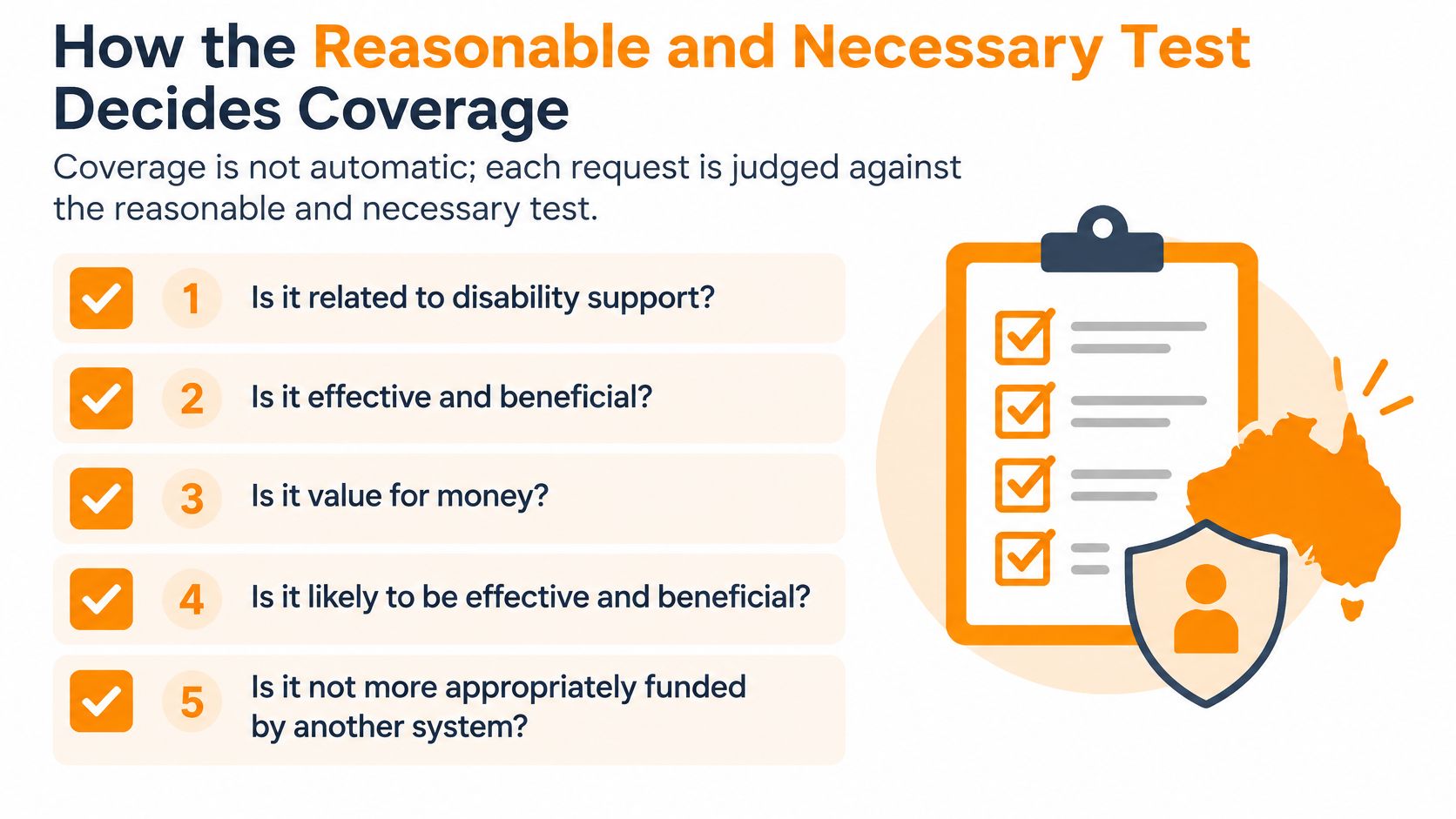
Coverage isn't an automatic right to any service you request. Each request is judged against the reasonable and necessary test. The NDIS outcomes framework and reasonable and necessary guidance shows that the NDIA considers whether a support is related to disability, helps pursue plan goals, is effective or likely to be beneficial according to current good practice, represents value for money, and is most appropriately funded by the NDIS rather than another system.
So the question is never just "what services does the NDIS cover?" It is "will my plan pay for this particular support, in this amount, from this budget?" The five questions below turn that into a check you can run before you agree to a service.
Run your request through five questions
- Is it related to your disability? Say fatigue and reduced hand function make showering unsafe. Morning personal care connects directly to that barrier.
- Does it help pursue a goal in your plan? If your goal is to live at home more independently, help with laundry and meal preparation should be written against that goal.
- Is it effective or likely to be beneficial, based on current good practice? A worker teaching a step by step cooking routine gives you a skill you can repeat. A vague promise to help around the house is harder to justify.
- Does it represent value for money? Two focused hours that complete cleaning and linen changes may be better value than open ended hours with no task list.
- Is the NDIS the most appropriate funder? A support worker helping you prepare for a medical appointment can fit the NDIS. The medical treatment itself belongs to the health system.
Where there is no evidence showing a support is reasonable and necessary, it will not be funded.
Evidence is where families can strengthen a request. Document the functional barrier, the expected outcome, how often support is needed, exactly what the worker will do, and how you'll measure progress. Replace general statements like "needs help at home" with a clear record: "can't safely bend to clean the shower, needs two hours weekly, outcome is a hygienic bathroom and reduced fall risk."
National outcomes data shows that daily living and transport are among the most commonly reported needs, so these requests sit at the centre of the scheme rather than at its edges. That context helps at planning meetings, but demand alone never approves a request. Your evidence does.
Run each new support through all five questions, in writing, before the first booking. If you can't answer one, ask your support coordinator to help close that gap.
Covered Cases, Boundaries and Transport Limits
A common assumption causes trouble. If something is disability related, people expect the NDIS to pay for it. That isn't the test.
The NDIS doesn't replace health care, education or ordinary public transport. What it can fund is disability related assistance that lets you use those systems. A worker helping you shower, dress and travel to a GP appointment can be a Core support. The GP consultation itself isn't.
Where transport funding stops
Transport has an added constraint. The NDIS guide to Core supports and budget flexibility explains that Core funding is generally flexible across its four subcategories but can't normally be transferred to Capital or Capacity Building, and transport funding is generally intended for participants who can't use public transport because of disability. The decision also considers other relevant schemes such as taxi subsidies.
That means inconvenience alone isn't enough. The functional impact of disability and the least cost suitable transport option matter. If you can use a bus with a companion but can't travel alone safely, describe that precisely. If a taxi subsidy already covers part of the trip, say so. Vague claims about transport being difficult are weaker than a clear description of what happens when you try to use public transport.
Testing common requests against the boundary
| Participant need | Likely category | Likely coverage | Check before buying |
|---|---|---|---|
| Weekly house cleaning | Assistance with Daily Life | Often funded when linked to a disability need | Cleaning price limit and whether it replaces a family task |
| Travel to medical appointments | Transport | Funded only where disability prevents public transport use | Other transport schemes such as taxi subsidies |
| Weekly community class | Social and Community Participation | Funded when it builds independence toward a plan goal | Goal link and the worker's written tasks |
| Gym membership | No Core category as a membership alone | Generally not a core support | Whether a specific support or prior approval applies |
| Phone or household appliance | Replacement support pathway, not standard Core | Generally not a core support | Approved replacement list and approval before purchase |
Read likely in that table carefully. It means the answer rests on your plan, not that the support is approved for everyone.
Weekly house cleaning often fits Daily Life when disability prevents you completing those tasks safely. But the cleaning price limit matters, and so does whether the task is one a family member would ordinarily do for the household rather than a disability support need. Write the tasks down. Bathroom cleaning, kitchen cleaning, laundry and linen changes are clearer than general help.
A weekly community class works differently. The activity fee and the worker's support aren't the same thing. Funding is stronger when the worker's role builds independence or social connection toward a plan goal, and those tasks are written into the service agreement. Your agreement should map each support to your plan goals, budget category, delivery setting, hours, rates and cancellation terms.
Gym memberships, phones and household appliances need more caution. They aren't standard Core supports just because they'd be useful. They may only be possible through a specific support, an item on an approved replacement list, or prior approval. Don't buy first and argue later.
For any uncertain service, ask one question first. Who is normally responsible for paying for this? If the answer is health, education, a transport system or ordinary household spending, pause and check before you proceed.
Price Limits and What Your Plan Can Actually Spend
A support can be disability related, priced correctly, and still not be claimable from your plan. That's the gap families miss.
The NDIS guide to what counts as an NDIS support describes a published framework with 37 support categories, exclusions and special approval pathways. Whether you can claim depends on your disability need, plan management rules, funding category, stated goals, price limits and any prior approval.
The 2026-27 limits for common Core supports
| Support | 2026-27 national limit | Notes |
|---|---|---|
| Standard weekday daytime support | $73.58 an hour | Higher limits for evenings, weekends and public holidays |
| Life skills development, weekday daytime | $73.58 an hour | Providers can charge less than the limit |
| NDIS cleaning (house cleaning and laundry) | $61.16 an hour | Limit takes effect 1 July 2026 |
| Meal preparation | Charged within the Daily Life arrangements that apply to your support and time of delivery | Confirm the line item and rate in your service agreement before the first shift |
| Travel and transport | Claimed under the NDIS Pricing Arrangements for provider travel and kilometres | Provider travel and kilometres claimed under NDIS Pricing Arrangements |
These 2026-27 national limits take effect on 1 July 2026. Higher NDIS price limits apply for evenings, weekends, public holidays and remote areas. Core supports prices are set by providers within national NDIS price limits, and providers can charge less than the national price limit for a support type. Price comparison is therefore worthwhile, especially for regular weekly support.
Our breakdown of the NDIS price limits for 2026-27 helps you compare the rate that applies at different times of day.
A price within the limit isn't a guarantee
Consider the questions participants ask most often. Can Core funding pay for cleaning, meal preparation, taxis, gym fees, a phone or a household appliance? Does my plan category permit it? Do I need approval first?
Cleaning and meal preparation can fit Daily Life when they're linked to disability related barriers and written into your agreement. Taxis need the transport test and a check of other subsidies. Gym fees, a phone and appliances generally sit outside standard Core supports. Certain non NDIS items may be substituted only when they appear on the approved replacement list and approval is obtained before purchase.
Price check: A rate under the limit answers only one question. You still need the right category, a goal link and, where required, approval in advance.
Before the first shift, confirm the hourly rate for the exact day and time, any provider travel charges, and the cancellation terms. Then confirm the claim category with your plan manager or support coordinator. Spending five minutes on those checks is easier than disputing an invoice after support has been delivered.
Matching Support to Culture, Language and Goals
Coverage on paper isn't the same as support you can use in daily life. A plan can fund personal care while still leaving you with a worker who doesn't speak your language, understand your food practices or communicate in a way that works for you.
The image below reflects the choices families weigh when support has to fit real life, not just a budget line.
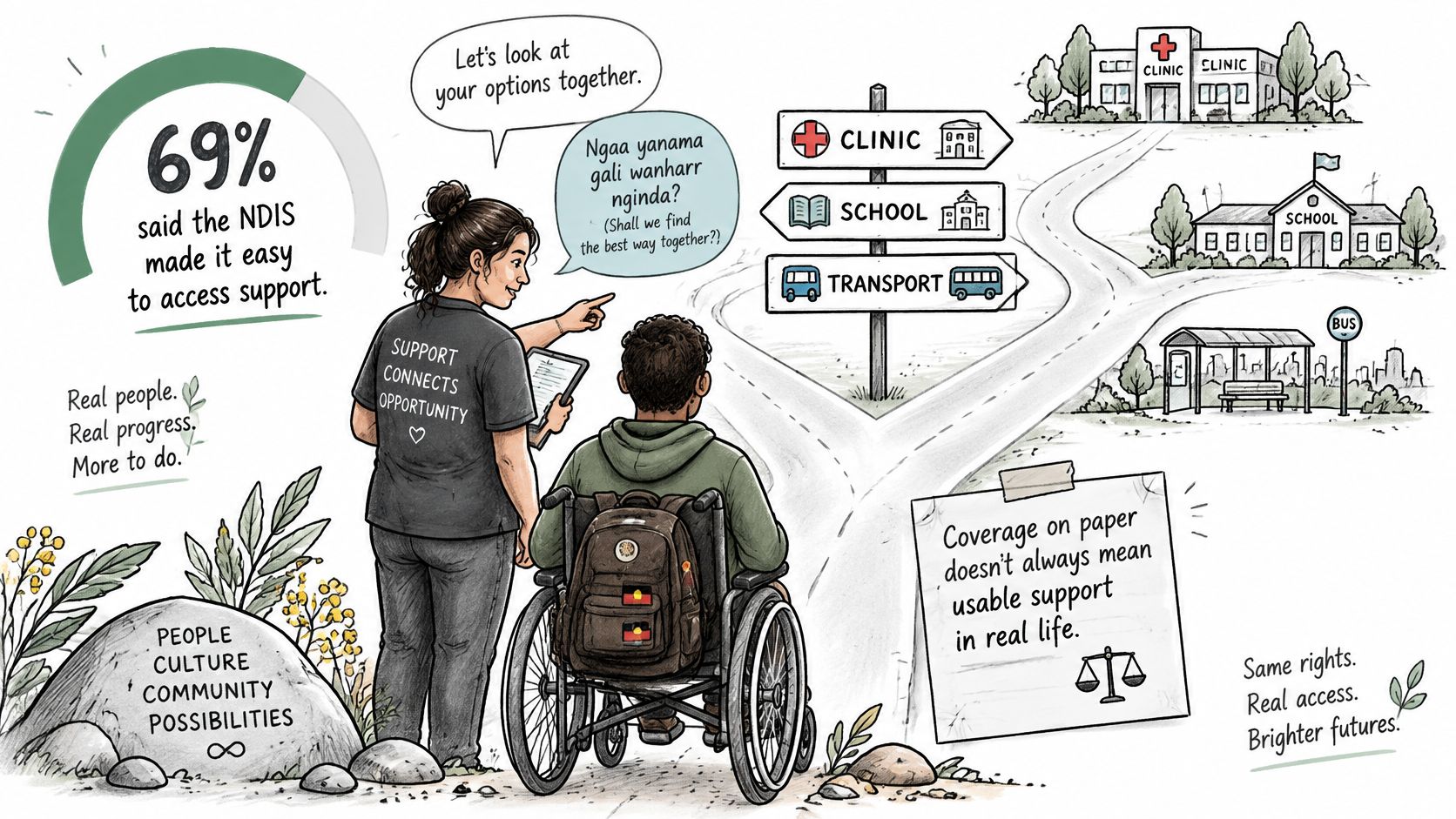
The NDIS participant datasets on culturally and linguistically diverse access report culturally and linguistically diverse participant numbers by state or territory, remoteness and average annualised committed support. In quarter 3 of 2025-26, only 69% reported that the NDIS made it easy to access and use information and receive support to lead their lives, while 61% reported confidence in reaching community supports and other government services. Language and location are recognised parts of access, not personal extras.
Questions that decide whether support works
Can you request an interpreter for planning or service discussions? How can your family check whether a worker understands your language, religion or communication style? What happens when your preferred worker is unavailable? Can you find a worker near you in regional Australia?
Ask those questions directly and early. Request shortlisted worker profiles. Meet your preferred worker before services start. If the first match isn't suitable, ask for alternative workers. If your circumstances change, request a change of worker rather than accepting support that doesn't fit.
We provide NDIS support to participants in every state and territory of Australia and match disability support to participants' language, culture and personality. For example, we match NDIS participants with Korean speaking support workers for everyday core supports. If cultural fit is central to your decision, our information on culturally appropriate disability support explains what to ask for in a match.
The short video below is useful background when you're thinking through choice and fit before support begins.
If a support is in your plan but can't be delivered appropriately, raise it in writing with the provider first. State the barrier plainly, such as language, travel distance, continuity or cultural safety, and ask what backup arrangement applies. If it isn't resolved, take it to your support coordinator and ask how the concern should be recorded for your next plan discussion.
Before the first shift, ask who your worker is, what languages they speak, how they'll handle food, prayer or family routines, and who covers leave. Those answers are part of coverage in practice.
Confirm Coverage in Your Plan Before You Start
Don't confirm coverage after the invoice arrives. Confirm it before the first shift.
To use NDIS funding with Enrichment Care, you need an NDIS plan. If you're unsure about eligibility, check with the NDIA or your support coordinator. Our eligibility checker asks four quick questions to check the main NDIS access criteria.
Your six step check
- Find the budget category your plan uses for the support.
- Write the plan goal the support serves.
- Check the price limit for the time of day and day of the week.
- Confirm approval or whether a replacement item approval is needed before purchase.
- Ask your support coordinator to document functional barriers, frequency and measures of progress.
- Check the service agreement maps each support to its category, hours, rates and cancellation terms before signing.
Then cost the pattern properly. Multiply your weekly hours by the 2026-27 rate that applies so your Core budget isn't overspent before the plan period ends. The support hours calculator shows what a weekly pattern of support costs at 2026-27 NDIS price limits and how far a Core budget will go.
If you're ready to turn funded hours into support that fits your routines, language and goals, we can help you check how personal care, cleaning, meal preparation, community participation and transport map to your plan. Visit Enrichment Care to discuss your Core supports and arrange a worker match that suits you.