Disability Services Ballarat: How to Get Support
Disability Services Ballarat explained: daily living and community supports, how to arrange NDIS support, costs and options if NDIS does not apply.
What if you've arranged more support hours, but you still can't get to your appointment because the bus stop, the venue, or the trip itself doesn't work for you? That's the gap many families hit when they search for disability services in Ballarat. A list of services tells you what's offered. It doesn't tell you how support fits your actual day, your budget, or your weekly journeys. This guide works through those decisions step by step.
Disability Support Options Available in Ballarat
Start by naming the daily problem, not the provider. Is the hardest part getting ready in the morning, keeping the house manageable, leaving home safely, or learning to do a task with less help? Each problem points to a different core support, and mixing them up leads to hours that don't solve the right thing.
| Support type | What it covers | Best suited when |
|---|---|---|
| Personal care | Help with everyday routines at home, delivered by a worker the participant has met | Hands-on help with routines is needed |
| Community participation | Attendance at activities, social outings and events | Social connection and activity are the goals |
| Travel and transport | Rides to work, study, appointments and friends | Getting out independently is difficult |
| Life skills development | Learning and practising everyday tasks to build independence | Skills building is the goal |
| Household assistance | Regular cleaning and meal preparation suited to tastes and culture | Keeping up the home is the main barrier |
| Complex needs support | Coordinated support across several areas of daily life | Needs span several areas at once |
Starting at home
Personal care covers everyday routines at home, delivered by a worker you've met and selected. It's the right starting point when mornings, showering, dressing, or moving safely around the house need hands-on help. Household assistance is different. It covers regular cleaning and meal preparation, with meals reflecting your personal tastes, cultural preferences, and advice from your health team. Say you're managing a household alone and cooking is slipping. That's household assistance, even if you don't need personal care.
Our core supports are personal care, community participation, life skills development, NDIS cleaning, meal preparation, and travel and transport. Keeping cleaning and meal preparation as named supports helps you check exactly what's in a quote, rather than accepting a vague promise of help at home.
Getting out and building skills
Community participation supports attendance at activities, outings, and social events. Choose it when the goal is connection, not just a ride. Travel and transport helps you reach work, study, appointments, and friends when getting there independently is difficult. You may need both on the same day, but they're solving different problems.
Life skills development means a worker helps you learn and practise everyday tasks so you can do more yourself over time. It suits someone who wants to build confidence with shopping, cooking, planning, or using a routine. Complex needs support coordinates help when needs span several areas at once, so one change doesn't unravel the rest of the week.
Support is available for autism, intellectual disability, psychosocial disability, acquired brain injury, cerebral palsy, Down syndrome, genetic conditions, physical disability and complex needs. Before you compare providers, match each daily problem to one support type. That simple list becomes the brief for every conversation that follows.
Local Need and Daily Barriers Across Ballarat
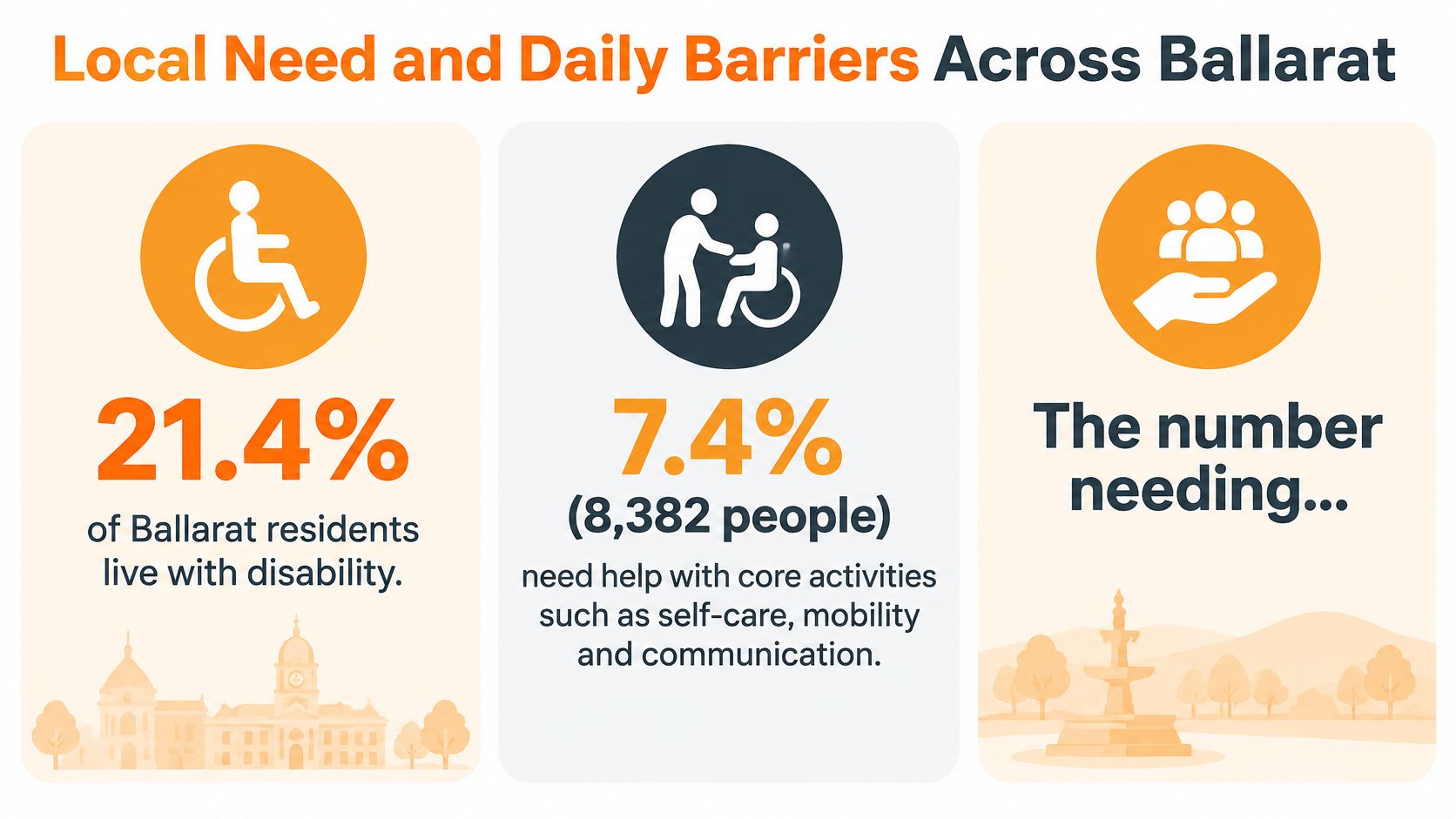
The scale of need in Ballarat is large, and it helps explain why families often feel services are stretched. Disability can affect self-care, mobility and communication, so local need shows up in morning routines, moving around safely, and being understood by services. That is why a list of tasks at home can look complete while the week still breaks down. Need also reaches across the life course: school-age children, working-age adults and older residents can all require help, but the right mix is rarely identical.
That mix matters. A worker who suits a child before school may not suit an older resident leaving hospital, and neither should be treated as an exception.
Families are part of the picture
Many Ballarat residents also provide unpaid care, so a support decision rarely affects one person alone. If a worker is late, a family member may miss work. If communication is unclear, a carer often becomes the interpreter, planner and backup driver. Good arrangements reduce that hidden load instead of shifting it around.
A support plan that only lists tasks at home misses half the problem if the person can't reach the places those tasks are meant to prepare them for.
Barriers beyond the front door
Daily barriers commonly show up on the way to hospitals, appointments, study, work and shops. A bus stop may be hard to reach or use. Public transport may not line up with an appointment time. A venue or public space may lack access once you arrive. Communication gaps with services can turn a simple booking into repeated phone calls.
Support hours work like a ticket: they only help if the route, the vehicle and the front door let you use them. If transport fails, community participation hours will not fix the missed activity on their own. If the NDIS does not apply, those same journeys still show which council, community or family arrangements have to carry the load.
Ballarat's 2026 to 2030 Disability Access and Inclusion Plan names transport, public spaces, communication, employment and service delivery as ongoing priorities. The council mainly advocates for changes to transport, hospitals and the NDIS because other levels of government run those systems. You are not imagining the join between systems. It is a real gap to plan around.
How to Arrange NDIS Support in Ballarat
Arranging support feels confusing because several decisions happen at once. Slow it down into a sequence. Each step below includes why it matters and the slip that most often causes delays.
The first step is checking whether the NDIS is likely to apply to you.
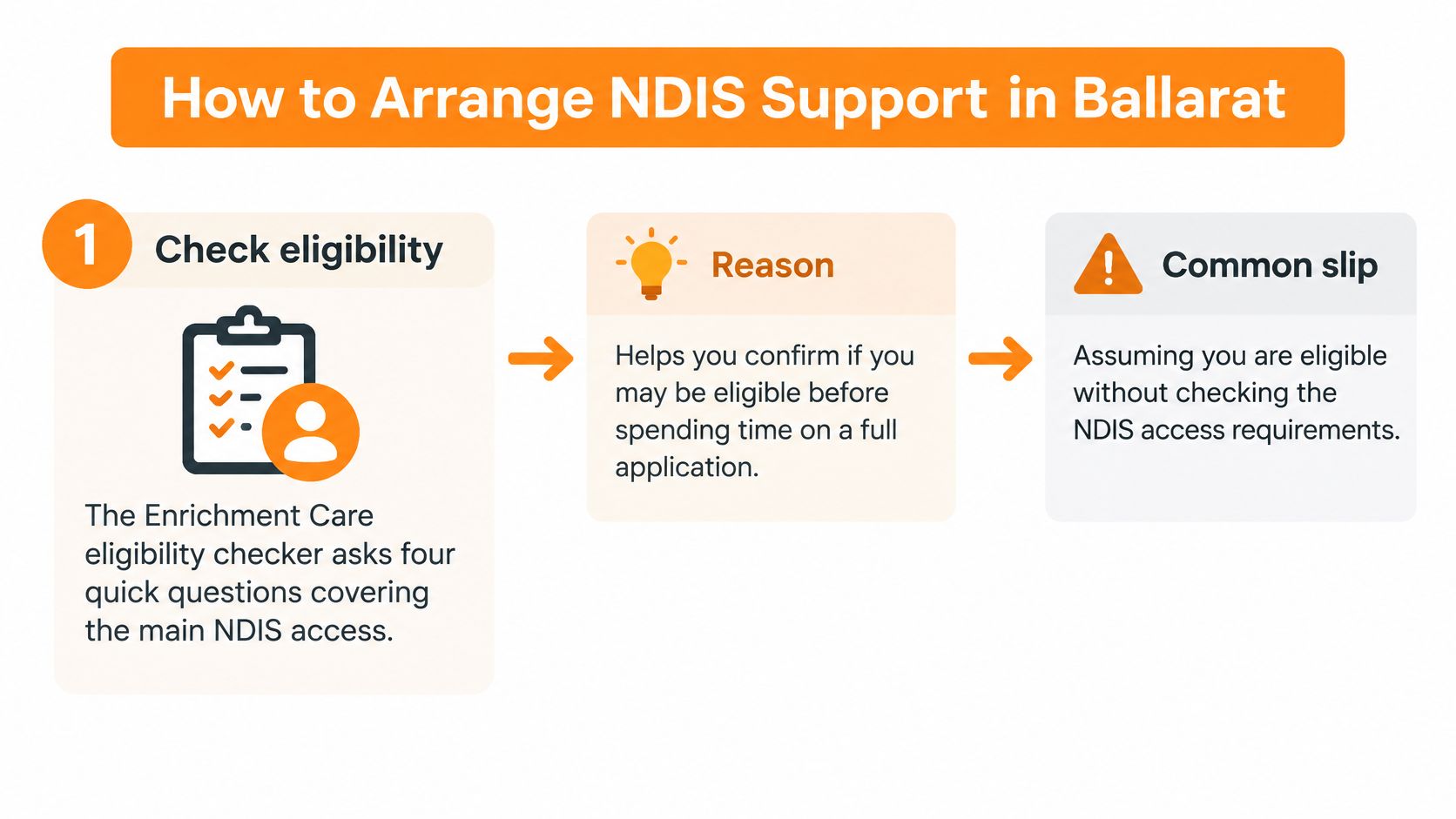
Check eligibility. Our eligibility checker asks four quick questions covering the main NDIS access criteria. A yes is a useful starting point, not a guarantee. The common slip is treating a quick result as a final decision.
Lodge an access request. Provide evidence of your disability and how it affects daily life. Describe what you can't do, what takes much longer, and what help you rely on. The common slip is describing the diagnosis in detail but saying little about daily impact. For a fuller walkthrough, read our guide to applying for the NDIS.
Prepare for the planning meeting by mapping your journeys. List regular trips such as home to hospital, study, work, shops, and recreation. Note which legs need transport help, which can use ordinary public transport, and where the route or destination is hard to use. More support hours won't fix an inaccessible destination.
This journey focus matters locally. The City of Ballarat's 2026 to 2030 Disability Access and Inclusion Plan, shaped by community engagement conducted from 16 February to 22 March 2026, identifies accessible transport, public spaces, communication, employment and service delivery as continuing priorities. It also notes that public transport, hospitals, and the NDIS are operated by other levels of government, leaving local government mainly in an advocacy role.
From plan to first shift
Read your plan and budget. Check which categories fund each support, especially Assistance with Daily Life, Social and Community Participation, and Transport. The common slip is adding up total hours without checking that each support sits in the right category.
Shortlist providers and call about availability. Ask about your suburb, preferred times, language needs, and the exact tasks involved. You can find a support worker on our website or call us on 1300 543 123. Don't rely on a general statement that a provider covers Ballarat.
Meet your preferred worker before the first shift. Then sign a service agreement that records the supports, costs, and rules. The common slip is agreeing verbally and discovering different expectations later.
Start with a check-in during the first weeks. Say what's working, what feels rushed, and what should change. You can ask for a different worker if your needs or preferences change.
This short video explains the early decision in plain terms before you commit to a provider.
Documents to keep ready
- Identity and contact details: Keep current details in one folder or phone note.
- Evidence of daily impact: Keep reports and examples that describe self-care, mobility, and communication needs.
- Your plan and budgets: Bring the pages that show categories and available funding.
- Weekly journey list: Include destinations, times, transport barriers, and who currently helps.
What Support Costs and How Funding Works
Funding follows the support you receive. Personal care and meal preparation usually come from Assistance with Daily Life, community participation from Social and Community Participation, and transport from Transport. If a quote places a support in an unexpected category, ask why before you sign.
| Support | National price limit 2026-27 | NDIS budget category |
|---|---|---|
| Life skills development (standard weekday daytime) | $73.58 per hour | Assistance with Daily Life |
| NDIS cleaning (house cleaning and laundry) | $61.16 per hour | Assistance with Daily Life |
| Personal care | Set by each provider, at or below the national price limit | Assistance with Daily Life |
| Meal preparation | Set by each provider, at or below the national price limit | Assistance with Daily Life |
| Community participation | Set by each provider, at or below the national price limit | Social and Community Participation |
| Travel and transport | Provider travel and kilometres claimed under NDIS Pricing Arrangements | Transport |
Work through the arithmetic
A price limit works like a ceiling on a room: it caps how high the charge can go, and providers can charge less than the national price limit for a support type. Say you arrange four hours of NDIS cleaning a week at $61.16 an hour. The maximum is $244.64 a week. For two hours of weekday daytime life skills development at $73.58 an hour, the maximum is $147.16.
Check the current limit for the exact support and time in your quote against our 2026-27 NDIS price limits guide. Evening, weekend, and different support items can change the figure, so don't copy a weekday daytime rate into every shift.
Quote check: Confirm the category, confirm the hourly rate, multiply by weekly hours, add any travel, then compare the total with your plan budget and service agreement.
Travel deserves its own line in that check. Provider travel and kilometres for travel and transport are claimed under the NDIS Pricing Arrangements, on top of the hourly support rate. That matters in Ballarat, where a week of support can mean trips from home to appointments, shops, and community activities spread across the city. Ask for the travel charge in writing, including how distance and travel time are counted, because a low hourly rate can look different once regular journeys are added.
For personal care, meal preparation, and community participation, request the hourly rate in writing before services start, since each provider sets its own price within the limit. Keep the agreed rate, hours, travel charge, and cancellation rules in the service agreement. That's the document you'll rely on if an invoice doesn't match what you expected.
Choosing a Provider and Matching the Right Worker
Provider numbers can give false comfort. The NDIS Ballarat LGA summary reports 2,869 participants and 280 active providers, equivalent to about 10.2 participants per active provider, and average annualised committed supports of approximately $34,274 per participant. That ratio is a market-capacity indicator, not a staffing ratio. One provider may serve many participants, and providers differ in support categories, hours, and geographic coverage.
A low overall ratio doesn't prove that a suitable worker is available for your language, culture, schedule, or support type. It also reflects providers that received payments in the area, not every organisation advertising services. Test availability against your actual week.
Criteria to test with every provider
- Language: Can the worker communicate clearly with you and your family?
- Religious practices: Will routines, clothing, prayer, and household expectations be respected?
- Food preferences: Can meals reflect taste, culture, and health advice?
- Family roles: Does the worker understand who makes decisions and who should be included?
- Communication style: Do you prefer direct instructions, quiet prompting, written notes, or another approach?
- Shared interests: Will community outings feel natural rather than forced?
- Travel time: Does the worker live close enough for reliable shifts?
- Rostering consistency: Will you see the same worker often enough to build trust?
- Changing worker: How easily can you request someone different?
As a worked example, Enrichment Care matches support to language, culture and personality, rather than task alone. Our team includes workers from more than 30 cultural and minority backgrounds, including Burmese-speaking, Chinese-speaking and Korean-speaking support. You receive shortlisted profiles, meet your preferred worker before services begin, and can consider alternative workers if the first match doesn't work. Our support workers hold the checks required for their role, including the NDIS Worker Screening Check.
Use these questions to ask a support worker to structure the first conversation. Then ask any provider three direct questions. Who would I meet first? How is the roster kept consistent? What happens if I want a different worker?
The right match isn't only about whether a worker can do the task. It's whether you can communicate comfortably on an ordinary, tiring day.
What to Do If NDIS Support Does Not Apply
Many people assume disability support either comes through the NDIS or doesn't exist. That assumption leaves a lot of people stuck. Ballarat's current consultation material on the Disability Access and Inclusion Plan 2026 to 2030 states that only just over 10% of Victorians living with disability are eligible for an NDIS plan. Recent Ballarat planning also prioritises accessible information, rights, safety and service delivery, so you're entitled to ask services for plain-language information about your options.
Not being eligible doesn't mean you have no support need. It often means your need must be met through several systems rather than one funded plan. That's harder to coordinate, but it isn't the same as having nowhere to start.
A practical sequence
If an access request is declined, request an access decision review. Check the reasons against the evidence you supplied. Look for missing information about daily impact, not just diagnosis.
While you wait, keep records. Note appointments, missed activities, tasks you couldn't complete, and help you relied on. Dates and short examples are more useful than general statements.
Speak with a local area coordinator. Ask about information, connections, and interim options while a decision is pending or after a decline.
Use mainstream and community services. Health, employment, transport, carer, and community services can provide referrals and practical help. Ask each service who else should be involved, so you don't carry the coordination alone.
Be clear about the limits of private support. A private provider can complement health, council, transport, and carer systems, but it can't replace them. Don't pay for support on the assumption that it will solve an eligibility, housing, or public transport problem by itself.
| Situation | Where to start | What it can help with |
|---|---|---|
| NDIS access request declined | Request an access decision review | Reviewing the decision and the evidence supplied |
| Waiting for an NDIS access decision | Ask a local area coordinator about other options | Information and connections while you wait |
| Needs below NDIS thresholds | Mainstream health, employment and community services | Practical help, referrals and coordination |
| Transport barriers to appointments | Ordinary public transport and community transport options | Routes to medical, study and work destinations |
| Carers needing support | Local government and carer services | Information, planning and respite |
If your needs fluctuate, say so plainly and record both good and difficult days. A fluctuating condition can be hard to explain in one appointment. A short diary shows the pattern, including recovery time and activities you avoid because the effort is too high.
Confirm Your Support Plan Before You Call
You don't need to solve every support need in the first phone call. You need a clear starting point. Complete this short checklist first, so the conversation stays focused on your week rather than a generic service list.
Your pre-call checklist
- Daily tasks: List the tasks that need help, in order of difficulty.
- Weekly destinations: Write down appointments, study, work, shopping, and activities you must reach.
- Worker preferences: Note language, cultural, and religious preferences that matter to you.
- Funding position: State whether you have an NDIS plan, you're waiting on a decision, or you're outside NDIS eligibility.
- Starting supports: Choose the one or two support types you'd like to begin with.
Then use the eligibility checker if NDIS access is still uncertain. To talk about support or make an enquiry, call Enrichment Care on 1300 543 123. To find out what your days with us could look like, call 1300 543 123 or find a support worker through our website.
Ask what a typical week could look like for your situation before you commit to hours. Which worker would you meet? Which budget would each support use? How would transport to your regular destinations work?
Match the support to the daily problem, check the budget, and meet the worker before the first shift. That's the sequence that turns a search for disability services in Ballarat into support you can rely on.
If you're ready to match support to the routines, journeys, language, and culture that shape your week in Ballarat, visit Enrichment Care to explore personal care, community participation, life skills, household help, and transport support. You can check your starting point, review worker matching, and contact the team to discuss what a practical first week of support could look like.