Disability Home Care Explained for Australian Homes
See what disability home care includes at home, from personal care and meals to routines, and how to judge a worker match in Australia.

About 3.2 million Australians living in households need help with at least one activity of daily life. Australia's 2022 Survey of Disability, Ageing and Carers estimated that 5.3 million people in households had disability, and 60.5% of them needed that assistance.
Disability home care is how that help lands. It is wider than a shower or a transfer. It is a safe house, a health routine, and a day that stays in order, shared between paid workers and the family, friends and neighbours who already show up. Funded hours still fail when the worker does not fit the language, the culture or the household's routines. Match and consistency are part of quality, not a bonus.
How Many Australians Need Help at Home
Australia's 2022 Survey of Disability, Ageing and Carers shows that support at home can involve more than personal care. A person may manage a shower yet need help with household upkeep, health-related routines, or tasks that require memory, planning and emotional steadiness.
| Activity | Support needed at home |
|---|---|
| Property maintenance | Keeping the home safe, clean and in working order |
| Health care | Following health routines between appointments |
| Cognitive or emotional tasks | Prompts, help sequencing steps and support through the day |
Household upkeep affects whether rooms and paths remain safe to use. Health-related routines can continue between appointments, while cognitive or emotional support can help someone follow the steps of an ordinary day. These needs may sit alongside bathing, dressing and mobility support.
Paid help and unpaid care share the same day
The survey also counted carers who provide unpaid support to people in households. Their help can sit alongside paid support: one person may assist with a morning routine, while a family member, friend or neighbour helps later in the day.
That arrangement depends on time and energy. A relative who provides regular support may also have disability or other responsibilities, so family availability should not be treated as unlimited backup.
Home support works best when the tasks and the people responsible for them are clear. A useful starting point is to map an ordinary day: what help is needed, when it is needed, and who can provide it.
What Disability Home Care Covers Each Day
Treat disability home care like a household roster. Every task has a time, a person who owns the decision, and a backup. A worker who improvises from the doorway will miss the order the household already uses.
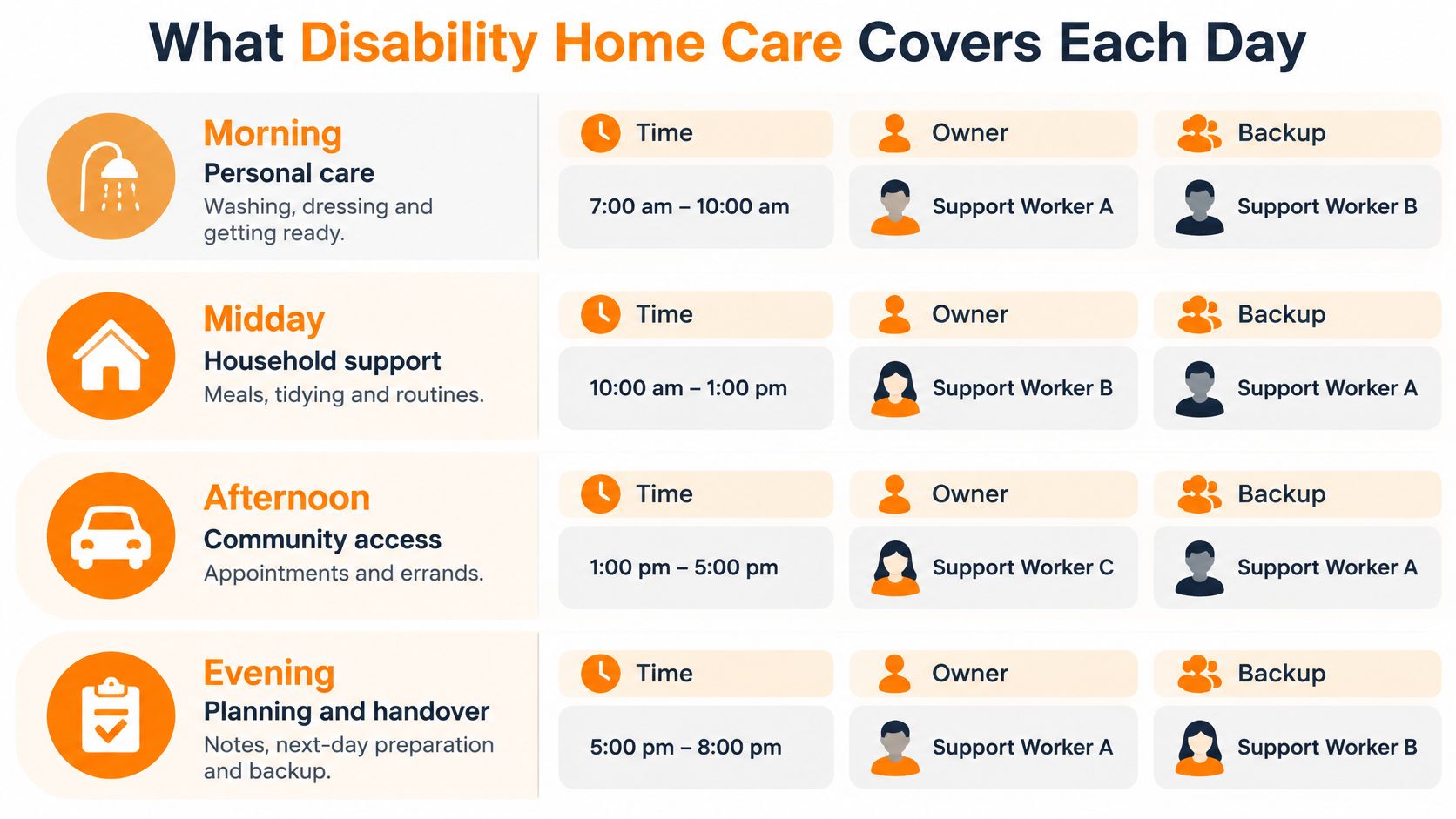
Four supports in the order of a day
Personal care opens and closes the day. Washing, dressing, grooming, toileting, transfers and medication prompts come from a worker the person has already met. The person keeps the routine they agreed. The worker follows it, including the pace, the products and the order of the bathroom.
Household help keeps the place liveable. Regular cleaning and laundry stop the home becoming a hazard. Meals follow taste, culture and the health team's advice. The worker cooks or cleans with the person, or for them when doing it alone is unsafe or exhausting. A familiar dish, cooked the way the household eats it, matters as much as a clean bench.
Everyday routines hold the sequence when memory, pain, anxiety or executive function snaps the chain between tasks. This is also where life skills get practised, in the kitchen or bathroom, not in a separate lesson. Prompts should thin out when the skill is growing, and stay when the person still needs the hand.
Community and transport gets someone to work, study, appointments, errands and friends. The person chooses the place and the activity. Travel is the means, not the point of the outing.
| Support | Purpose | Typical tasks | Who decides |
|---|---|---|---|
| Personal care | Start and finish the day safely | Washing, dressing, grooming, toileting, transfers, medication prompts | The person, with the worker following the agreed routine |
| Household help | Keep the home liveable | Cleaning, laundry, meals matched to taste, culture and health advice | The person and health team set the standard; the worker works with them or for them |
| Everyday routines | Hold the sequence of the day | Prompts, sequencing and life skills practised in real tasks | The person sets the goal; prompts fade as skill grows |
| Community and transport | Stay connected outside the house | Travel to work, study, appointments, errands and friends | The person chooses where to go and what to do |
Life-skills practice sits inside these real tasks. Folding the same towels, plating the same breakfast, or walking the same path to the bus is the practice. A worksheet that never meets the kitchen does not change Tuesday morning.
These are the practical pieces of core supports people use to stay in their own home. Funding decides how many of those hours can be rostered. Worker fit decides whether the roster is usable.
Practical rule: If a task has no owner and no backup, it is not on the roster yet. It is a gap waiting for a bad week.
How NDIS Funding Sits Behind Home Support
NDIS funding can support different kinds of home arrangements, from scheduled visits to more intensive daily support. The right pattern depends on how much help a person needs and how those hours fit their household routines.
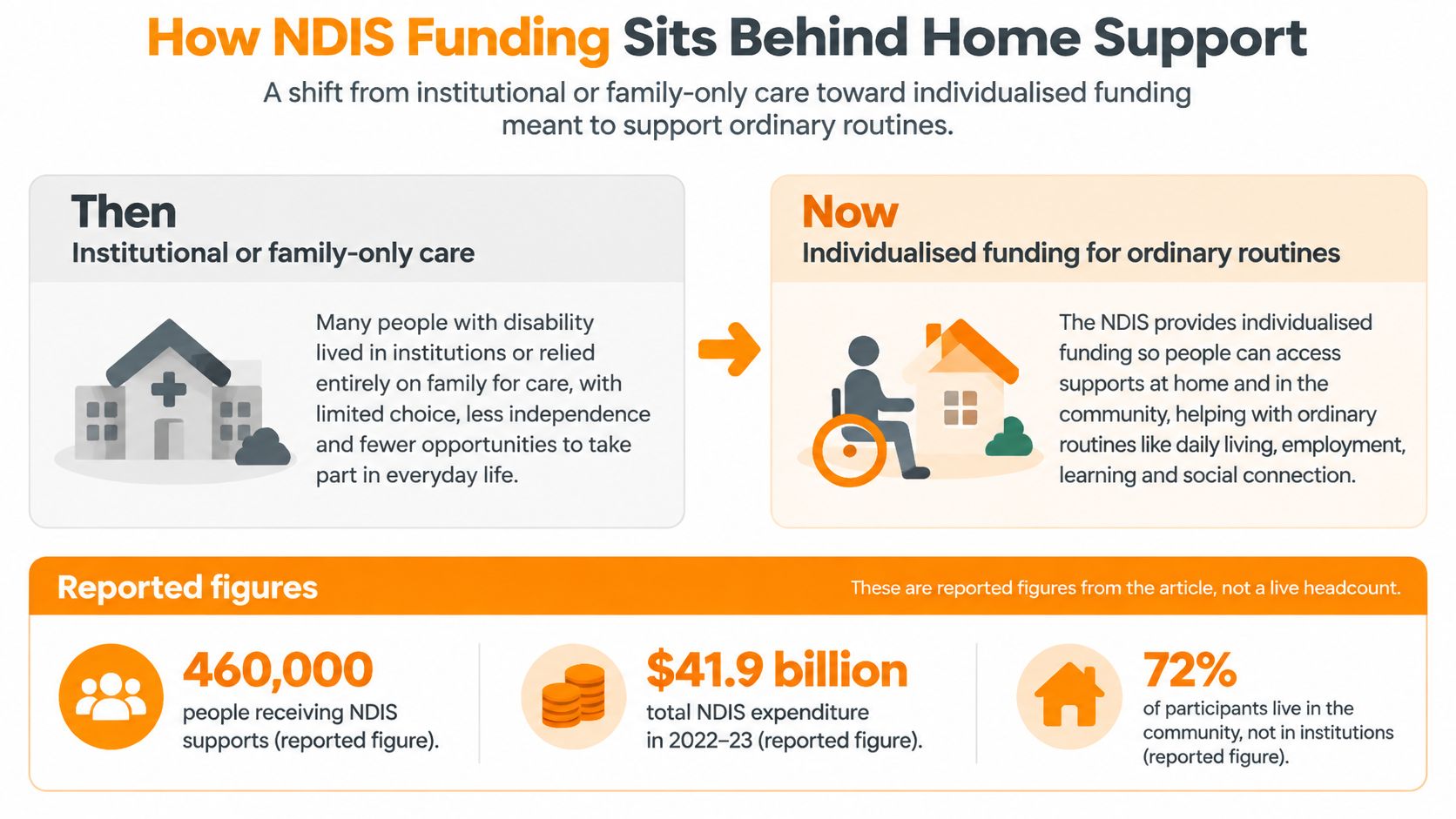
Reported scale, not a live headcount
An NDIS consultation document reported that the scheme supported nearly 400,000 Australians, with more than 24,000 participants receiving Supported Independent Living (SIL). It also reported more than $8.3 billion in funded supports associated with SIL, about 30% of total NDIS funding at the time. SIL participants were about 6% of all participants.
These figures describe the scale reported in that document, not a current headcount. They show that SIL represents a substantial share of funding for a relatively small group of participants. They do not mean that everyone needing help at home requires round-the-clock support.
SIL is generally for people who need extensive support to live with greater independence, often around the clock. Scheduled help in a person's own home is a different arrangement, with support planned for particular times and tasks.
Help in your own home is a different setting
A roster of visits can be shaped around a person's day, with hours arranged for the support they need. It does not automatically mean 24-hour care, and it is not limited to people receiving SIL.
| Setting | Designed for | Typical intensity | Scale in the cited figures |
|---|---|---|---|
| Supported Independent Living | People who need extensive support to live with greater independence | Often around the clock | Over 24,000 participants, about 6% of participants; over $8.3 billion, about 30% of funding |
| Help in your own home | People who need scheduled assistance and still live at home | Visits across the day, not automatically 24-hour | Not limited to the SIL group |
The trade-off is between intensity and fit. Around-the-clock support can suit a household where a person cannot safely be left alone. Scheduled visits use fewer hours, but only help if the worker arrives when agreed and can follow the person's language, culture and household routines. Funded hours are only useful when the support fits the person's everyday life.
Who Qualifies for Disability Home Support
Access comes before any argument about hours. NDIS access generally requires that you are under 65 when you apply, that you live in Australia as a citizen, permanent visa holder or protected special category visa holder, and that you have a disability that is permanent or likely to be lifelong and that substantially affects daily life.
People who first need support after 65 are usually directed to aged care. Younger people who do not meet NDIS access may still reach home support through state or territory disability programs, or through other community services. The front door is not the same for every age.
What the access request is really testing
The National Disability Insurance Agency decides eligibility through an access request. Reports usually describe how the disability affects everyday tasks, not only the name of a condition. A diagnosis on its own is not the test. The functional impact on daily routines is.
- Confirm the gatekeepers. Check age, that you live in Australia, and your citizenship or visa status before you collect paperwork.
- Gather recent reports. Ask a treating doctor or specialist to describe what you cannot do safely alone, how often, and what help you already use.
- Lodge the access request. Send it to the National Disability Insurance Agency with those reports attached, in the form the agency is using at the time.
- If you are accepted, build the plan. Set goals and the funded supports that match the tasks that fail in a normal week.
Rules change. Confirm the current criteria with the agency before you lodge, and use an NDIS eligibility checker only as a way to organise your questions, not as the decision. The decision sits with the agency.
Three Days of Support in an Ordinary Home
The categories only become clear when you watch a day. In each scene below, the person still decides the food, the pace and the destination. The worker carries the part the person cannot do safely alone.
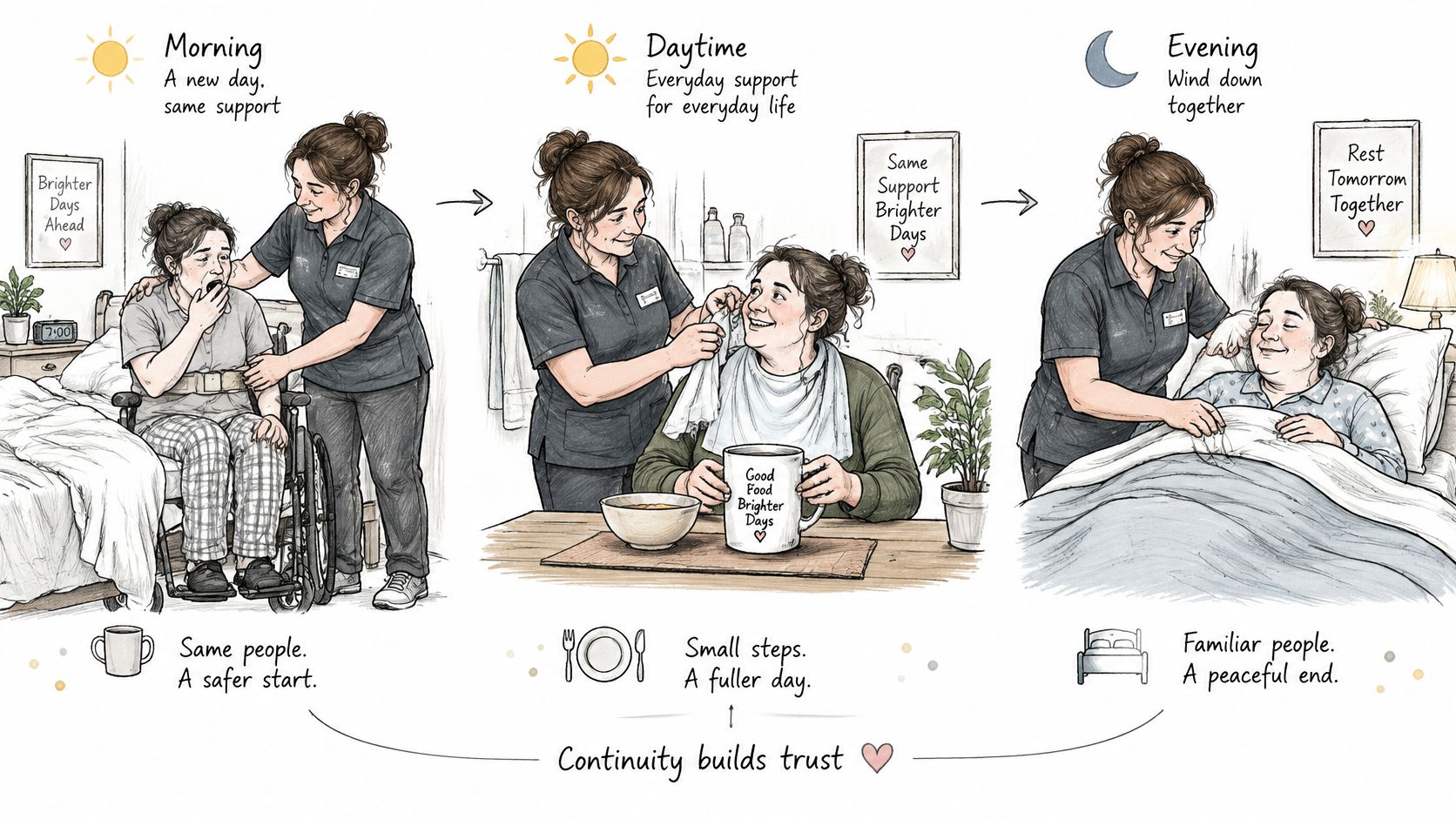
A physical disability and heavy mornings. The known worker arrives for transfers and a shower, then helps with a breakfast the person has already chosen. They leave. A separate cleaning visit keeps the floors and the bathroom safe. The same worker returns in the evening for the wind-down routine. The person still chooses the clothes, the meal and what can wait until tomorrow.
An intellectual or psychosocial disability. The breakfast sequence is the same each week, with fewer prompts as the steps stick. They cook a familiar meal together. In the afternoon they go where the person chooses, and transport is only the way to get there. The worker does not pick the outing to fill a timesheet.
A family coordinating complex communication. They ask for a worker who shares their language, and they meet that worker before the first shift. Meals stay aligned with culture and with the health team's advice. Personal care is not a stranger arriving unnamed. The person, or the family member they have asked to speak for them, still sets the boundaries.
A good pattern can still collapse. The regular worker calls in sick, and nobody has briefed the backup on food, communication, or the bathroom routine. The hours were funded. The day was not.
A short walk-through of how a support shift is talked through can make that handover less vague.
The test of these days is not whether the hours were used. It is whether skill, control and a predictable routine are growing.
Signs Home Care Is Building Independence
NDIS outcomes are measured with a baseline survey when someone enters the Scheme, then again at roughly annual plan reassessments. The domains cover daily living, home, health and wellbeing, relationships, community participation, and work and learning.
In NDIS participant outcomes reporting, the share who said the NDIS had helped with daily living rose from 60.7% after one year to 65.4% after two years and 69.5% after three years. Treat that climb as a benchmark, not a promise that every plan will move the same way. Quality is not the number of hours delivered.
Four signs a household can actually see
- Fewer prompts for the same routine. The person finishes washing, dressing or breakfast with less cueing than at the start.
- More of the task done by the person. They plate more of the meal, or they manage a household job that used to be done entirely for them.
- Showing up. Appointments and community activities happen on the days they were planned, not only when someone remembers at the last minute.
- The person says the worker fits. If they dread the shift, avoid care, or cannot communicate with the worker, the hours are not building control.
Because the measurement is longitudinal, write a baseline when support starts. Review it at reassessment. If independence is flat, change the prompts, the schedule, or the worker match. Do not add hours by habit and call that progress.
Some people will always need hands-on care. For them the goal is control and a predictable routine, not the withdrawal of help.
Match the Worker and Arrange Support
A plan can hold hours and still leave care unused. In 2022, 39.4% of people aged 0 to 64 reported that they needed more formal assistance than they were receiving, according to the Productivity Commission. The gap is not only volume. It is whether the support is usable and acceptable on a Tuesday morning.
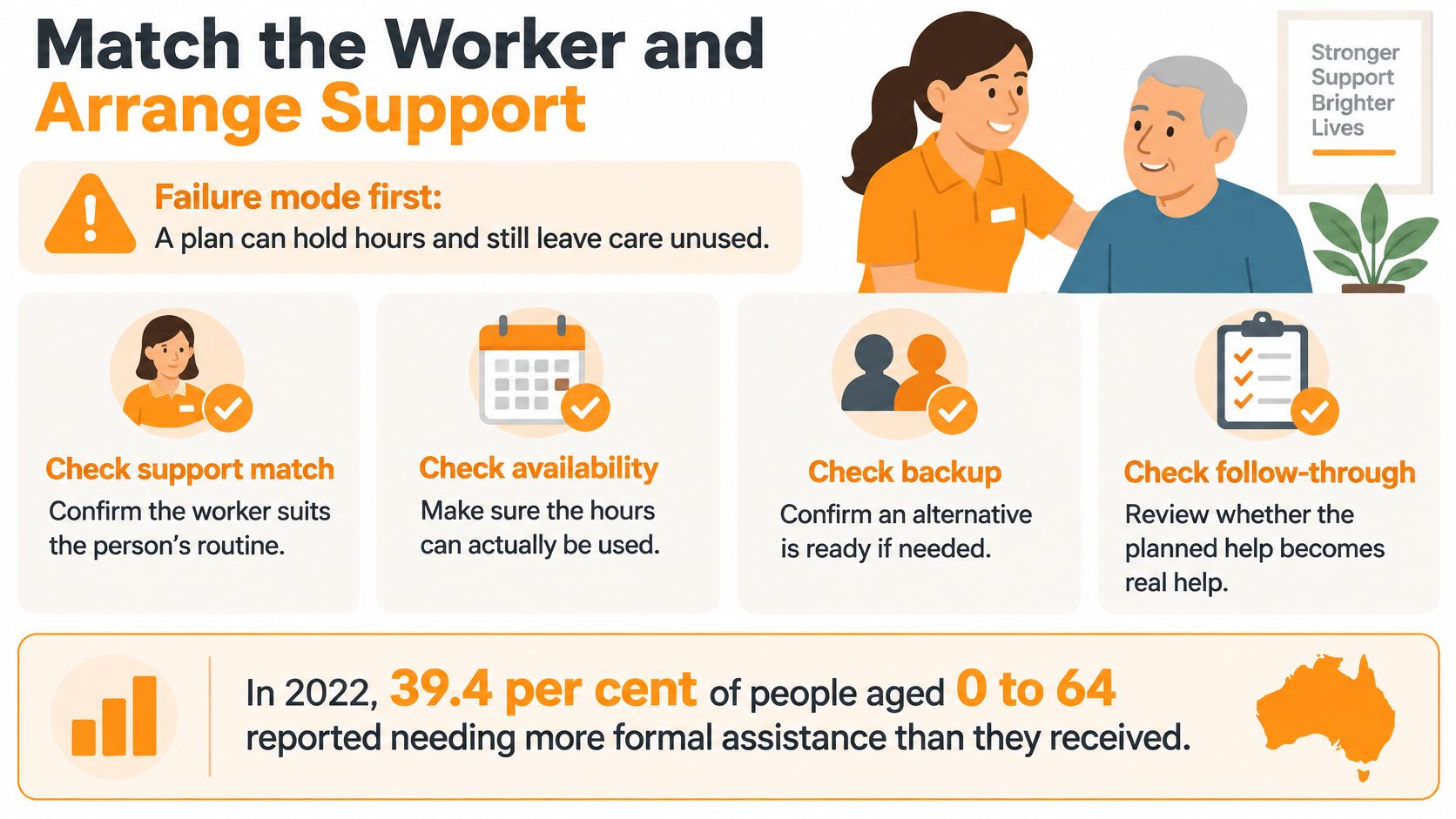
This bites hardest in multilingual households, for Aboriginal and Torres Strait Islander participants, for migrants, for people with psychosocial disability, and for relatives who coordinate care. A worker on the books is not effective support if communication fails, or if the person avoids care because food, religion or personal boundaries are misunderstood. We match disability support to each participant's language, culture and personality, including for disabilities that are not on a set list, and you do not need one particular diagnosis to be considered. Cultural match never replaces skill, reliability or safety.
Write the match before you roster
Put these on paper before anyone is booked.
- Language. The language used during care, including with family in the room.
- Religious practice. What happens during care and at meals.
- Food. What to cook, and what must not be in the kitchen.
- Decisions. Who decides at home, and when a family member speaks.
- Communication. Speech, devices, signs, or other non-speaking methods.
- Personal care boundaries. Any gender preference for intimate support.
- The shift itself. Interests that make the hours workable rather than endured.
Then move in this order.
- Name the tasks that fail. Across personal care, household help, everyday routines, and community access, write what breaks in a real week, plus language, food and communication preferences.
- Check the budget line. Personal care and meal preparation usually sit in Assistance with Daily Life. Confirm the line before you promise a roster.
- Sense-check the hours against price limits. The 2026-27 national price limits below are a budget guide for standard Assistance With Self-Care Activities, not a quote.
- Trial, meet, and name a backup. Shortlist workers, run a trial shift, meet the preferred worker before the first shift, write the preferences into the service agreement, and name a backup who already knows the routine. You can find your support worker by those criteria rather than by whoever is free on the day.
| Time band | Price limit per hour |
|---|---|
| Weekday daytime | $73.58 |
| Weekday evening | $81.07 |
| Weekday night | $82.57 |
| Saturday | $103.54 |
| Sunday | $133.50 |
| Public holiday | $163.46 |
A weekday evening hour and a Sunday hour do not buy the same amount of help. If the hard tasks sit at night or on weekends, say so before the roster is locked. Consistency is the other half. The same worker, a written routine, and a backup who has read it will outperform a larger pile of hours delivered by strangers.
Enrichment Care arranges NDIS disability home care in participants' homes across Australia, matching workers to language, culture and personality so personal care, meals and community access follow the household's real routine. If funded hours are going unused because the worker does not fit, a shortlist and a meeting before the first shift will tell you more than another line in the plan. Visit Enrichment Care to organise support around the day you already live.
Authored using the Outrank tool