Homecare Support Worker: What They Do and How to Choose
Learn what a homecare support worker does, the tasks they cover, and how to choose one who suits your routines, language and support needs.

You're trying to organise help at home, but the questions keep multiplying. Who'll arrive, will they understand your routines, and will they help you do things your way rather than take over? Choosing a homecare support worker starts with understanding what good support should make possible: a day with more choice, the right assistance and room to use your own abilities.
What a Homecare Support Worker Does
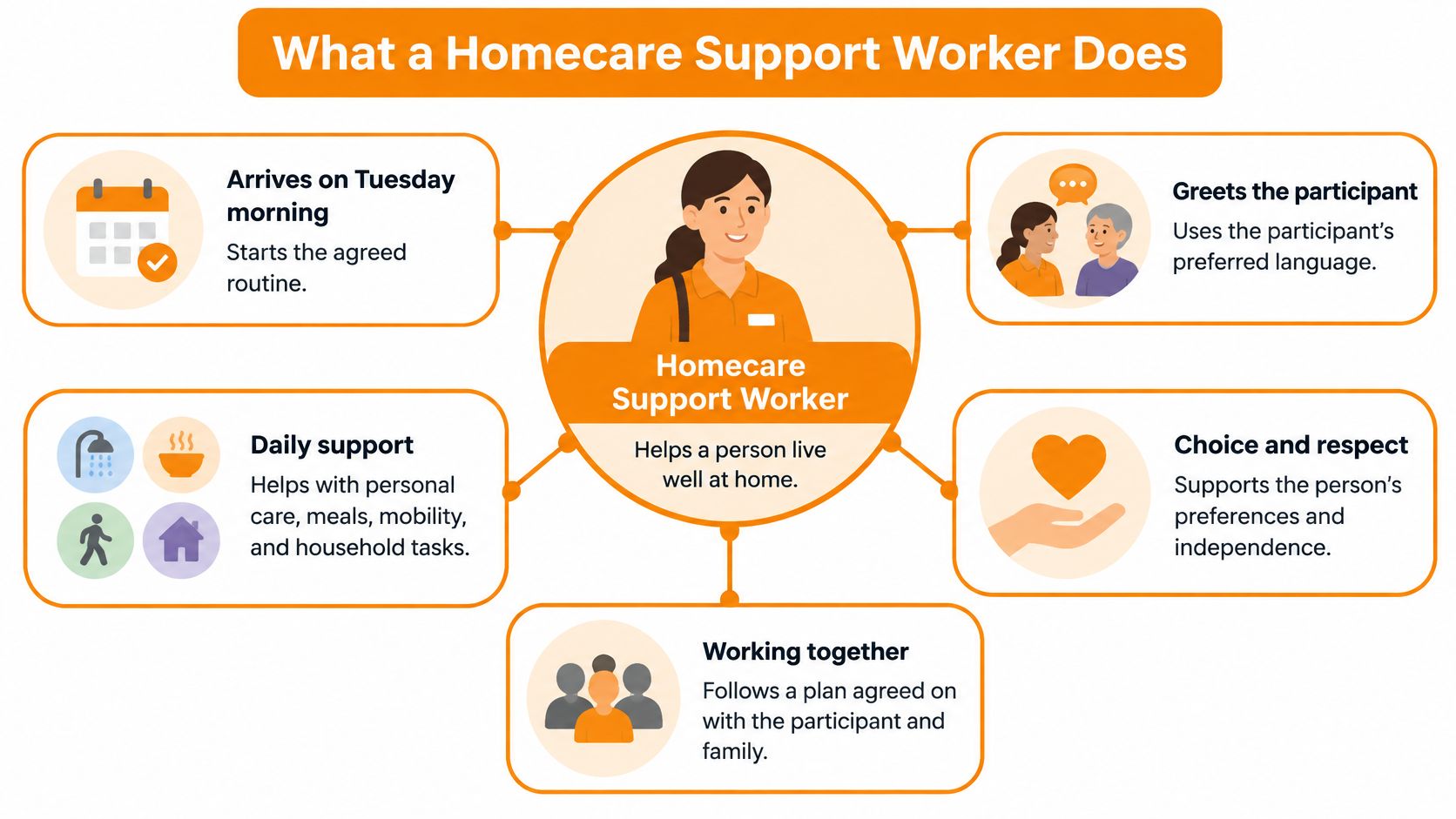
Say a worker arrives on Tuesday morning, greets you in your preferred language and checks whether you're ready to start the routine you agreed on together. You choose breakfast, explain that you'd like to shower later, and ask for help getting ready for an outing. The worker supports those decisions rather than treating the morning as a fixed list of chores.
A homecare support worker helps a person with disability live at home and take part in community life. Think of the role as scaffolding rather than a builder: the structure belongs to you, and the worker supports the parts where you need help. They don't redesign your life around their preferences.
A recognised disability support role
The Australian Bureau of Statistics' 2024 occupational classification recognises disability support workers as a distinct occupation, describing work that develops individual living skills, improves community access and promotes social inclusion. It classifies community and residential aged-care workers separately.
That distinction matters when you're arranging help. Disability support isn't general domestic assistance, even when a shift includes laundry or washing dishes. The purpose might be to make an inaccessible task manageable, preserve energy for an outing or help someone practise an everyday skill.
For NDIS-funded support, agreed tasks should relate to the person's disability-related needs, funded supports and individual goals. A worker's presence doesn't make every household job an appropriate funded task.
Practical test: Ask whether the task supports a skill, preserves the person's choice or helps them connect with their community.
Not every task needs to achieve all those things. Someone may need a worker to complete personal care without a teaching component. What matters is that the assistance serves the person, rather than making the worker's preferred routine the default.
Core Tasks and Who Does Them
NDIS homecare work includes assistance with daily personal activities and assistance with social and community participation. The NDIS guidance on these supports describes personal assistance as help or supervision that enables greater autonomy, alongside support to engage in social, recreational and community activities.
Daily personal assistance can include washing, dressing, hygiene and medication assistance within the worker's agreed responsibilities and competence. Community support can involve appointments, therapy, family visits, recreation and errands. The important distinction is between helping someone participate and making decisions on their behalf.
Homecare support tasks and who decides
| Support type | What the worker does | Participant's role | Typical example |
|---|---|---|---|
| Personal care | Helps with washing, dressing, hygiene and medication prompts | Chooses routine, preferences and the level of help | Showering with a shower chair and verbal prompts |
| Household assistance | Cleans and does laundry alongside the person or on their behalf | Sets priorities and standards | A weekly kitchen clean done together |
| Meal preparation | Cooks with the person or for them | Chooses recipes, tastes and dietary preferences, with health advice considered | Preparing meals that suit culture and health team advice |
| Life skills development | Teaches and prompts everyday tasks | Decides which skills to practise | Using a phone to book an appointment |
| Community participation | Attends outings, activities and social events | Chooses where to go and what to do | Attending a local club or art class |
| Travel and transport | Helps the person get to appointments, work, study and errands | Decides destination and timing within agreed arrangements | Accompanying a GP visit |
The participant's role column is easy to overlook when a family is focused on getting practical help organised. Yet it identifies the decisions that should remain with the person. A worker can help prepare dinner without choosing the menu, or accompany an appointment without answering every question for the participant.
Keep responsibilities clear
A support worker isn't automatically a nurse, therapist or substitute decision-maker. Medication prompts shouldn't become medication administration, and an exercise suggested casually shouldn't replace instructions from the treating professional. Where a task needs specific training, equipment or clinical direction, clarify that before it begins.
Our guide to a day with a support worker offers a practical way to think about how different activities fit into a routine. Use it to identify the actual help needed, including preparation and transitions, rather than listing only destinations or household jobs.
Before the first shift, request a written task list aligned with the support plan. Include what the worker will do, what the participant wants to do themselves and what requires escalation. This gives everyone a shared starting point without turning the person's day into an inflexible timetable.
Building Independence Without Doing Everything
A spotless kitchen and a completed checklist don't necessarily mean someone received good support. If the worker made every decision and completed tasks the person wanted to practise, the shift may have been efficient without being useful.
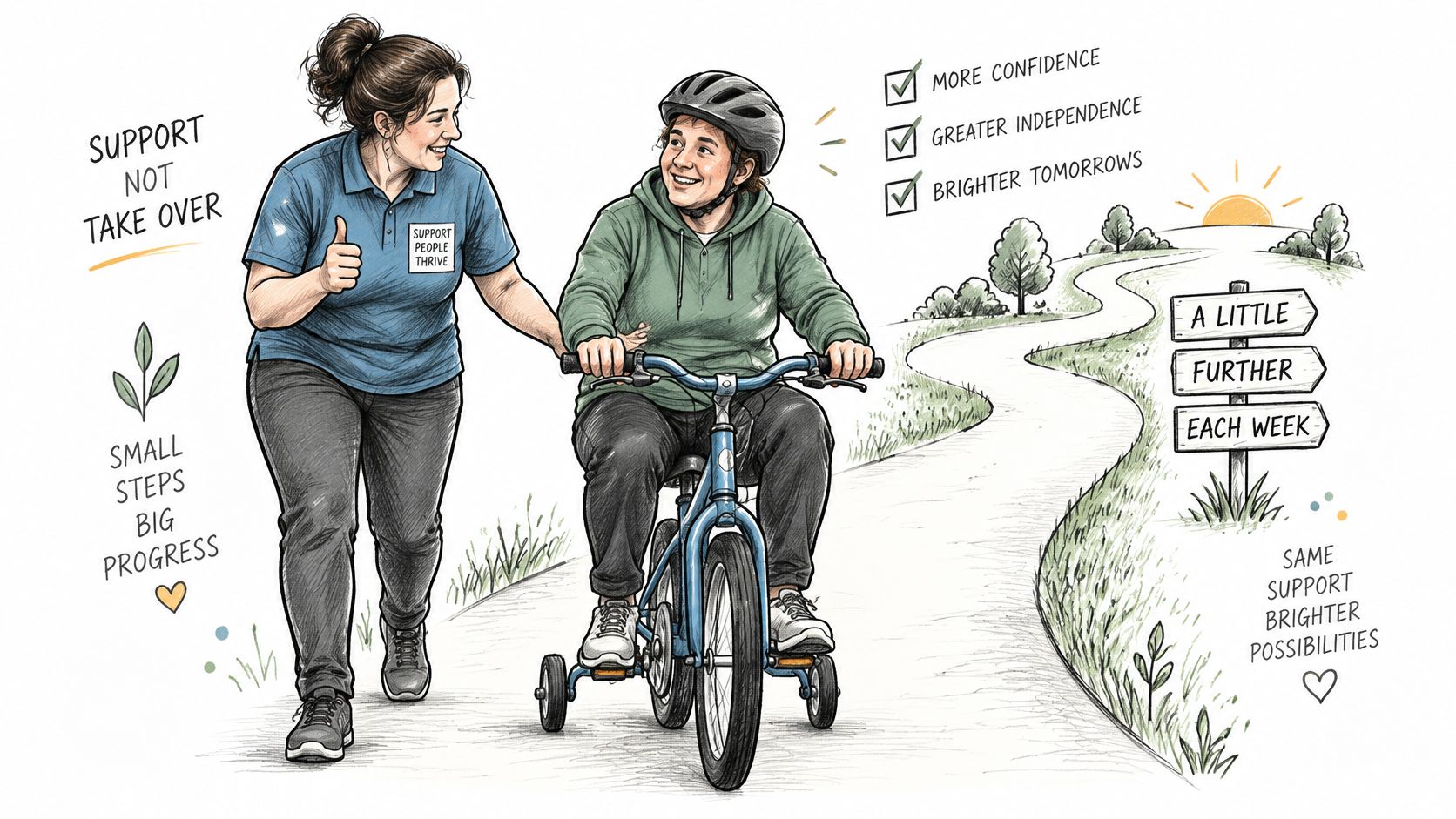
Training wheels offer a helpful analogy. They provide enough stability to make riding possible, but the right arrangement changes with the rider. For some people, assistance can reduce as confidence grows; others need ongoing support to participate comfortably and safely.
Match help to the task
Graded assistance means adjusting the help rather than choosing between complete independence and having everything done for you.
- Prompting: A reminder, gesture or visual cue helps the person begin or continue. The worker allows time for a response instead of repeating instructions rapidly.
- Assisting: The worker helps with particular steps while the person completes others. Physical guidance needs consent and must follow relevant safety instructions.
- Doing for: The worker completes the task when the person needs or chooses that assistance within the agreed plan. This isn't a failure of independence.
Say someone can make a sandwich using a visual checklist. The worker might point to the next picture, help open a difficult container and leave the remaining preparation to the person. Making the whole sandwich would remove the very practice the person wanted.
After a fall, however, someone may need close assistance with showering. The worker should follow the updated care and mobility instructions, not encourage unsupported standing to demonstrate progress. Assistance can reduce when a review confirms that doing so is safe.
Independence includes directing your support. It doesn't require doing every physical task yourself.
Notice progress without creating pressure
Keep notes specific: the person selected ingredients, followed the checklist or asked for help opening packaging. Avoid broad labels such as independent when they conceal the assistance that made success possible.
Our guide to building independence at home can help frame activities around meaningful participation rather than speed. Allow for pain, fatigue and fluctuating capacity, too; needing more help today doesn't erase an existing skill.
At regular reviews, ask which tasks the person can do now, which need prompts and which steps they want handed back. Review these questions monthly if that suits the support arrangement, without treating reduced assistance as a compulsory outcome.
Matching Needs to a Worker, Case by Case
A worker can have strong practical skills and still be the wrong person for a particular household. Matching needs to account for how the participant communicates, what makes their day predictable and which relationships or activities matter to them.
At Enrichment Care, we learn about the participant's needs, routine, language, culture and interests, then shortlist suitable workers and send their profiles. We also consider personality and care needs, so selection goes beyond finding someone available.
Matching priorities by situation
| Situation | Matching priority | Why it matters |
|---|---|---|
| Preferred language is not English | Shared language or reliable interpreter access | Instructions, choices and safety information must be understood |
| Cultural or religious practices shape routines | Shared understanding of food, prayer times and modesty | Prevents daily routines from being disrupted or disrespected |
| Non-verbal or augmentative communication | Worker trained in the participant's communication method | Lets the person express choices and concerns |
| Autism or sensory needs | Calm communication and predictable routines | Reduces stress during personal care and transitions |
| Strong routine or fixed daily schedule | Continuity and stable rostering | Keeps the day predictable and reduces anxiety |
| Goals focused on community life | Shared interests and transport confidence | Makes outings and activities enjoyable and reliable |
| Physical support or mobility needs | Manual handling training and mobility skills | Supports safe transfers for the person and worker |
Look beyond a shared label
Speaking the same language can make everyday conversation easier, but it doesn't establish every cultural preference. Ask the participant about food preparation, religious observance, privacy and family involvement rather than assuming that people from the same background want identical support.
Communication fit also involves more than speech. If someone uses gestures, a picture board or a communication app, the worker needs to understand how that person expresses agreement, refusal, discomfort and uncertainty. A familiar family member can explain the method without becoming the person's permanent spokesperson.
For someone who finds transitions difficult, a suitable worker might explain the next activity, use an agreed visual schedule and allow processing time. A lively conversational style that suits another participant may feel overwhelming here.
Availability needs to match the routine, not just the initial shift. Jobs and Skills Australia's disability support worker profile reports 151,400 disability support workers nationally, with 66.1% working part time. Ask how a shortlisted worker's hours fit the required schedule and what continuity is possible.
Bring a short written profile to the matching conversation. Include essential support needs, communication preferences, routines, interests and anything the person strongly dislikes. Separate essential requirements from preferences that can be discussed, so a promising match isn't rejected over something minor.
Checking a Worker and Starting Well
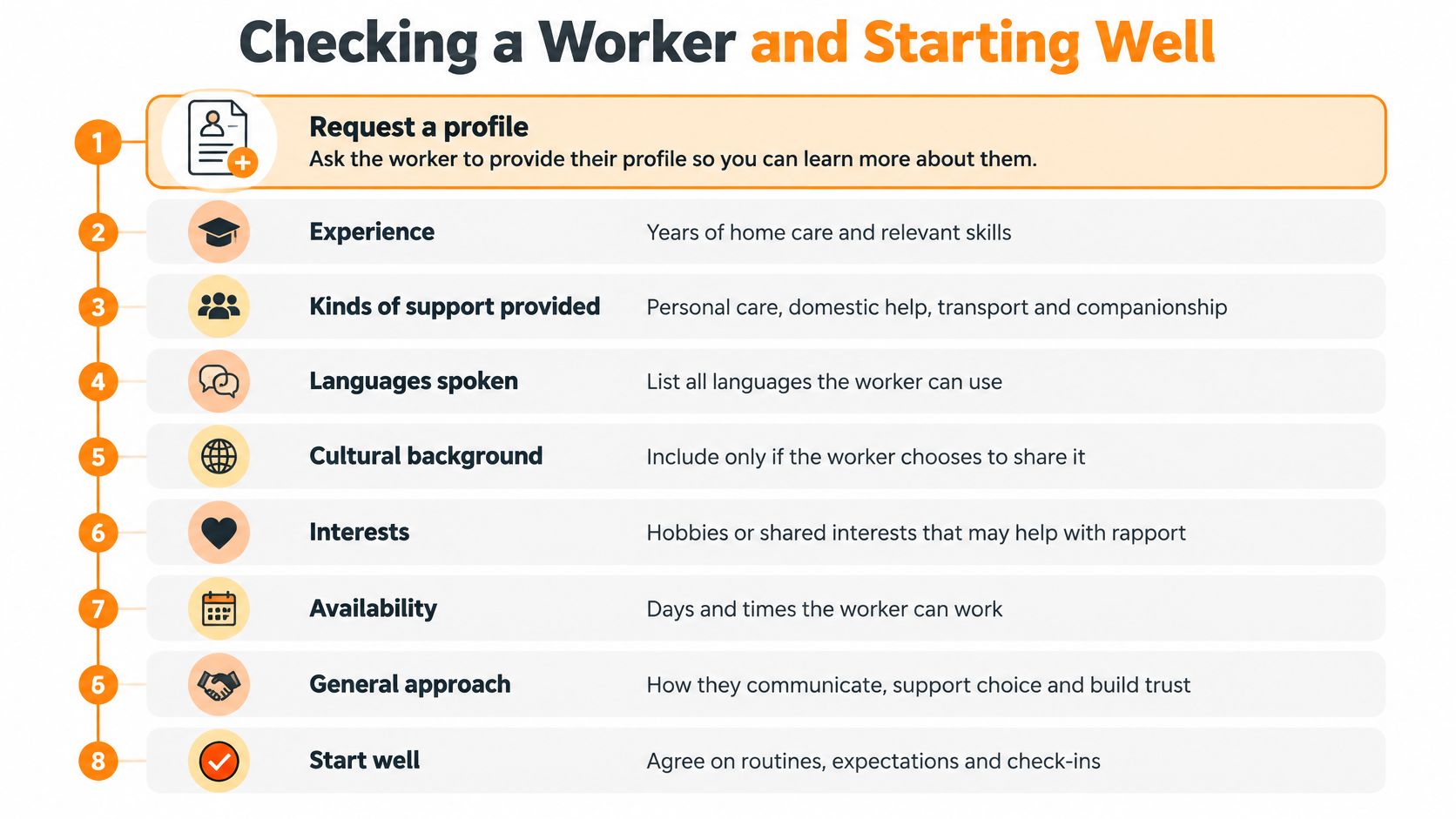
A worker profile helps you prepare, but it isn't the same as meeting the person. Start by comparing the profile with the participant's written preferences, then use the introduction to explore how they would work together.
Our worker profiles cover experience, kinds of support provided, languages, interests, availability and general location. Cultural background is included where the worker chooses to share it. Read each detail against a practical need: relevant showering experience matters more than unrelated experience, while general location can help you discuss realistic travel and scheduling arrangements.
Move from profile to practical checks
- Confirm screening and task competence. Our support workers hold the checks required for their role, including the NDIS Worker Screening Check. Screening is a safeguarding check, not proof that someone can perform every specialised task, so discuss the skills needed for the proposed shift.
- Talk through the actual routine. Choose an activity such as getting ready for an appointment. Explain the person's communication, privacy preferences and required assistance, then ask the worker how they would approach it.
- Clarify changed shifts. Ask who will contact you if a worker is unavailable, how alternatives will be discussed and what happens if no suitable replacement is available. Request the arrangements in writing.
- Identify the concern pathway. Know who to contact about a mismatch, an incident or an urgent change in support needs. Don't leave this until something has gone wrong.
Use our questions to ask a support worker to prepare for that conversation. The participant should have room to ask their own questions, with communication assistance where needed, rather than listening while everyone else makes the decision.
Use the meeting to check comfort
At our meet and greet, the participant meets their preferred support worker before supports start, and family members are welcome to join. Notice whether the worker addresses the participant directly, listens without interrupting and checks before touching belongings or offering physical assistance.
Discuss boundaries as well as rapport. Agree on access to the home, private spaces, phone use during support and how personal information will be handled. A friendly introduction is useful, but it shouldn't replace clear expectations.
Before agreeing: Make sure the participant has a genuine opportunity to say yes, no or that they need more time.
Pre-shift checklist
| Check | What to confirm | Why it matters |
|---|---|---|
| Worker screening | NDIS Worker Screening Check held | Confirms screening clearance, not competence for every task |
| Profile fit | Languages, cultural understanding, interests and availability match the person's needs | Helps assess day-to-day fit |
| Routine | Worker can follow the support plan routine | Keeps the day predictable |
| Changed shifts | Written plan for missed or changed shifts | Helps prevent gaps in support |
| Concerns | Clear escalation route to the coordinator | Problems can be raised early |
Agree on an initial shift that gives the participant a fair opportunity to experience the arrangement. Choose familiar activities where possible, rather than making the first meeting a demanding outing or a complicated new routine.
Set a review date after the person has had time to form an opinion. Ask about comfort, communication, punctuality and whether agreed boundaries were respected, not whether the tasks were completed.
You don't need certainty about a lifelong match before starting. You do need a worker the person feels able to communicate with and a clear way to respond if that changes. Our participants can ask for a different worker at any time, including after a positive introductory meeting.
Signs a Match Isn't Working and How to Fix It
A participant starts avoiding an upcoming shift, becomes unusually quiet around the worker or asks a family member to stay nearby. Alternatively, the worker seems exhausted, unsettled or unable to follow the agreed routine. These are reasons to check what's happening, not proof that either person is at fault.
Safety belongs in that conversation. Safe Work Australia's nursing, care and support workforce profile reports that assault claim frequency is approximately 6.5 times higher than across other occupations. For a worker supporting someone alone at home, fatigue, isolation and unclear risk instructions need practical attention rather than blame.
Warning signs, likely causes and fixes
Treat these causes as possibilities to investigate, not conclusions about the participant or worker.
| Sign | Likely cause | First fix |
|---|---|---|
| Participant avoids or refuses shifts | Poor fit on communication or personality | Ask what feels wrong, then review the profile and needs |
| Routine changes without notice | Support plan or roster is out of date | Update the plan and agree a change process |
| Worker does tasks the person could do | Over-assistance | Agree prompt levels and review goals monthly |
| Frequent late or cancelled shifts | Roster or travel gap | Request a roster review with the coordinator |
| Worker seems exhausted or distressed | Heavy load, isolation or fatigue | Raise with the coordinator and arrange check-ins |
| Participant feels unsafe | Risk not assessed or controls missing | Pause unsafe support, escalate and request a different worker |
Listen before changing the arrangement
Ask the participant directly what feels wrong, using their preferred communication method and a private setting. Don't assume that refusing a shift means refusing all support. The concern might involve rushed personal care, unwanted conversation, an unfamiliar replacement or something the person hasn't yet felt comfortable describing.
Raise the concern with the support coordinator and the provider's nominated contact. Request a worker review or a different worker where needed, and record any revised routines, communication instructions and responsibilities in the support plan.
A worker shouldn't improvise a transfer or high-risk personal-care procedure to keep a shift moving. If equipment, health needs or the home environment changes, stop the unsafe task and seek the appropriate assessment or instructions. Arrange safe alternative assistance rather than leaving an essential need unaddressed.
A workable match allows concerns to be raised without pressure to stay silent. Document what changed and who will follow it up, so a replacement worker doesn't encounter the same unresolved problem.
At Enrichment Care, we arrange NDIS support for everyday life at home and in the community, with matching that considers your routines, language, culture, interests and care needs. Visit Enrichment Care to share what matters to you, review suitable worker profiles and meet your preferred worker before support begins.