Melbourne Disability Services Guide for 2026
Compare Melbourne disability services for daily living, community access and worker matching, with 2026-27 NDIS price limits.

About one-third of Victorians with disability had a profound or severe disability, according to the Victorian Government's disability profile, using Australian Bureau of Statistics figures from 2011. That historical measure helps explain why disability support can't be reduced to an occasional outing or help with housework. Some people need assistance woven through their whole day.
Choosing Melbourne disability services means connecting that assistance into a workable week. A suitable worker matters, but so do travel arrangements, cultural understanding, backup cover and someone taking responsibility for invoices. The useful question isn't which services are available. It's whether the person can keep their routines, preferences and relationships when something changes.
Melbourne Disability Services Mapped by Support Type
Start with the support, budget line and price, rather than a worker's available hours. Identify what you want help with, check how it fits your plan, then compare the cost of delivering it at the times you need.
The lookup below separates everyday supports that can sound similar but serve different purposes. The listed prices are national limits, not automatic charges or a promise that every activity fits a particular funding category.
Core supports, budget lines and weekday limits
| Support | What a week can include | Usual NDIS budget line | Weekday daytime limit 2026-27 |
|---|---|---|---|
| Personal care | Bathing, dressing and home routines with a known worker | Assistance with Daily Life | $73.58 an hour for standard support |
| Life skills development | Practising everyday tasks towards more independence | Assistance with Daily Life, with the exact item confirmed against the plan | $73.58 an hour |
| House cleaning and laundry | Regular cleaning to keep the home safe and comfortable | Assistance with Daily Life | $61.16 an hour |
| Meal preparation | Meals matched to taste, culture and health-team advice | Assistance with Daily Life | $73.58 an hour where standard support applies |
| Community participation | Activities, social outings and time in the community | Assistance with Social, Economic and Community Participation | Confirm the applicable support item and time band in the NDIS price guide |
| Travel and transport | Getting to work, study, appointments and friends | Applicable transport funding or support item, separating provider travel and kilometres | Confirm the charging rules for each travel component |
Our prices stay within national NDIS price limits. For the listed standard daytime supports, evening, weekend and public holiday limits are higher, and providers can charge below the applicable limit. Community participation and transport don't have a single weekday cap established here, so don't insert the personal-care rate into those rows when preparing your budget.
An activity's name doesn't settle its funding. Cooking might mean a worker preparing dinner because you need assistance, or practising chopping and following a recipe towards greater independence. Describe what the worker will do before assigning the budget line.
Check the suburb, not just the service area
Victoria had 202,704 active NDIS participant plans at 30 September 2025, according to the NDIS participant report. That's a statewide count, not a Melbourne headcount; the dataset also supports closer comparisons by local government area, age and support type.
For a participant, local coverage matters more than a broad claim of metropolitan availability. A worker might technically cover your suburb but face an awkward journey before a morning shift.
Before comparing workers, write down:
- The actual task: Assistance with showering is different from a general morning check-in.
- The location: Include where the shift starts and finishes, especially for community activities.
- The timing: Distinguish a flexible cleaning visit from support needed before work.
- The intended outcome: Record whether you want the task completed, shared or practised.
Keep that task map alongside your plan. It gives you something concrete to discuss when a proposed roster looks affordable but doesn't quite match your day.
Plan Management Choices After an Access Decision
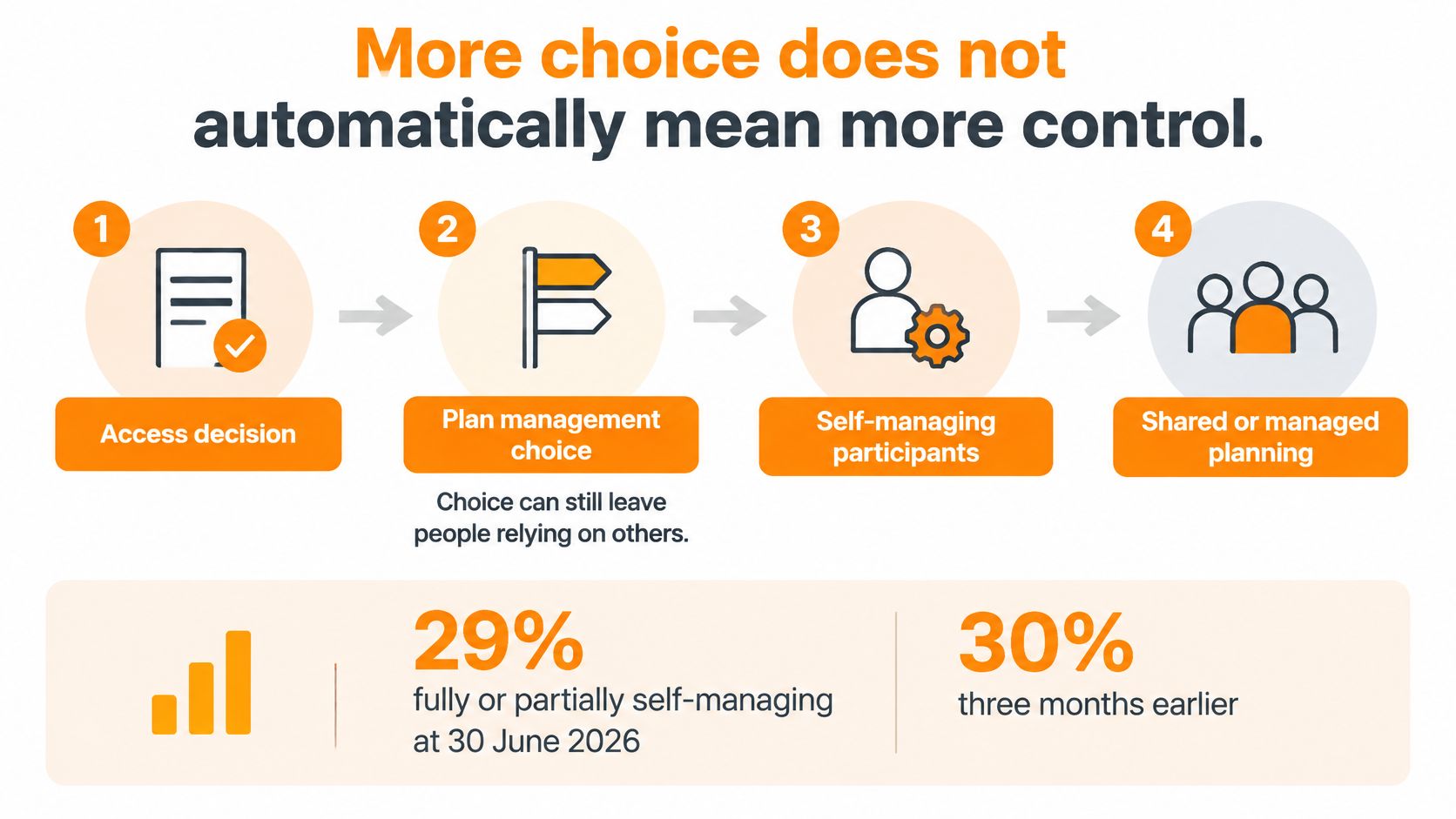
More choice doesn't automatically mean more control. If nobody agrees who checks invoices, tracks spending or follows up a disputed charge, the administrative work can fall to the participant or family.
The NDIA's participant pathway project describes testing a more accessible, inclusive and equitable pathway after identifying barriers to access and planning. Practical navigation matters because understanding an approval isn't the same as knowing how to use a plan.
This diagram sets out the management choices to discuss after an access decision.
Separate planning from paying
After access is approved, prepare evidence that describes functional support needs: which tasks are difficult, what assistance is needed and what happens without it. Relevant health reports and a written account of an ordinary day can help make that discussion specific.
Then compare management options. Self-management gives you responsibility for organising payments and records. Plan management places invoice processing and budget tracking with a plan manager, while NDIA management uses the agency's payment arrangements and associated provider requirements.
None of these choices replaces deciding what you want your support to achieve.
| Who | Best used when | Does not replace |
|---|---|---|
| Local council | Finding local community programs | An NDIS planning decision |
| Local area coordinator | Linking mainstream and community supports | Clinical or legal advice |
| Support coordinator | A complex plan needs providers linked | Paying invoices |
| Plan manager | Invoices and budget tracking need doing | Choosing goals or workers |
| Advocate | A support decision needs to be challenged | Day-to-day support |
| NDIA | Access, planning or a plan review | Rostering a worker |
Give each responsibility an owner
Our service agreement sets out supports and costs under NDIS pricing rules. Cultural matching doesn't create a separate funding category: personal care and meal preparation usually sit within Assistance with Daily Life.
If you disagree with a support decision, request the reasons and information about review options from the NDIA. An advocate can help you understand and communicate your position; general information isn't individual clinical or legal advice.
For people still considering access, our four-question eligibility checker is an initial screen of the main criteria, not an access decision.
Decision test: If invoices and record-keeping already feel heavy, consider plan management first. Self-management suits people who want the administrative control and have the time and support to exercise it.
Daily Living Help Inside the Home
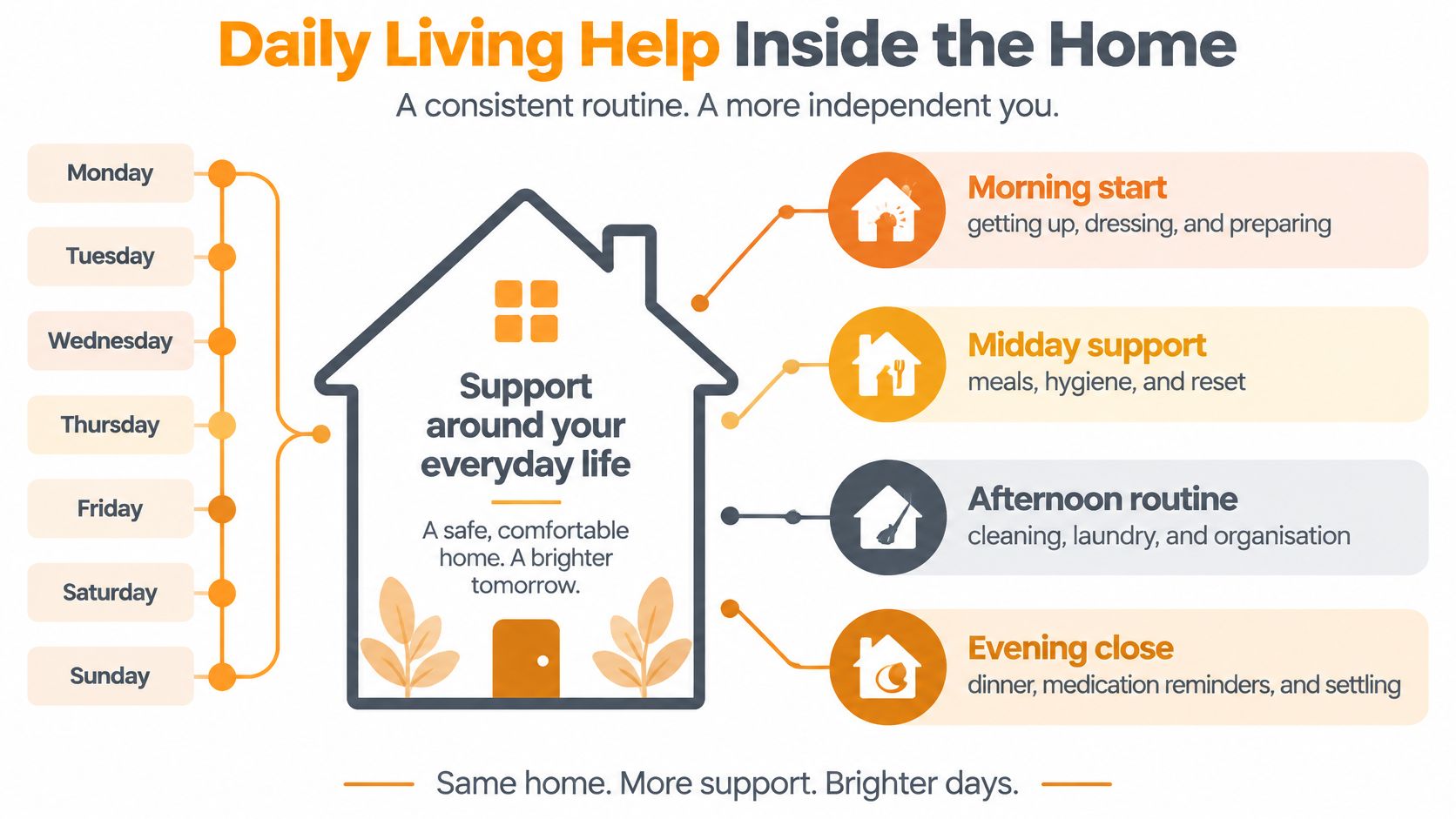
Home support works best as scaffolding around a routine, not a list of chores done to someone. The person keeps the decisions and the steps they want to do, while a worker assists where help is needed.
Say a participant wants to choose their clothes and wash their face independently, but needs assistance showering and fastening clothing. A useful morning plan makes those boundaries clear, rather than instructing the worker to get the person ready.
The daily sequence below shows where assistance can fit without taking over the whole day.
Keep doing and learning distinct
After dressing, breakfast might involve different kinds of assistance. A worker could prepare food, help the participant use kitchen equipment, or prompt a familiar sequence while the participant does the practical steps.
Those aren't interchangeable. If the aim is life skills development, allow space for practice rather than judging success only by how quickly breakfast reaches the table. A simple visual sequence, ingredients placed within reach and consistent prompts may be more useful than verbal instructions delivered all at once.
Our guide to building independence at home explores support that leaves room for the person's own skills. Independence doesn't have to mean doing everything without help; it can mean choosing when and how help happens.
Later in the day, household support might address laundry, bathroom cleaning and clear walking spaces. Our cleaning service provides regular assistance to keep the home clean, safe and comfortable, from a worker the participant knows. It isn't framed as an occasional spring clean.
Make the routine personal and safe
Meal preparation should reflect taste, cultural food preferences and health-team advice. If a clinician changes a food-texture recommendation, the meal instructions need updating before the next cooking shift, rather than relying on a message passed between relatives.
We arrange support for autism, intellectual disability, psychosocial disability, acquired brain injury, cerebral palsy, Down syndrome, genetic conditions, physical disability and complex needs. A disability not appearing on a public list isn't a reason to rule out a conversation about the person's actual support requirements.
For complex physical care, familiarity alone isn't enough. The worker needs the skills relevant to the task and a clear understanding of the person's care instructions; our workers hold the checks required for their roles, including the NDIS Worker Screening Check.
Before arranging home support, mark each morning task:
- Keep: What do you want to continue doing yourself?
- Practise: Which steps do you want help learning or maintaining?
- Delegate: What would you prefer a worker to do for you?
Community Participation That Survives a Missed Shift
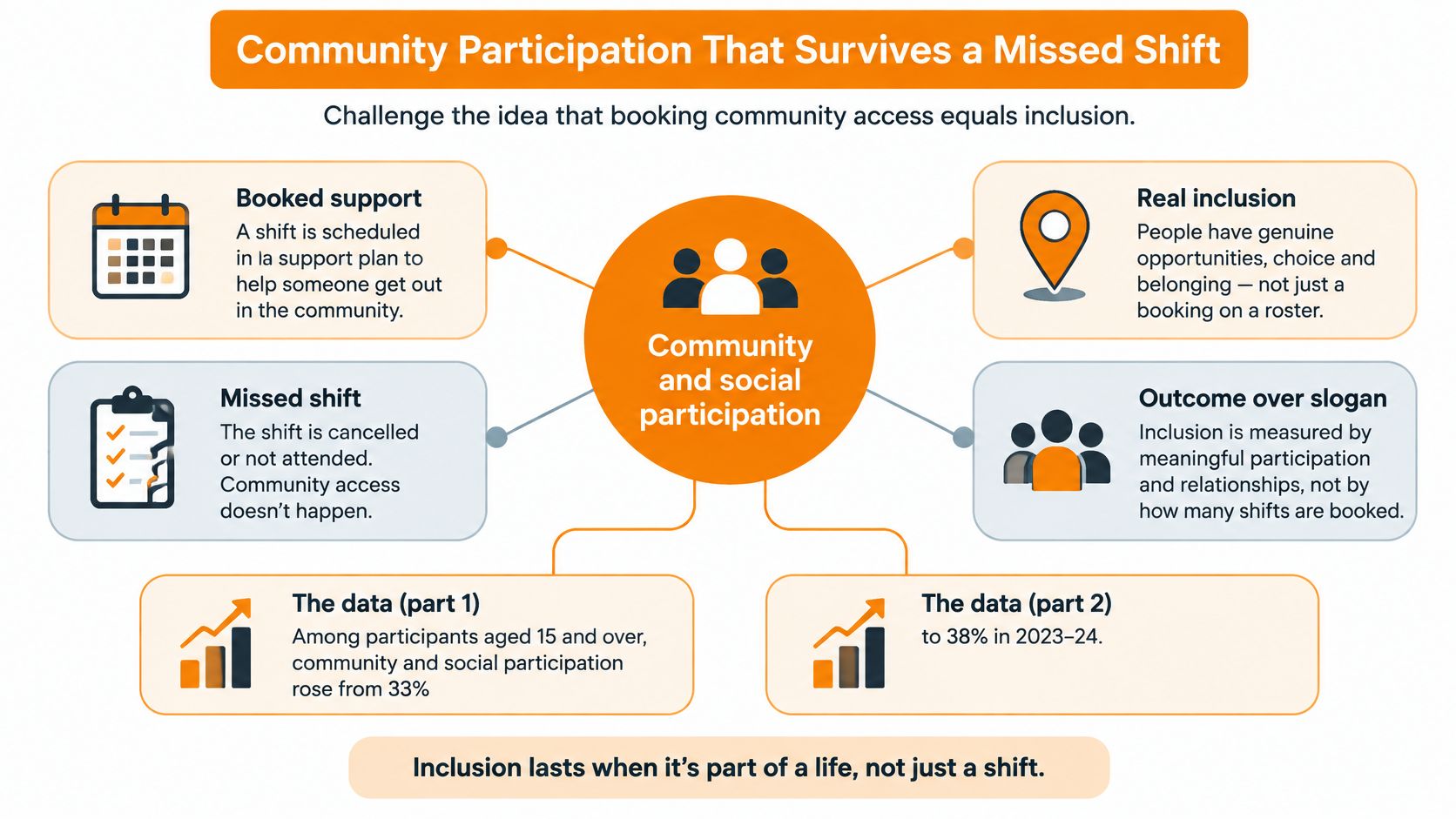
Among participants aged 15 and over, community and social participation rose from 33% at baseline to 41% at latest reassessment, a relative increase of 21%, according to the NDIS outcomes report. That's an encouraging outcome, but it doesn't tell a Melbourne family whether tomorrow's outing will happen if the usual worker is sick.
Booking community access isn't the same as being included. A participant may have funded hours yet miss an activity because transport wasn't arranged, the replacement worker doesn't understand their communication, or the venue is overwhelming.
The practical links between a booking and meaningful participation are shown below.
Build around commitments, not spare shifts
Start with the places that matter: a clinic appointment, TAFE class, work, a faith gathering, recreation or a family responsibility. Then organise assistance around the whole journey, including preparation, arrival and getting home.
For example, attending a library group may require more than a worker accompanying someone through the door. The participant might need a quieter arrival time, help greeting familiar people, an agreed place to pause and a clear departure cue.
A workable participation arrangement includes:
- A nearby worker: Someone whose journey makes the shift practical.
- A backup arrangement: A replacement who can access the necessary instructions and understands the participant's communication.
- A suitable venue: Check entrances, toilets, noise, seating and space to step away.
- An agreed transport arrangement: Identify the vehicle or public transport route and how the relevant costs will be covered.
Our community participation support can assist with activities and social outings. The destination should reflect the participant's interests, not where a worker usually takes people.
Check the whole journey
Victoria's workforce initiatives include training focused on complex physical needs, psychosocial disability and culturally considerate support for Aboriginal and Torres Strait Islander people. The practical lesson is to check skill, cultural safety and proximity, rather than treating every available worker as interchangeable.
Provider travel and kilometres are claimed under the NDIS Pricing Arrangements. Separate the worker's travel to deliver support from transport with the participant, and get the proposed charges explained before agreeing to the outing.
Changing workers shouldn't require abandoning a valued activity. Record the route, communication preferences and what helps if the participant becomes uncomfortable.
Before relying on a recurring outing, establish who comes when the regular worker is away, and whether that person already knows the routine.
Matching Workers to Language Culture and Routine
Victoria's active NDIS participants included 21,663 culturally and linguistically diverse participants, or 11.2%, and 7,015 First Nations participants, or 3.6%, at 31 March 2025, according to the Victorian NDIS quarterly report. These are statewide figures, but they make cultural responsiveness a practical consideration for Melbourne services, not an optional extra.
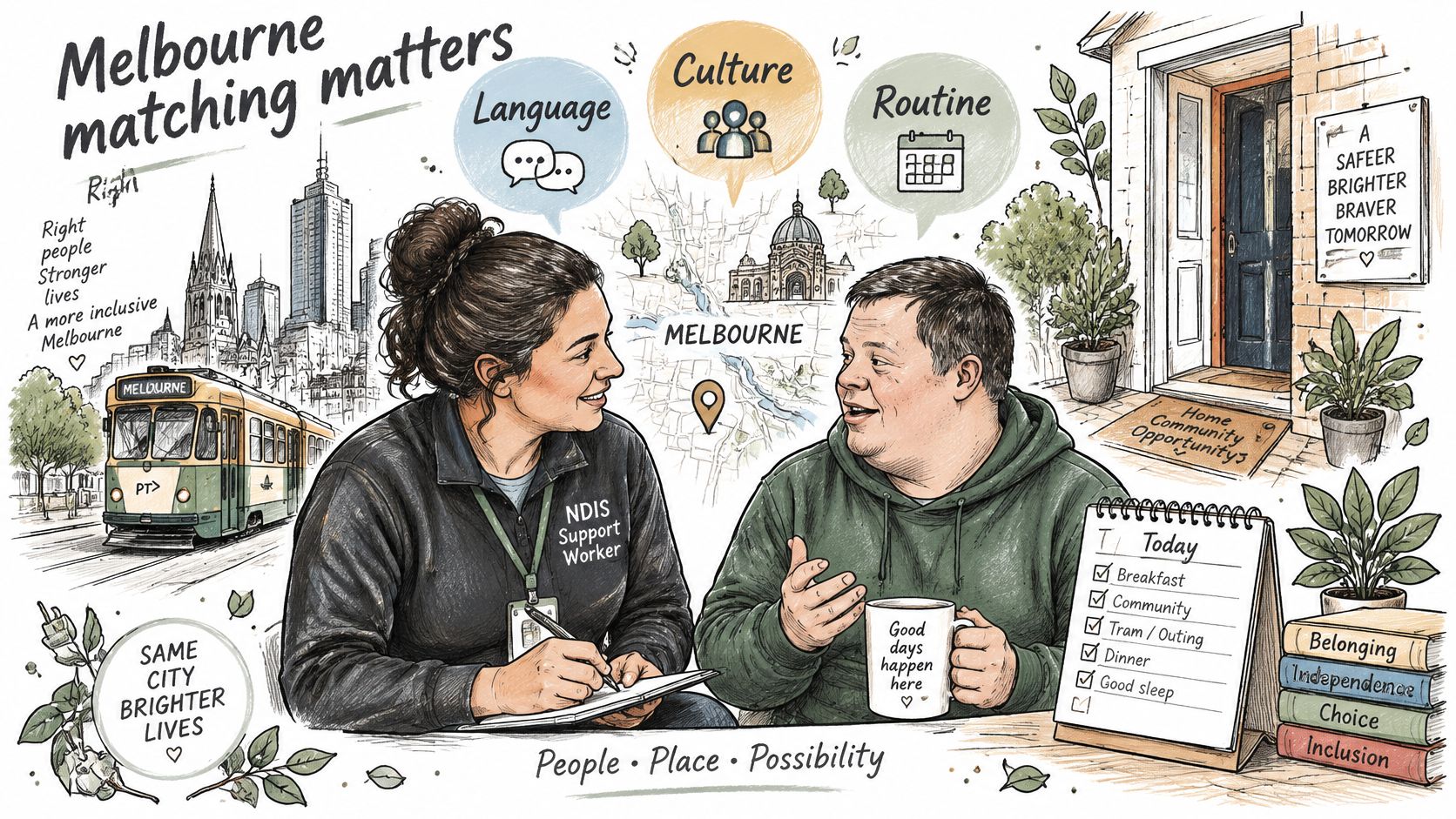
A useful introductory conversation gives the participant room to explain preferences in their own way.
Write the matching brief before reading profiles
Language is a starting point, not the whole match. Religious practices, food preparation, family roles, communication style and shared interests can all affect whether support feels comfortable.
Before looking at profiles, record:
- Communication needs: Preferred spoken language, communication aids and how the person expresses discomfort.
- Cultural priorities: Faith observances, food requirements, privacy preferences and relevant household customs.
- Personal interests: Choose a couple of genuine interests that could support an easy conversation or shared activity.
Our team includes workers from more than 30 cultural and minority backgrounds, with Burmese-speaking, Chinese-speaking and Korean-speaking support among the options. We match language, culture and personality rather than using the task list alone.
One family's feedback gives a concrete example: “Great service. Sam from Enrichment Care was able to match us with a Korean-speaking disability support worker, who has helped my daughter with Angelman syndrome.” That account illustrates a language match; it doesn't establish that every person with the same condition needs the same approach.
Meet before services start
We provide shortlisted profiles so participants can choose whom they'd like to meet. The introductory meeting happens before services begin, and another worker can be considered if the first match isn't right.
Use that meeting to notice how the worker communicates. Do they address the participant directly, allow time for a response and check preferences rather than making assumptions based on cultural background?
The video below provides another way to explore support and matching.
Our approach to culturally appropriate disability support includes consistent rostering, regular check-ins and the option to request a different worker when needs or preferences change. A good first meeting is the beginning of checking fit, not the end.
For Melbourne participants, we recruit and match workers who live nearby. A city office address tells you little about whether the person arriving at your door can reliably work your preferred routine.
A Week of Support Across Melbourne Routines
The following composite scenarios are illustrations, not actual participant histories. They show how similar services can be arranged differently without assuming that a diagnosis determines someone's week.
An inner-Melbourne family is organising support for their daughter, who has Angelman syndrome. An adult with psychosocial disability in an outer suburb is building a routine around appointments, shopping and reconnecting with a local interest.
Different weeks, different priorities
| Part of the week | Inner-Melbourne family | Adult in an outer suburb |
|---|---|---|
| Morning routine | Personal care with a familiar Korean-speaking worker | A predictable start, including prompts and preparation for the day |
| Community activity | A familiar, quieter activity during an afternoon | A local interest group with time to arrive without rushing |
| Appointment | Travel assistance for a therapy visit | An appointment combined with nearby errands |
| Home environment | A separate cleaning block | Household tasks included in a planned home visit |
| Everyday practice | Cooking a simple meal together | Preparing a shopping list and practising a manageable meal |
| Continuity | A second familiar worker prepared for an absence | A nearby worker and a clearly documented replacement routine |
For the family, separating cleaning from the outing protects time for their daughter's activity. Keeping cooking as practice also prevents a well-intentioned worker from taking over every meal.
For the adult in the outer suburb, fewer, longer shifts may suit better than scattered short visits. That arrangement needs to reflect their energy and preferences, but it can leave enough time to complete a journey and settle back at home without rushing.
We match culturally diverse participants with local workers across every Australian state and territory. For either Melbourne scenario, the useful detail is where the worker lives relative to the participant's routine.
Change the arrangement when life changes
A new health recommendation about meals would require updated cooking instructions in the family's week. A request for another worker would require an agreed handover, while a move to another suburb would mean checking routes, local activities and worker proximity again.
The adult might find that combining appointments and shopping is tiring rather than helpful. In that case, the arrangement should change instead of treating the original timetable as a test they must pass.
Planning exercise: Sketch your own week and circle the single gap most likely to break it. That might be an uncovered morning, an unclear transport charge or an outing that relies entirely on one worker.
Start With a Worker Who Fits Your Plan
The next decision is a specific support arrangement, not a commitment to fill every available hour. Identify whether you need personal care, life skills practice, cleaning, meal preparation, community participation, travel assistance or a combination.
Write down the days that must stay consistent and the language or cultural preferences that should shape the match. Then give the money tasks an owner before the first shift, including checking invoices and monitoring the remaining budget.
Bring a week, not just a request for hours
Have these details ready for an initial conversation:
- Your written week: Include home tasks, destinations and where assistance starts and finishes.
- Your matching needs: Note language, faith, food, communication and personal preferences.
- Your must-keep days: Identify commitments that can't easily move, such as work or an appointment.
During the conversation, describe the routine and clarify which plan line would fund each part. We can arrange shortlisted profiles and a meeting before services start, with supports and costs documented in the service agreement.
You can contact our team on 1300 543 123. Feedback or a complaint can also go to that number or admin@enrichmentcare.com.au, so keep those details with your support paperwork.
Confirm funding before committing
If you're unsure whether you can access the Scheme, don't book ongoing support you haven't established how to fund. Use the eligibility checker as a starting point, then speak with a local area coordinator or the NDIA about your circumstances.
You don't need a perfect timetable before making contact. You do need a clear account of what matters to you, where assistance would help and which decisions you want to keep making yourself.
Enrichment Care offers Melbourne disability support for daily living, community participation and transport, matched to participants' needs, language, culture and routines. Visit Enrichment Care or call 1300 543 123 with your written week, matching preferences and must-keep days to discuss suitable worker profiles and an introductory meeting.