NDIS for ADHD: Eligibility and Evidence
See whether NDIS for ADHD applies: access tests, functional evidence and the supports a plan can fund.
ADHD does not automatically qualify a person for the NDIS; access depends on a permanent functional impairment and a likely lifetime need for support, not the diagnosis. The important question is not whether you have ADHD, but what you cannot reliably do without disability-specific assistance.
Advice to just submit a diagnosis letter misses that distinction. A stronger application connects an impairment, such as executive dysfunction, to ordinary tasks, the help those tasks require, and why that need is expected to continue. When other disabilities are involved, the file also needs to explain which impairment disrupts daily life most and how ADHD adds to the difficulty.
Whether ADHD Meets the NDIS Tests
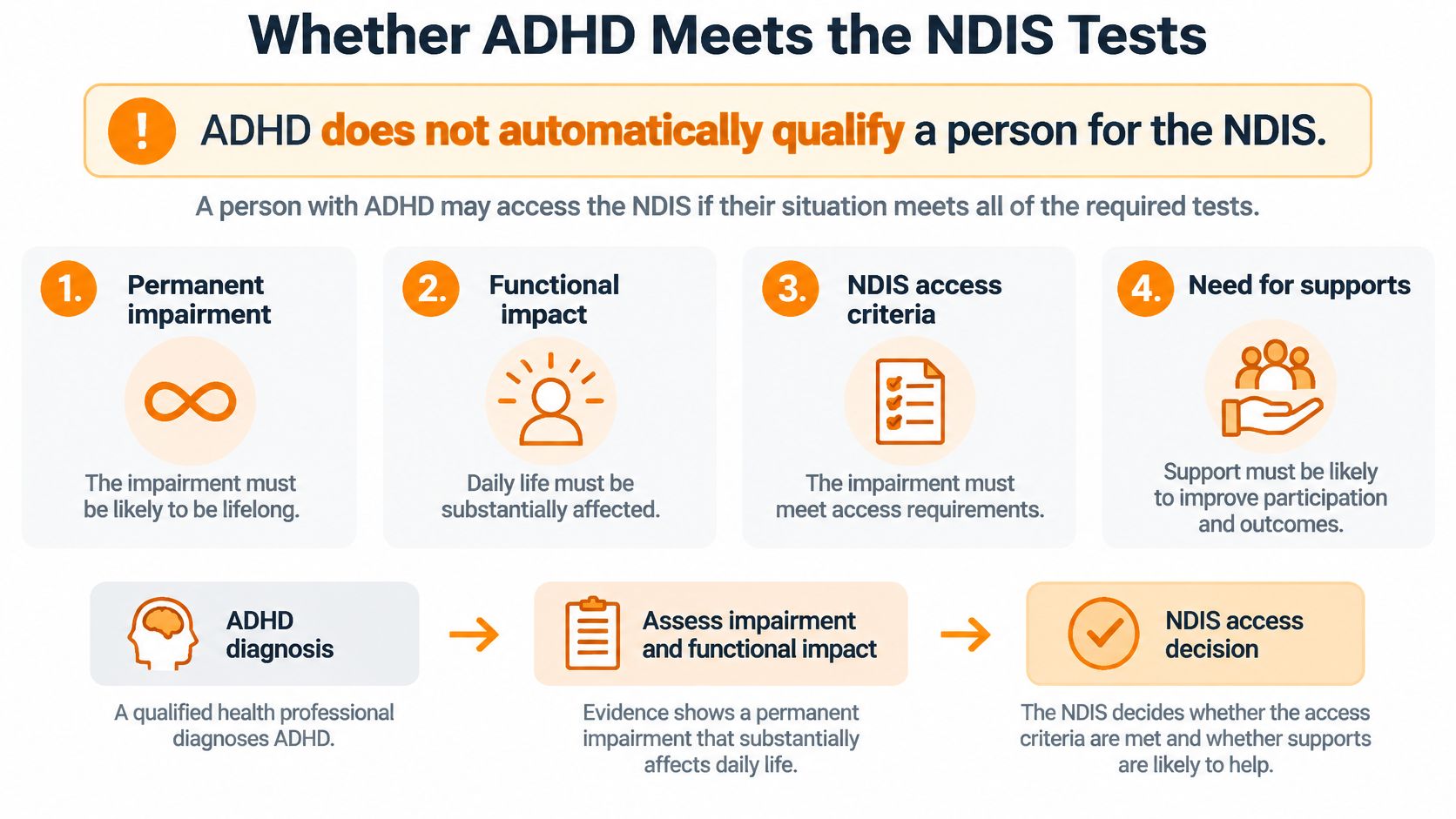
NDIS for ADHD is an impairment-based pathway, not a diagnosis-based entitlement. The disability requirements concern permanence, functional capacity, participation and ongoing support need, as set out in the NDIS access guidance.
A diagnosis can explain why someone struggles. It doesn't, by itself, establish how substantially those struggles affect everyday functioning. Equally, a recent diagnosis doesn't mean the impairment is recent, but the evidence needs to establish its history.
NDIS access tests applied to ADHD
| Access test | What must be shown | Example that falls short |
|---|---|---|
| Permanent impairment | Impairment is permanent or likely to be permanent | A recent diagnosis with no history of lasting impact |
| Substantially reduced capacity | Substantial reduction in at least one of six domains | Traits that do not change how everyday tasks are done |
| Social or economic participation | Impairment affects social or economic participation | Difficulty described only inside clinic sessions |
| Lifetime NDIS support | Likely to need NDIS supports across the lifetime | A time-limited treatment plan with no ongoing assistance |
The distinction matters when choosing examples. Occasional lateness says little about disability-related assistance. A documented pattern of being unable to organise departure, despite adjustments and treatment, gives a clinician something more useful to assess.
The visual below provides an overview. Use the table's wording when organising evidence against the disability requirements.
Common doesn't mean automatically eligible
The Australian Institute of Health and Welfare overview reports that approximately 315,000 Australians aged 4–17, or 7.4% of that age group, experienced ADHD in the 2017 national survey. That establishes a substantial population-health issue, not an individual entitlement.
For your own file, identify the area where assistance matters most: managing yourself, communicating, learning, participating socially or completing daily living tasks. Start with that area rather than collecting another report that repeats the diagnostic label.
You can use the NDIS eligibility checker as an initial organising prompt, not an access decision. Before gathering more paperwork, write down the single daily task that's hardest without help.
Six Domains Where ADHD Changes Daily Life
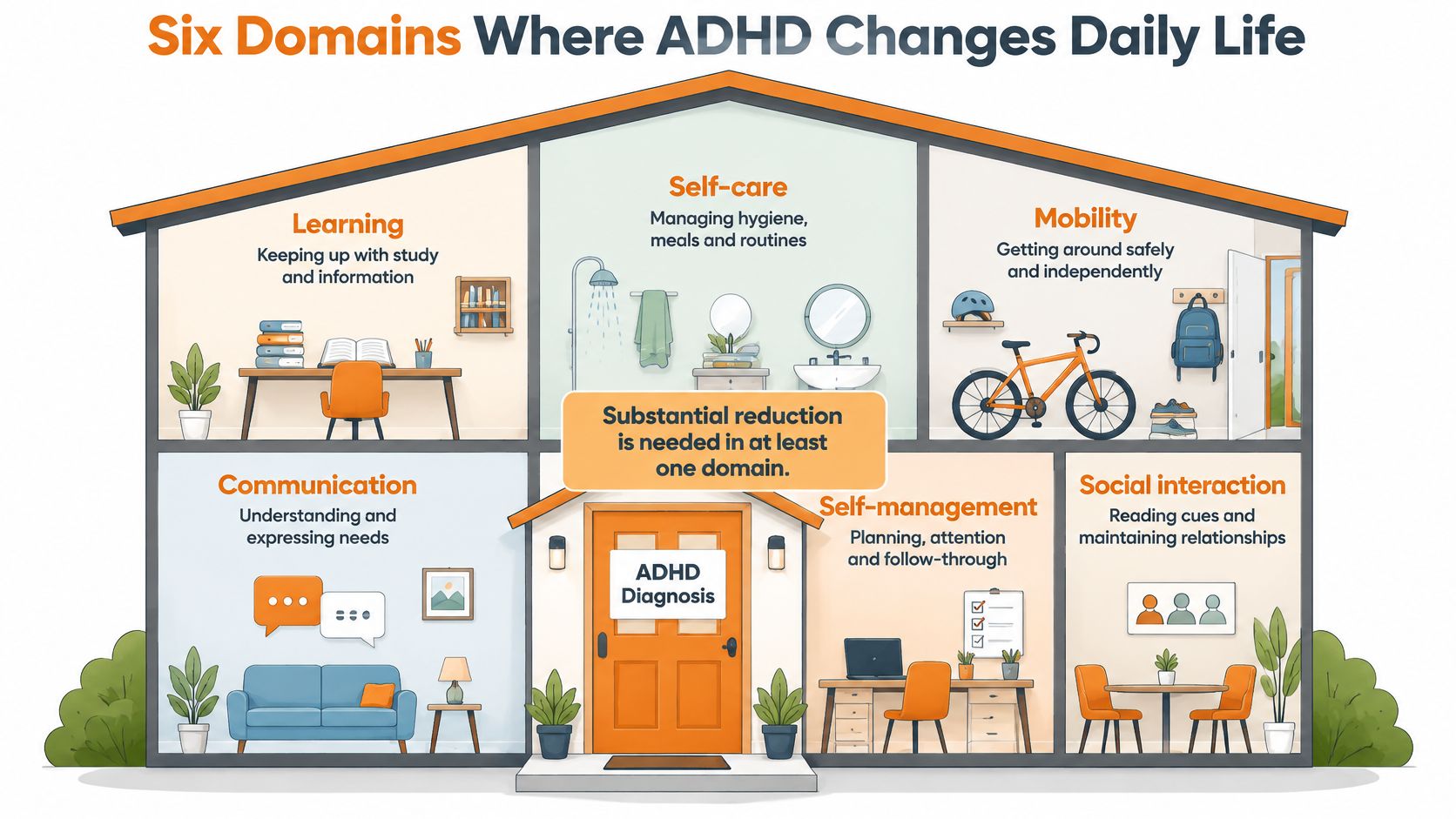
Think of the diagnosis as the name on the front door. The functional domains are the rooms where the NDIA needs to understand what happens.
The NDIS disability requirements identify six activity domains and require substantially reduced capacity in at least one, not all six. The assessment concerns everyday function without disability-specific support, rather than a list of symptoms or an unusually difficult week.
This diagram shows the domains as parts of ordinary life.
ADHD functional domains and evidence to collect
These examples are prompts for observation, not assumptions about everyone with ADHD.
| Domain | Everyday difficulty | Evidence to collect |
|---|---|---|
| Learning | Cannot start, sequence or finish study or a new skill | Incomplete tasks across school, study or work despite adjustments |
| Communication | Loses multi-step instructions and cannot explain needs | Observations from home and community, not one clinic visit |
| Social interaction | Relationships and group activities break down | Records of withdrawal or impulsivity across settings over time |
| Self-management | Appointments, money, medication timing and time management break down | Missed appointments, unpaid bills and unsafe gaps in routines |
| Self-care | Personal care and meals do not start without prompts | Carer notes on hygiene, dressing and eating sequences |
| Mobility | Difficulty getting to places safely, including planned travel | Documented travel risks linked to inattention, rather than an assumed walking impairment |
Make the observations credible
Learning and self-management can provide clear examples when executive dysfunction interrupts tasks across different settings. A person might understand an assignment yet be unable to organise the steps, or know a bill is due but depend on someone else to initiate payment. Record what assistance changes the outcome, not just whether the task was eventually completed.
Communication and social interaction need equally careful description. Interrupting occasionally isn't the same as being unable to sustain a necessary conversation or participate in a group without assistance. Include observations from people who know the person at home and in the community, rather than relying entirely on behaviour during a clinic appointment.
For self-care, identify where the sequence stops. Does the person recognise that a shower is needed but never begin, or start dressing and become unable to finish without repeated redirection? Carer notes should distinguish a reminder from sustained supervision.
Describe the task that stops, the assistance that restarts it, and what happens when that assistance isn't available.
Treat mobility cautiously. Don't turn missed appointments into a claim about physical walking ability. Include this domain only when the evidence explains an actual limitation in getting around safely and independently, such as a documented travel risk.
For another explanation alongside your written notes, the following video may be useful.
Choose the domains with the strongest records. A focused account of persistent difficulty is more useful than trying to fit every ADHD trait into every category.
Building Functional Capacity Evidence
An evidence pack should explain a person's functioning, not merely contain a stack of reports. Give each document a job: establish the impairment, describe its practical effects, or explain the assistance required.
Start with a simple activity diary alongside existing clinical reports, school observations, appointment records and carer notes. Record ordinary days as well as harder days, so the professional reviewing them can distinguish an ongoing limitation from an isolated event.
Build the account in a practical order
Name the impairment in functional language. Instead of writing only ADHD, identify the relevant difficulty, such as executive dysfunction, working-memory limitations, impulsivity or emotional dysregulation. Ask the treating professional to explain permanence and the expected course after appropriate treatment.
Show the pattern across settings. For a person who can't sequence tasks, collect examples from getting ready at home, completing a study activity and preparing to leave a community venue. Include the periods between episodes of greater difficulty.
Explain what treatment has and hasn't changed. List treatments and adjustments tried, their outcomes, and the task limitations that remain. For example, improved attention during an appointment may coexist with continuing difficulty initiating meals at home.
Describe a typical unsupported day. Identify who currently starts the morning routine, checks household safety, organises appointments and helps with money. Don't describe a supported day as independent because a family member's assistance has become familiar.
Specify frequency and intensity. Daily verbal prompting to begin showering describes a different need from someone remaining present throughout the routine. State the actual assistance rather than using a broad phrase such as needs support.
Ask an appropriately qualified professional to interpret the evidence. A functional capacity assessment can help, but it isn't mandatory. The important outcome is a clear professional account linking impairment, observed limitations and expected assistance.
Use this checklist to organise the documents before seeking a report.
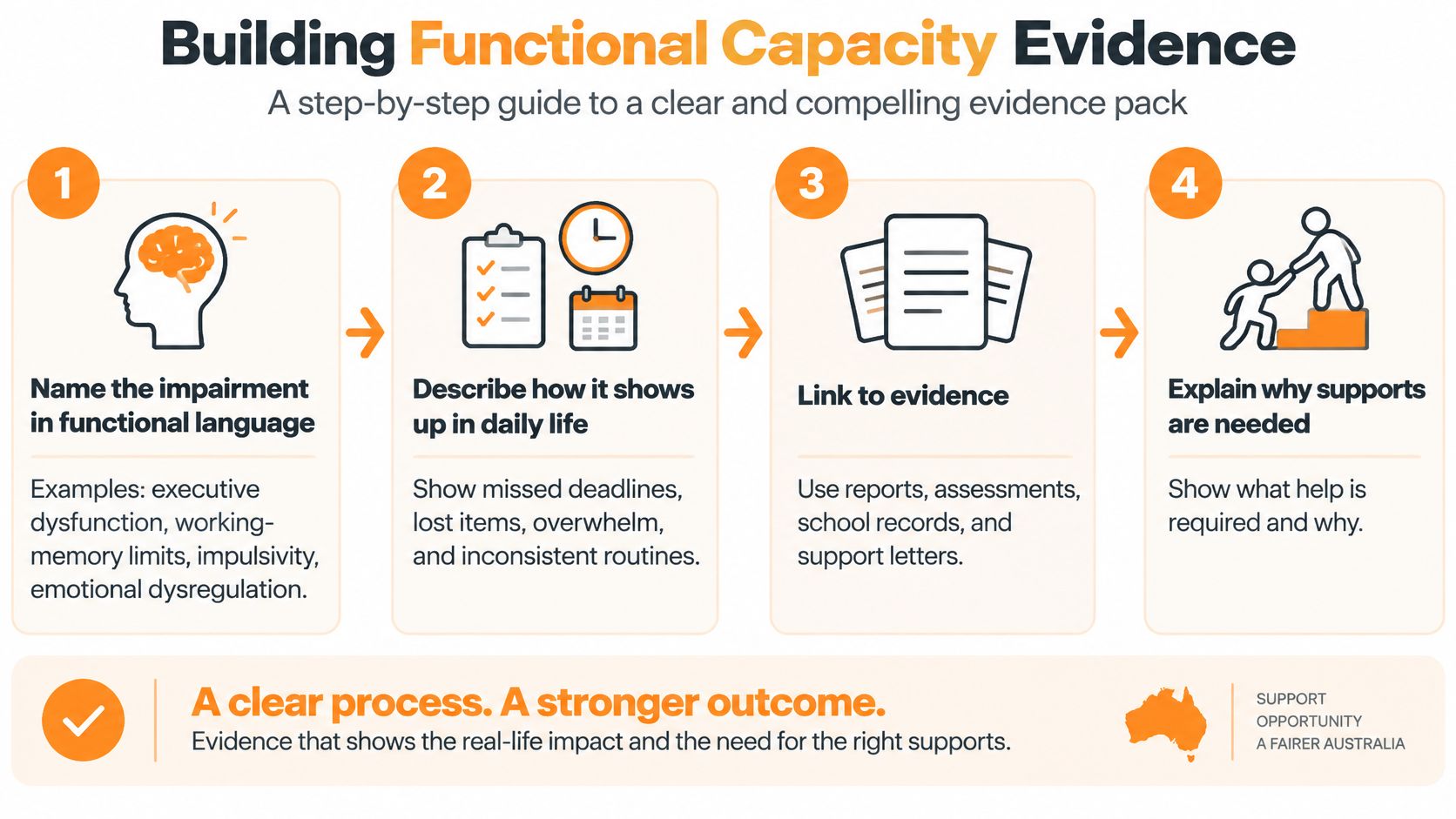
Check whether each sentence explains function
Test a draft against task, unsupported baseline, setting, assistance and consequence. If a sentence leaves out an element, ask whether the reader can still understand the actual support need.
For example, replace struggles with organisation with a concrete account: at home, the person doesn't begin preparing an evening meal without a carer laying out the sequence and prompting the first action; when that help is unavailable, the meal is missed. Use this wording only when it accurately describes the person.
Evidence check: A short, specific account of an ordinary week is more useful than a long list of traits without consequences.
Don't withdraw necessary assistance to demonstrate a problem. Describe existing observations and let the professional assess what they mean.
Lodging the Access Request
Once the evidence is organised, the access request should present a coherent account that the National Disability Insurance Agency can assess. Keep copies of what you submit, including attachments, so you can answer follow-up questions consistently.
Check age and residency requirements before spending more time on reports. A persuasive functional account doesn't replace the other access requirements, and a provider can't make the access decision.
Turn the evidence into an application
Confirm the basic requirements. Gather the identity and residency documents relevant to the application. Check the applicable entry requirements rather than assuming a diagnosis is enough.
Select the strongest functional evidence. Include the clinical explanation and observations that show the most significant limitations. Label attachments clearly, such as treating clinician report or home routine observations.
Complete the access request. The person applying, or someone authorised to act for them, should include the diagnosis documentation and the worked account of daily life. Keep descriptions consistent across the form and attachments.
Respond precisely to information requests. If the NDIA asks about a gap, answer that gap with observations, dates and relevant professional clarification. Sending the same diagnosis letter again won't explain a missing functional detail.
Prepare for planning if access is approved. Translate the documented needs into tasks, goals and the assistance being requested. Approval to enter the scheme doesn't mean every proposed support will be funded.
The guide to applying for the NDIS can help you organise the application process alongside your evidence pack.
Make the request accessible
For children, parents and carers are central sources of information about family routines. School observations can add context, but the account should also explain functioning outside the classroom and distinguish disability-related help from ordinary age-appropriate care.
Use plain language, and request accessible communication or interpreting assistance when needed. A family shouldn't have to turn everyday observations into technical language before discussing them with a professional.
If access is declined, read the reasons before deciding what to do. Identify whether the issue is a missing requirement, insufficient evidence or a disagreement with the assessment, then seek advice about available review options rather than resubmitting the same material.
ADHD Beside Another Primary Disability
Most participants with ADHD recorded in the cited NDIA snapshot had another primary disability. The NDIA budget-estimates document reported 10,080 participants with ADHD, including 1,090 with ADHD as their primary disability and 8,990 with it as a non-primary disability.
That distinction changes how families should approach the paperwork. The task isn't to choose whichever diagnosis sounds most likely to secure funding. It's to identify the impairment with the greatest effect on ordinary life, then explain the contribution of the other impairments.
What the participant counts do and don't tell you
The Australian Parliament's ADHD inquiry chapter separately reported 4,864 participants listing ADHD as a primary or secondary condition at 31 March 2023, with 188 primary and 4,676 secondary.
These are administrative snapshots from different reporting periods. Don't add them together, interpret them as a count of all Australians with ADHD, or use them to predict an individual applicant's chances.
The useful finding is narrower: ADHD-related needs can be relevant within the scheme even when ADHD isn't the primary disability recorded. An existing primary disability doesn't make the effects of ADHD irrelevant to understanding a person's daily assistance.
Describe the interaction rather than adding labels
Consider these hypothetical situations:
- Psychosocial disability and executive dysfunction. A person experiences significant anxiety alongside ADHD. Their report should distinguish avoidance from difficulty initiating medication routines or organising bills, then explain how these interact and what assistance remains necessary.
- Autism and ADHD. A person needs predictability to attend a community activity but also loses track of the departure sequence. Describe what a familiar worker does before and during the outing, rather than assuming the paired diagnoses explain the support.
- A child's morning routine. A parent can describe where dressing, eating and leaving home repeatedly stop. If a standard written account is difficult to produce, those observations can be discussed with a professional using accessible or translated communication.
For culturally and linguistically diverse families, preserve the meaning of the observation. Clarify who provided the help, what the child or adult did, and which part required intervention; don't let a language barrier turn a detailed account into a vague statement about dependence.
Listing additional diagnoses doesn't create an entitlement. Name the greatest functional effect first, then describe how the impairments interact. That gives the assessor a clearer picture than separate reports that never explain the person's combined needs.
Supports That Build Everyday Participation
Say an adult's goal is to leave home ready for a regular community activity. The difficulty begins before the outing: personal care doesn't start, breakfast is left unfinished and departure preparations become overwhelming.
A useful support description names those tasks and the worker's role. The NDIS functional capacity guidance supports an individualised account of ordinary functioning over time, including assistance needs between periods of greater difficulty. Frame the proposed help around daily living and participation, not treatment of core ADHD symptoms.
Everyday ADHD supports and how to measure them
| Support activity | Functional gap | Progress measure |
|---|---|---|
| Visual schedule for the morning routine | Cannot initiate or sequence self-care | Share of steps completed without prompts |
| Meal preparation broken into steps | Cooking is unsafe or left unfinished | Safely completed steps each week |
| Regular cleaning routine | Home becomes unsafe without prompting | Tasks finished on the agreed cycle |
| Travel planning to appointments | Time blindness causes missed commitments | On-time arrivals per month |
| Community activity with fading prompts | Cannot participate independently | Outings completed as prompts reduce |
During the morning routine, a worker might help the participant check a visual schedule, identify the next action and begin it. The progress note should distinguish between independently checking the schedule and following repeated spoken directions.
For meal preparation, the participant might practise arranging ingredients, following a written sequence and checking that appliances are off. Cleaning support could follow a predictable task list, while travel practice could involve preparing belongings, checking the route and recognising the departure cue.
Measure useful change without promising independence
A good progress note records the task, the unsupported baseline, the setting, the assistance and the result. It should also explain when extra help was needed, rather than recording only successful days.
For the community outing, describe whether the participant joined the activity, what the worker did and whether prompts could safely be reduced. Don't treat attendance alone as proof of independent participation, and don't assume every participant's assistance needs will steadily decrease.
The goal is to make the prompt smaller where possible, not to remove help before the person can safely manage.
These examples concern disability-related assistance, not medication or psychiatric treatment. They also aren't a claim that having ADHD justifies a particular allocation of hours. Funded hours need a task-based purpose, such as sequencing self-care, keeping the home usable or reaching community activities, rather than a general promise to improve concentration.
For children, work within family routines and the child's health-team advice, with parents remaining central. Adults should connect proposed assistance to the limitations documented in their own evidence, not copy another participant's weekly roster.
When planning skill development, the capacity-building funding guide can help frame questions about goals. Check the actual plan and support arrangements before assuming an activity belongs in a particular budget.
Decide Your Next Access or Support Step
Choose between building an access case and arranging support that's already funded. They're different decisions, and booking a worker won't resolve an unanswered eligibility question.
Use your worked account of daily life to identify which path fits. The next action should address the missing requirement or the documented task, not produce more paperwork.
If access isn't yet established
Check whether the evidence addresses permanence, substantial functional limitation, participation and ongoing assistance. If it doesn't, ask the relevant professional what remains unclear rather than requesting a stronger-sounding letter.
Mainstream health care, school learning support or relevant state services may be appropriate while you clarify needs. Seeking those options isn't an admission that the difficulties are minor; it's a way to pursue help without relying on an uncertain NDIS outcome.
If you already have an approved plan
Match the proposed service to the daily task and available funding. Enrichment Care provides core supports across Australia, including personal care, community participation, life skills development, cleaning, meal preparation, and travel and transport.
To use NDIS funding with us, you need an NDIS plan. You don't need a particular diagnosis from our list of disabilities, and our service agreement sets out the supports and costs before delivery.
Use the planning image as a prompt to bring the practical documents and the people who know the routine together.
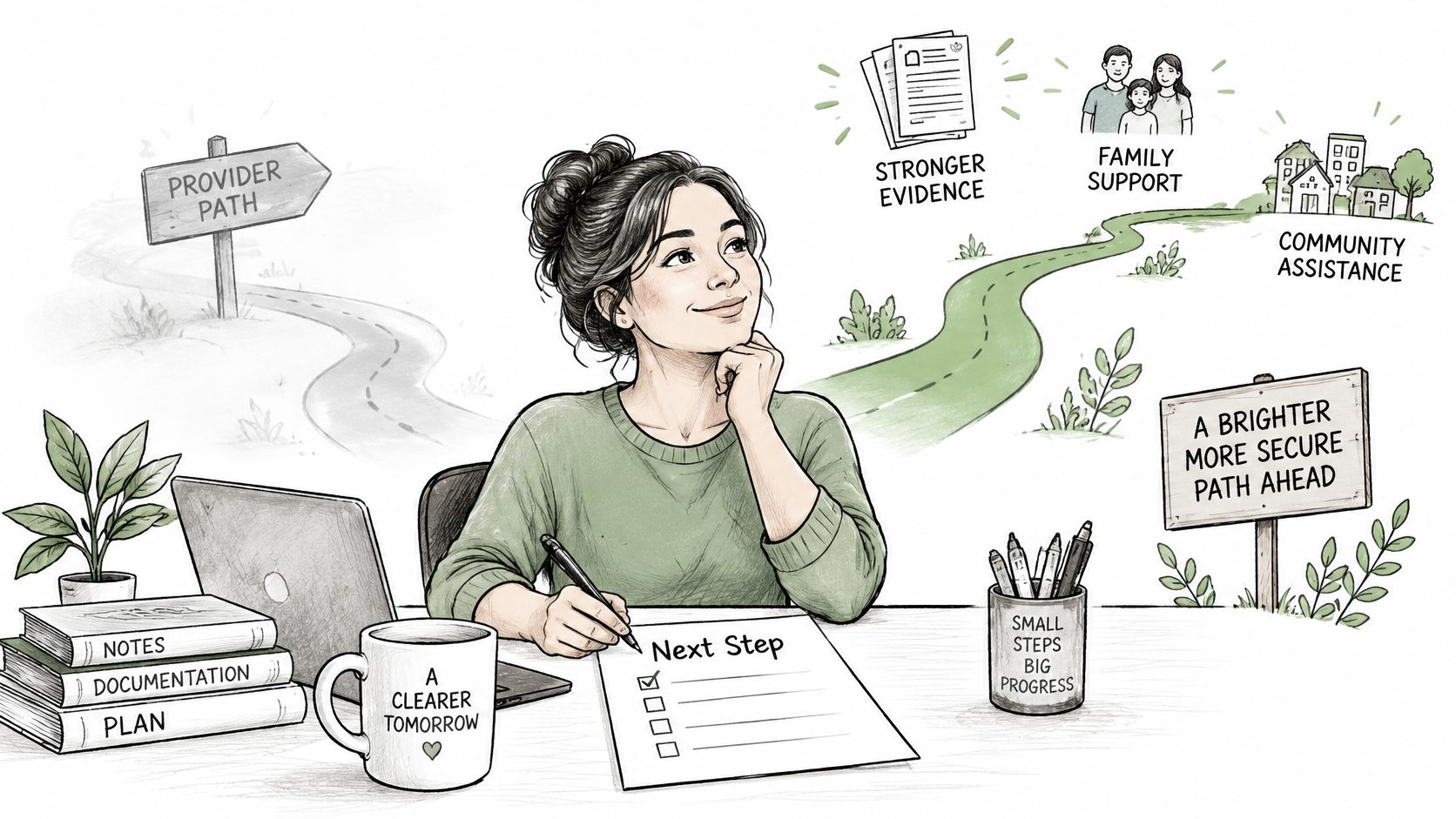
Before making contact, complete these actions:
- Write the hardest task. State what the person can't reliably complete without prompting or assistance.
- Name someone who knows it well. Identify the professional or carer who has observed that task over time.
- Choose the next document. Decide whether you need an access request supported by evidence or a service agreement for assistance your plan can fund.
That choice keeps the next conversation specific: either what must be established for access, or what a worker needs to do.
Enrichment Care offers practical daily living and community support matched to participants' needs, language, culture and routines. If you have an approved plan and need help with tasks affected by ADHD-related impairment, visit Enrichment Care to discuss the assistance you need and the arrangements before services begin.