NDIS Home Care Providers: Fit, Match and Cost
See how NDIS home care providers differ on support type, worker match and 2026-27 limits, then check hours before you sign.

The most popular advice is to find a few NDIS home care providers, compare their websites, and pick the one you like. That's the wrong finish line. A directory gives you names, not morning showers covered, cleaning done, or a worker who turns up when your regular worker is sick. Start there if you want, but don't stop there. Pick the provider type that fits your life first, then test whether it can roster the hours, match the worker, and stay within your plan.
What an NDIS Home Care Provider Is
Say you find a provider online on Monday. By Friday you still don't know who'll help you shower, whether Tuesday cleaning is available, or who covers a sick day. You've found a name, not support yet.
An NDIS home care provider is the organisation or worker arrangement that delivers everyday core supports in your home and community, paid from an approved NDIS plan. It's not a private aged-care package that you buy off the shelf. Think of it more like choosing a regular household teammate who needs to fit your tasks, timing, language, and backup needs.
The usual bundle includes personal care, household tasks, meals, life skills, community participation, and travel to appointments and activities. The provider turns that list into people, times, and a roster.
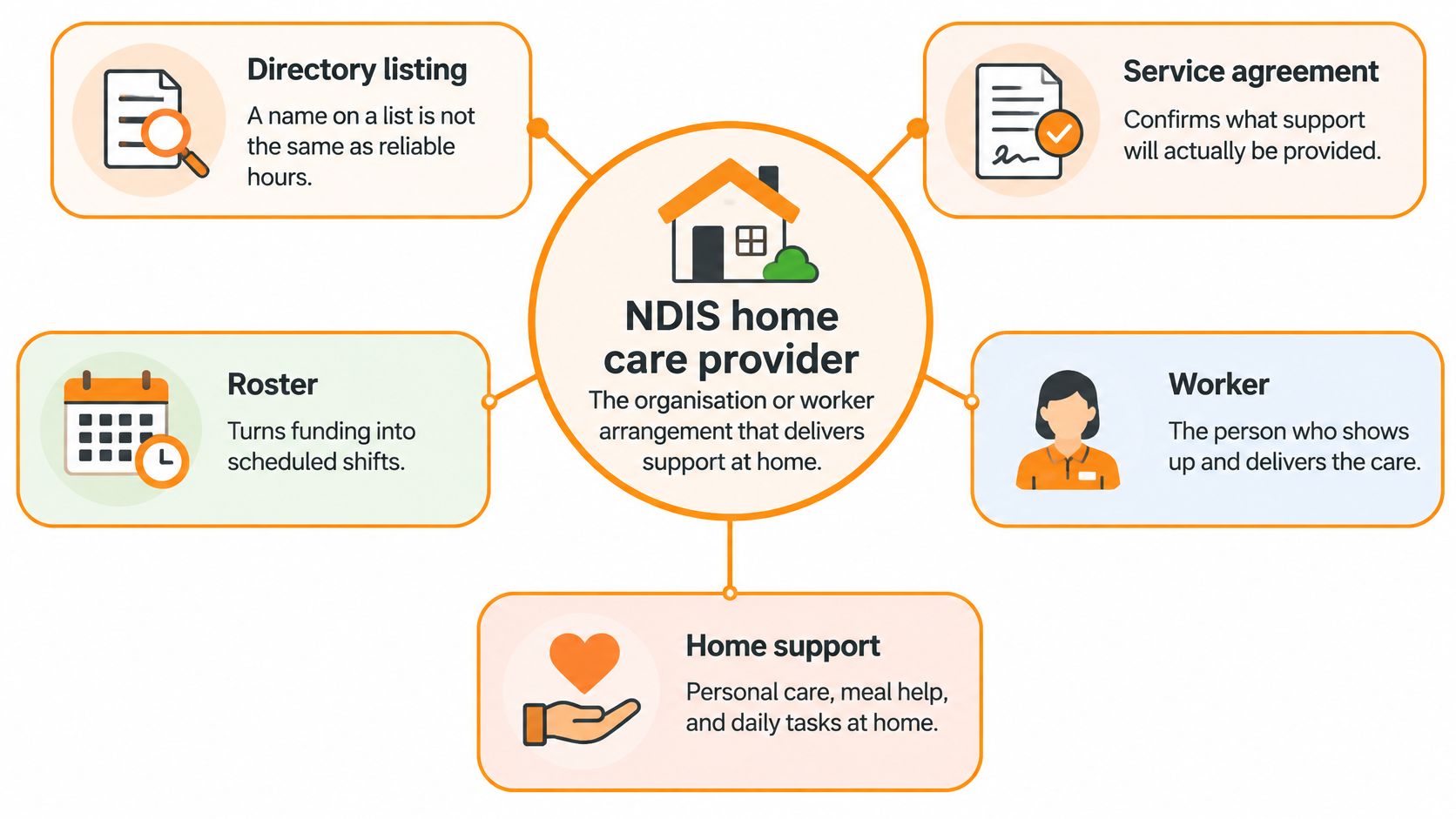
Registration and delivery aren't the same thing. The NDIS data platform context includes Commission figures of 26,282 registered providers and 17,464 active providers in the second quarter of 2025-26, up 5% and 4% respectively. Registration means regulatory approval. Active status better shows who's currently delivering supports, so check that before you trust a listing.
Types of NDIS Home Care Providers
You'll meet different provider models, and each one changes your hours, backup, and paperwork. Compare them side by side before you talk about price.
| Provider type | How it operates | Best fit | Check before signing |
|---|---|---|---|
| Registered agency | Employs rostered workers under NDIS Practice Standards | Participants needing backup cover and set rosters | Named backup worker and complaints path |
| Sole trader or unregistered worker | One primary worker, often self-employed | Stable, lower-complexity supports with a known worker | Who covers leave and illness |
| Self-managed arrangement | Participant pays the provider directly from the plan | Participants who want direct control of invoices | Written prices and records of each claim |
| Plan-managed arrangement | Plan manager processes provider invoices | Participants who want administrative support | Rates and claim process agreed with the plan manager |
A registered agency employs rostered workers, must meet the NDIS Practice Standards, and runs documented systems for complaints, incidents, and workforce disruption. That structure suits you if a missed shift would leave you unsafe or stuck at home.
A sole trader can feel simpler. You get one primary worker and often more flexibility on timing, but there's no automatic second person. Ask directly who covers leave and illness, because the answer decides whether your week holds together.
Payment arrangements sit beside the provider type. With NDIS-managed supports, the agency pays the provider directly. With plan-managed supports, a plan manager processes invoices. With self-managed supports, you pay and keep records. They all draw on the same plan budget and price limits, so your choice changes admin and control, not the hourly cap. Circle the type that matches the hours you need.
Support Types and 2026-27 Hourly Limits
The support type sets the price limit, while the time of day can change it. The figures below are national limits for a standard weekday daytime hour, not prices every provider must charge.
| Support | What it covers | 2026-27 weekday daytime limit | How it is funded |
|---|---|---|---|
| Personal care | Everyday routines at home with a chosen worker | $73.58 an hour | Assistance with Daily Life |
| Community participation | Activities and social outings | $73.58 an hour | Plan category matching the support |
| Life skills development | Practising everyday tasks toward independence | $73.58 an hour | Plan category matching the support |
| Meal preparation | Preparing meals to suit your tastes, culture and health advice | $73.58 an hour | Usually Assistance with Daily Life |
| House cleaning and laundry | Regular cleaning to keep the home safe and comfortable | $61.16 an hour | Assistance with Daily Life |
| Travel and transport | Getting to appointments, activities, work, study and friends | Claimed under NDIS Pricing Arrangements | Provider travel and kilometres |
How to read the rows
Personal care supports everyday routines at home, such as showering, dressing and getting ready for the day. Its 2026-27 standard weekday daytime limit is $73.58 an hour.
Community participation helps you attend activities and social outings, such as a class or a catch-up with friends. The standard weekday daytime limit is also $73.58 an hour.
Life skills development involves practising tasks to build independence, such as making lunch, using a shopping list or taking a familiar bus route. Its 2026-27 standard weekday daytime limit is $73.58 an hour.
Meal preparation means a worker helps prepare food that suits your tastes, culture and health advice. Culturally matched meal preparation, like personal care, is funded from the NDIS budget category that matches the support, usually Assistance with Daily Life.
House cleaning and laundry has a separate, lower limit: $61.16 an hour in 2026-27. Cleaning hours therefore use a different price limit from personal care or life skills development.
Travel and transport can involve support to reach appointments, activities, work, study and friends. Provider travel and kilometres are claimed under the NDIS Pricing Arrangements, so ask how these costs will be shown in your service agreement.
Caps are not compulsory charges
Providers set core support prices within national NDIS price limits, and they can charge less than the limit. The limit is a ceiling, not a required hourly rate.
Price rule: Compare the written price with the limit for the specific support and time. A weekday daytime figure may not apply to a different shift.
Higher limits apply for evenings, weekends, public holidays and remote areas. Check the applicable limit when comparing prices for those times. The 2026-27 NDIS price limits show how limits vary by support and time.
Match each support to the budget category that fits it, then estimate the hours you need. The price cap helps you understand potential costs; it does not confirm that a provider can roster those hours.
How to Judge Whether a Provider Can Cover Your Hours
Your service agreement is the control that turns a plan into a roster. Run this test in order, and don't skip the uncomfortable questions.
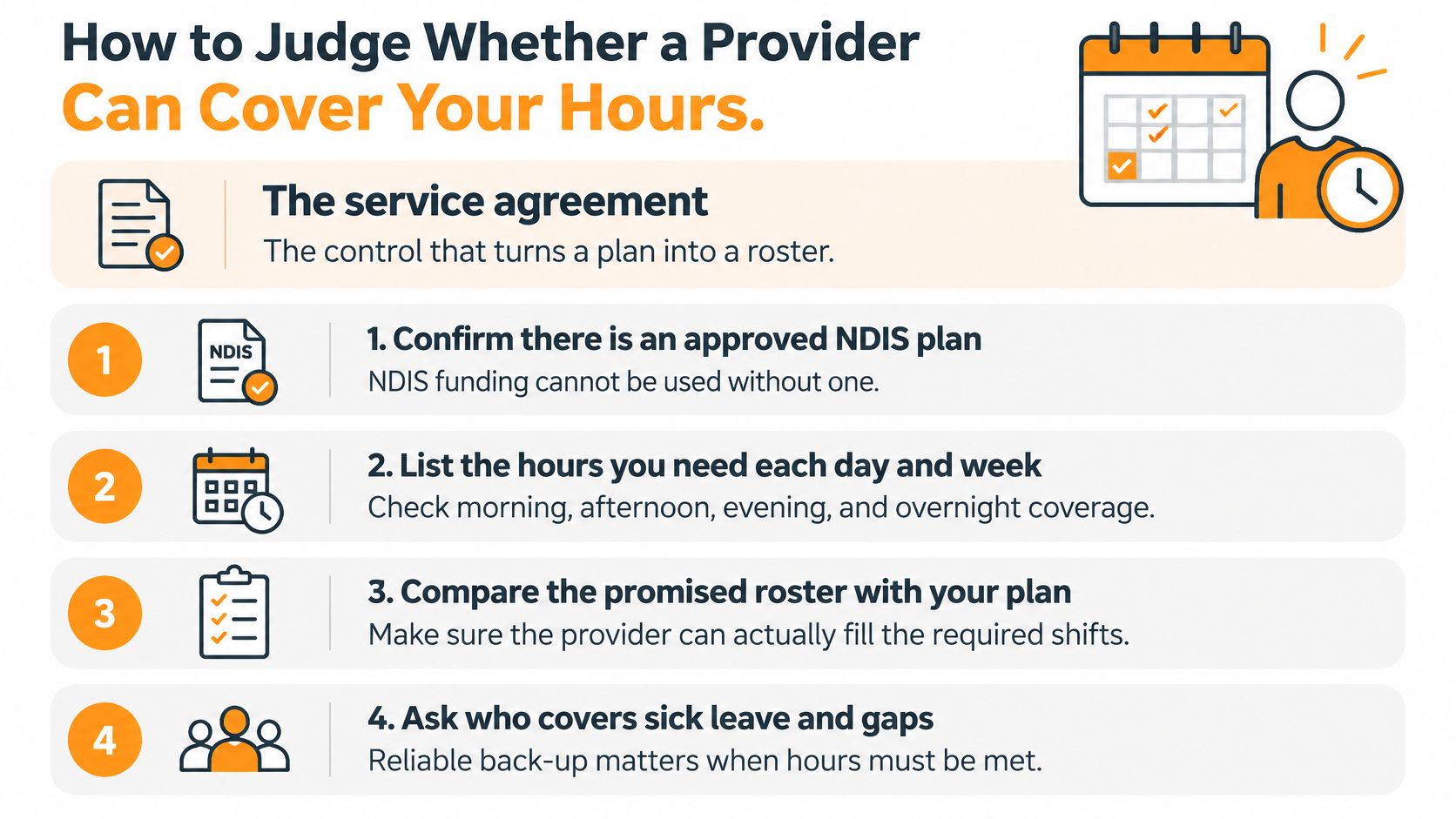
The seven-step hours test
- Confirm your approved plan: To use NDIS funding with us, you need an NDIS plan, and without one the funding can't be used for these supports.
- List tasks and weekly hours: Write morning personal care, two cleaning visits, one community outing, or whatever your real week needs, then match each item to its price row. Our support hours calculator can help you turn that list into a starting estimate.
- Check the primary worker: Ask whether those hours can be filled by a worker who lives near you, including outside a capital city, because distance affects reliability.
- Name the backup: Ask who covers a sick day or leave so your week doesn't collapse to zero.
- Clarify travel: Provider travel and kilometres are claimed under the NDIS Pricing Arrangements, so ask how they're charged and whether travel time eats into support hours.
- Read the written agreement: Our agreement sets out supports and costs under NDIS pricing rules, and it should also cover the details below.
- Treat it as change-controlled: Update it when needs, workers, locations, prices, or preferences change, and don't start until you understand the agreed scope.
The agreement items aren't fine print to skim. The NDIS provider responsibilities guidance describes a written service agreement identifying the supports delivered, delivery method, price, payment arrangements, review dates, participant and provider responsibilities, and the process for resolving disagreements or service failures. It also notes the NDIS recommends agreements for ordinary supports even though they're not universally mandatory, while they're mandatory for specialist disability accommodation providers and encouraged for supported independent living.
That detail reduces arguments later. Rostering, worker substitution, travel, cancellations, and unused hours are the exact points where families get frustrated. If they're written down, you can point to the page instead of debating what someone said on the phone.
What sits behind the roster
A provider can promise hours and still lack the systems to deliver them safely. Look for workers who are competent for the role, participant-specific risks recorded before the first shift, and a complaints path you can use. Those aren't admin extras. They're what stop a new worker walking into your home without knowing your communication needs, your health risks, or what to do if something goes wrong.
If frequency, backup, or travel is still vague, the provider isn't ready to sign with you.
That's your pass rule. Vague answers at the start usually become missed shifts later, so pause and ask again, or choose someone else.
How Worker Matching Works Before the First Shift
Stand at your front door for a minute. The person who walks in will help with private routines, food, family conversations, and the parts of your day you don't share with strangers. Technical skill matters, but it isn't enough on its own.
A good match weighs language, religious practice, food, family roles, communication style, and shared interests. A worker can know how to provide personal care and still be wrong for you if every conversation feels hard or your household routines are constantly misunderstood.
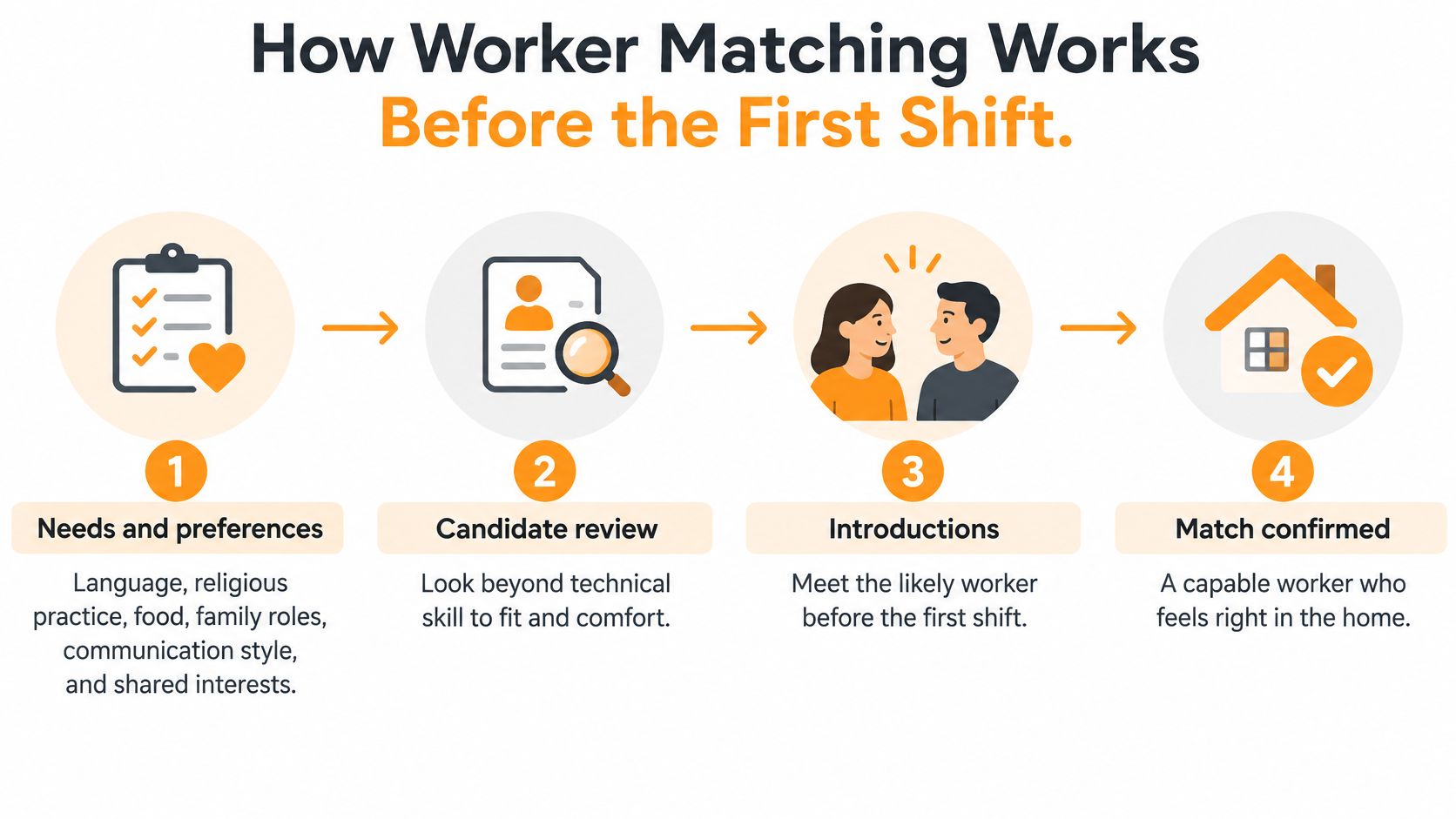
A sound matching sequence
We match support to your language, culture, and personality across Australia. We send worker profiles before you choose and arrange a meet and greet before supports start. You can see what happens at a meet and greet before you book one.
The sequence should feel like choosing teammates. Profiles give you a shortlist. The meet-and-greet is the trial before the season starts. If the first meeting doesn't feel right, you should be offered an alternative instead of being pushed to accept.
A concrete example helps. Matching a Korean-speaking worker for everyday core supports removes a language barrier when you and your family discuss showers, meals, and routines. You don't have to gesture through personal care instructions or rely on a relative to translate every visit.
A workforce drawn from many cultural and language backgrounds, including dedicated Burmese-speaking, Chinese-speaking, and Korean-speaking options, gives you a wider matching pool. It isn't a guarantee until a named worker is accepted by you. The pool matters, but the final test is still the person in your home.
Checks and your exit if it feels wrong
Our support workers hold the checks required for their role, including the NDIS Worker Screening Check. The NDIS Practice Standards and quality indicators require workers to be competent for their roles, trained in relevant procedures, and able to deliver person-centred support, with documented systems covering complaints, incidents, work-health-and-safety risks, emergencies, and workforce disruption.
Before shift one, your risks, communication, and cultural requirements should be briefed clearly. Incidents and near misses should be logged, and you should know how to complain if the match, a missed shift, or service quality isn't suitable. Rostering for consistency and regular check-ins give you chances to raise small problems before they become reasons to leave.
You can also request a different worker when your circumstances or preferences change. Your decision this week is simple. Accept the worker, ask for another profile, or pause. Don't let politeness lock you into daily support that doesn't feel right.
What a Typical Week of Home Care Looks Like
Say a participant in suburban Sydney with cerebral palsy starts most weekdays with a known worker for morning personal care. The worker knows the order of the routine, how much help is wanted, and what a good start looks like. That familiarity saves time and spare explanations every single day.
Later, a separate cleaning visit keeps the home clean, safe, and comfortable. It's regular help from a worker they know, not a rotating cast learning the house from scratch. Floors, bathroom, laundry, and kitchen tasks get done before they build into a safety problem.
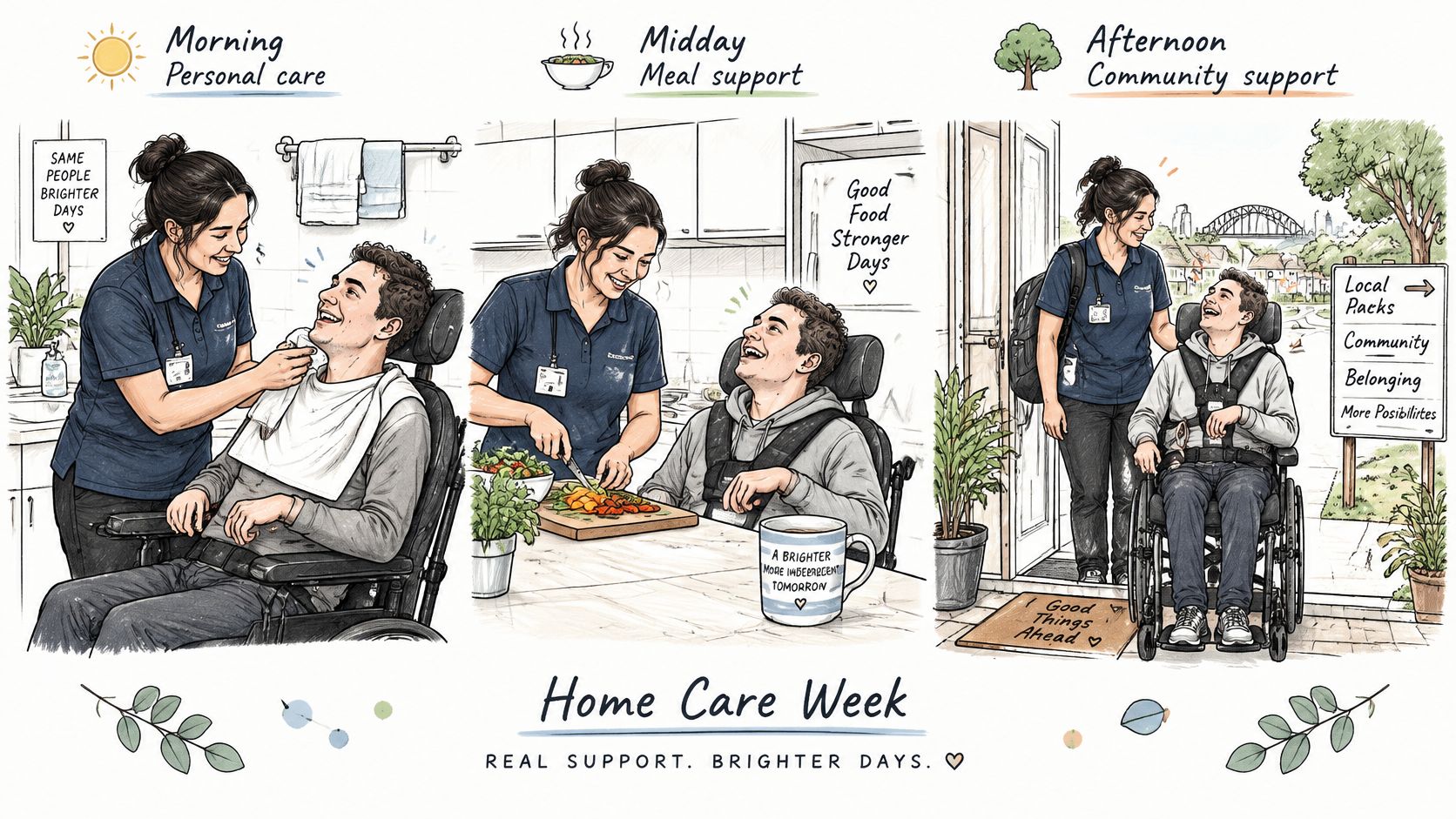
In the afternoon, the participant has a physio appointment and then a community group. Our workers can help participants get to appointments, activities, and errands as part of daily living support, so the journey is part of the support rather than a separate puzzle for family to solve.
Meal preparation follows the person's tastes and the health team's advice. If lunch needs a particular texture, familiar flavours, or ingredients that fit the household, the worker prepares that meal, not a standard plate. On two other days, a life-skills block might mean practising a simple lunch together, step by step, so independence grows without turning every meal into a lesson.
Two variations on the same pattern
An autistic participant might need a predictable worker, low-change routines, and a quiet community activity. The same person across the week isn't just a preference here. The roster itself is part of the support, because fewer changes mean less energy spent adjusting.
A participant with psychosocial disability or complex needs might have family and a support coordinator closely involved. The worker handles household tasks the family can't sustain every day, while the family stays part of the wider support picture. Home care fills the practical gap instead of replacing everyone else.
Good home care is a familiar worker doing ordinary tasks at the agreed times.
That pattern can be arranged in every state and territory by recruiting and matching a worker who lives near the participant, not by flying a Sydney roster interstate. Core supports offered are personal care, community participation, life skills development, NDIS cleaning, meal preparation, and travel and transport.
This kind of support is built for people with autism, intellectual and psychosocial disability, acquired brain injury, cerebral palsy, Down syndrome, genetic conditions, physical disability, and complex needs. Look at the sample week and mark which hours match your plan. Then mark what's still missing, because that missing list is your real starting point.
When Choice Does Not Mean Enough Hours
A directory is only a starting point. A provider may offer the right type of support but still be unable to cover the days, times, or frequency you need. Choice becomes access only when the roster works in practice.
| Gap | Question for the provider |
|---|---|
| Household chores still unmet | Can you roster the weekly cleaning and meal hours? |
| Mobility needs still unmet | Can you support travel to appointments and activities? |
| Cognitive or emotional support still unmet | Can you match me with a suitable worker consistently? |
| Services cost too much | What will the support cost under the NDIS pricing arrangements? |
| Not enough hours supplied | What happens if you cannot fill the agreed hours? |
| Could not arrange a service | How long might it take from agreement to the first shift? |
| No service available | Can you roster a worker near my home? |
Turn each question into a practical check. For household tasks, ask whether your cleaning and meal-preparation hours can be rostered, on which days, and by whom. For travel, clarify whether the worker can accompany you to appointments, activities, and errands, and how provider travel or kilometres are claimed.
Consistency also depends on backup. Ask whether the same worker can usually provide the support and what happens if they are unavailable. A provider's ability to offer a service does not guarantee it can cover every requested hour.
Write down hours the provider cannot cover, cancelled shifts, and introductions that do not work out. Dates and brief notes can help you discuss the gap with your support coordinator, local area coordinator, or at a plan review. The aim is to identify whether the problem is frequency, timing, worker fit, travel, or backup, then decide what needs to change.
Confirm the Provider and Start Supports
Use a clear go or no-go rule. Start only when the tasks sit inside your plan, the hourly prices sit at or under the limits you've compared, a named worker has been met, and backup plus travel are written down.
If any one of those is missing, pause. The first fortnight rarely sorts out a problem that was obvious before day one. It usually turns it into your new normal.
What a clean start looks like
You can find a support worker on our website or call us on 1300 543 123. Review profiles, meet before supports begin, and sign an agreement that lists supports and costs. Families, support coordinators, and your other providers can stay involved throughout, because home care works alongside them rather than replacing them.
If you're leaving another provider, we help you move across, including with the service agreement, and match you with a worker before your supports move across so there's no gap. That order matters. Prepare the new agreement and worker first, then stop the old supports, so you don't face an empty week.
Enrichment Care provides NDIS support to participants in every state and territory of Australia and matches on language, culture, and personality. You can reach us on 1300 543 123 or at enrichmentcare.com.au if you want to test that option against your own hours list.
If you don't have a plan yet, start with the NDIS access process before comparing NDIS home care providers. Comparing rosters and prices won't help until you know whether you have funding and what it covers.
Your action for this week is concrete. Write your weekly hours, ask one provider the backup and travel questions, and book a meet-and-greet before any shift is rostered. That sequence turns choice into support you can count on.
We arrange NDIS core supports at home and in the community across Australia, matching you with a worker by language, culture, personality, and routine, then confirming hours, backup, and travel before supports start. If you're ready to test your weekly hours against a real roster, visit Enrichment Care or call 1300 543 123 to find a support worker and book your meet-and-greet.