NDIS How Does It Work? Plans, Budgets and Reviews
NDIS How Does It Work? Learn how access, plans, budgets and reviews fit together, plus the 2026-27 changes to know.
If the NDIS gives you funding, why can't you spend it on whichever support would make life easier today? The answer is the difference between receiving a cash payment and having funding attached to an approved plan.
When people ask, “NDIS, how does it work?”, they're often asking several things at once: whether they qualify, who decides their budget, and how they can use it without breaking the rules. Start with the pathway, then look closely at what your own plan allows.
The NDIS Pathway from Access to Plan Review
The National Disability Insurance Agency (NDIA) administers the scheme. You apply for access first; choosing workers and arranging funded services comes later.
| Stage | What happens | What you do |
|---|---|---|
| 1. Access request | NDIA checks age, residence and disability evidence | Lodge the request with supporting evidence |
| 2. Access decision | Eligibility is confirmed or declined | Ask for a review if the decision seems wrong |
| 3. Planning meeting | Goals, supports and needs are discussed | Prepare goals and evidence beforehand |
| 4. Plan approved | Individual plan and budgets are issued | Check budgets and the management type |
| 5. Plan use | Supports are delivered and claimed | Keep records that match the plan's supports |
| 6. Plan review | Plan is reassessed or changed | Request a review when circumstances change |
Most newcomers start with an access request, not a service booking. The NDIA needs evidence to assess eligibility before it considers an individual funding plan, so a provider's willingness to help doesn't establish access.
Our guide to applying for the NDIS can help you organise that first stage. Keep a copy of what you submit so you can respond clearly if more information is requested.
What changes after approval
The planning conversation should focus on your life and goals, rather than producing a shopping list of services. After approval, you move into practical arrangements: selecting providers, agreeing on supports and having delivered services claimed through your chosen management arrangement.
Keep the decisions separate: Being eligible, receiving funding and being allowed to purchase a particular support are different questions.
A scheduled reassessment provides an opportunity to revisit the plan. A change in circumstances may also mean you need to seek a change before that point. Timeframes aren't identical for everyone, so gather relevant evidence early rather than waiting until support arrangements become difficult to sustain.
What the NDIS Is and Who Qualifies
Think of the NDIS as a personal budget attached to a shopping list agreed in advance, rather than money deposited for unrestricted spending. The analogy helps explain the boundaries, although a plan can allow flexibility rather than naming every individual purchase.
The NDIS explanation of funding describes an Australian government-funded scheme providing individualised funding to eligible people with permanent and significant disability. Applicants must satisfy age and residence conditions and meet disability or early-intervention requirements.
The relationship between eligibility, planning and funding looks like this.
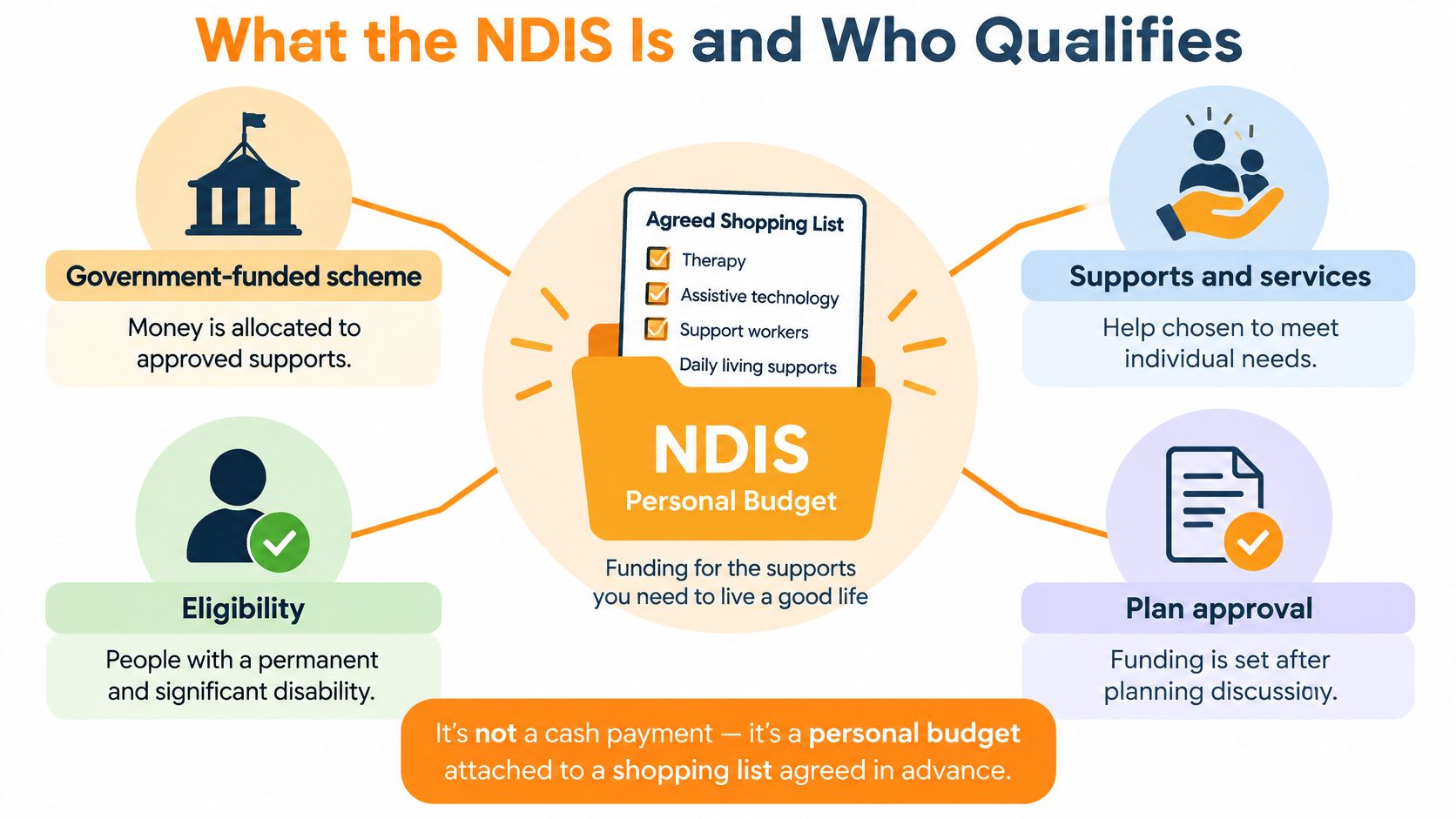
How eligibility and funding connect
Say an adult with a physical disability wants help getting ready at home and support to reach work. Their access evidence needs to explain the disability and its effects, not just their preference for a support worker.
If accepted, they discuss what they want to achieve and what assistance they need. Their individual plan describes supports intended to help them pursue goals, increase independence and participate in everyday life.
A goal such as maintaining employment helps explain why assistance matters. It doesn't automatically make every work-related expense payable from the plan.
- Potential funded assistance: Disability-related help with personal routines or participation, where the plan and funding rules allow it.
- Not automatic approval: A purchase that feels useful but doesn't meet the requirements for NDIS funding.
- Participant choice: Participants generally choose the providers who deliver their funded supports.
What the scheme doesn't do
The NDIS isn't a universal welfare payment or an unrestricted cash benefit. An approved budget isn't permission to buy anything connected, however loosely, with wellbeing or independence.
Evidence about daily life therefore matters alongside medical information. Describe what you can do independently, where assistance is needed and what happens without it, so the funding discussion addresses actual disability-related needs.
Check Your Access Before Your Planning Meeting
Should you start the access process now or gather more evidence first? Begin by checking what you already have, then identify gaps before lodging an application that leaves important questions unanswered.
Use this preparation sequence.
- Check age and residence conditions. Confirm that you meet the relevant access criteria before concentrating on service choices. Don't assume a diagnosis alone establishes eligibility.
- Gather evidence about daily functioning. Collect medical reports, assessments and letters from treating professionals. Useful evidence explains the lasting effects of disability on activities such as communication, mobility, self-care and everyday tasks.
- Check the official requirements. Compare your documents with the NDIA's eligibility guidance. The NDIA makes the final access decision, not a provider or an online screening tool.
- Write goals in your own words. Consider home, work, study, community involvement and independence. Describe what you want to do, rather than trying to copy funding terminology.
- Request interpreting support early. If you need a professional interpreter for the planning conversation, raise this when arranging the meeting. You should be able to understand questions and explain your needs accurately.
- Consider the fit of future support. Language, culture and routines affect whether assistance works in practice. Note preferences that matter to communication, meals, personal care or family involvement.
Our NDIS eligibility checker asks four quick questions about the main access criteria. Treat it as an initial check, not an access decision.
Keep a shared set of records
Create a folder for submitted documents, correspondence and contact dates. Record what was discussed and any next action, especially when the NDIA requests further evidence.
Bring your evidence and goal list to your first conversation with a provider or support coordinator. If you've already received a plan, bring the current plan documents too, so everyone works from the same information.
How to Build Your Plan Step by Step
The planning meeting is where your plan takes shape. Preparation helps you explain the difference between tasks you can manage, tasks you're learning and tasks that require ongoing assistance.
This visual summarises how evidence and goals contribute to a support plan.
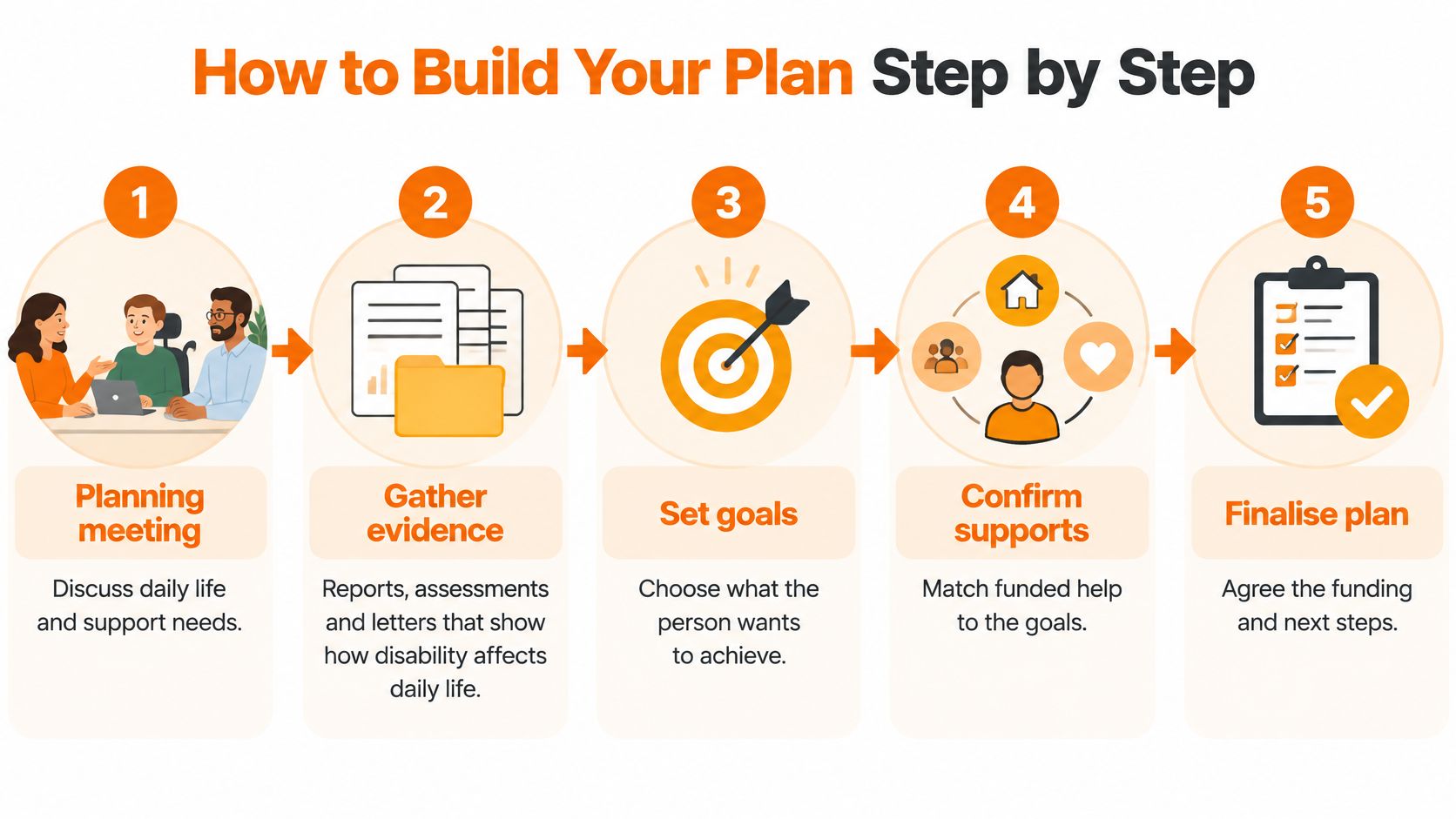
Prepare, discuss and check
- Gather evidence with practical detail. Reports, assessments and professional letters should explain how disability affects daily life. A report that describes difficulty preparing food is more useful when it also explains the assistance required.
- Write down your goals. Cover the parts of life that matter to you, whether that's living more independently, studying or seeing friends. Goals should sound like your priorities, not a provider's service menu.
- Match assistance to each goal. Identify the tasks involved and roughly how often help is needed. For example, attending a community group may require assistance getting ready, travelling and communicating during the activity.
- Arrange the planning meeting and communication support. Request a professional interpreter if the conversation needs a language other than English. A worker who speaks your language isn't necessarily a qualified interpreter; speaking the language alone doesn't qualify them for that role.
- Check the proposed plan where available, then the approved documents. Look for accurate goals, suitable budget categories and clear descriptions of any specifically allocated supports. Ask for clarification if important needs are missing or the connection between a support and your daily life is unclear.
- Confirm the management arrangement. Understand who will process payments and what administration you'll handle. This affects how you set up services, check invoices and monitor available funds.
- Choose providers and arrange the start of support. Agree on tasks, timing, costs and responsibilities before services begin. To use NDIS funding with us, you need an NDIS plan.
A planning discussion isn't a guarantee that every requested support will be funded. Keep a record of what you requested and the evidence supporting it, so you can identify any unresolved issue when the approved plan arrives.
The video offers another way to approach the planning process.
Signs of a usable plan
- Recognisable goals: You can see your own priorities in the wording.
- A clear connection: You understand which assistance addresses each disability-related need.
- Practical instructions: You know which funds can pay for the planned services and who handles payment.
- Questions resolved: You aren't relying on a worker's assumption about an unclear allocation.
Budgets, Management Types and Price Limits
Use this table to separate two different things: budget categories describe the funding purpose, while management arrangements describe how payments are handled. A category doesn't tell you who processes the invoice.
| Budget or arrangement | Covers | Who pays or claims |
|---|---|---|
| Core supports | Daily living, community participation, transport and household help | Set by the core budget, claimed under the management type |
| Capacity-building supports | Therapy, skill building, employment and education | Set by the capacity-building budget and management arrangement |
| Capital supports | Equipment, assistive technology and home modifications | Set by the capital budget and management arrangement |
| Recurring supports | Ongoing supports listed in the plan | Set by the recurring budget and management arrangement |
| Self-managed | Participant chooses and pays providers | Participant pays and tracks spending |
| Plan-managed | Plan manager handles invoices | Plan manager claims from the NDIS |
| NDIA-managed | Ongoing supports paid through the NDIA | NDIA processes the claims |
These are broad descriptions, not a guarantee that every listed activity is funded in every plan. Read the actual allocation and support description before booking.
Match the support to its purpose
Core funding commonly addresses everyday assistance, such as help showering, cleaning or taking part in community activities. Capacity-building funding focuses on developing abilities, such as learning strategies to complete a task more independently.
Capital funding addresses approved equipment, assistive technology and home modifications. Recurring funding covers ongoing items identified in the plan; don't assume it's an extra flexible pool for other expenses.
The distinction can be subtle. Having someone prepare a meal and receiving structured assistance to develop cooking skills may involve the same kitchen, but the support's purpose and approved category can differ.
Follow the payment route
With self-management, you handle provider payments and spending records. With plan-management, the plan manager handles invoices and claims; with NDIA-management, providers submit claims for the NDIA to process. A plan can combine management arrangements.
The NDIS Pricing Arrangements and Support Catalogue set support items and applicable maximum prices, and providers cannot claim above the relevant maximum for NDIA-managed or plan-managed participants. Prices can be negotiated below that ceiling.
For example, a provider charging the applicable maximum uses more of your available funding for the same service duration than a provider offering an agreed lower rate. Compare the actual support, timing and any permitted additional charges, rather than treating the ceiling as a compulsory price.
Our guide to NDIS price limits provides further pricing context.
Before the first claim: Confirm the management type, support item, regional pricing rules and claim period, then retain records of the assistance delivered.
Spending Within Your Budget Without Breaching Your Plan
Core funding is flexible is an incomplete explanation. Flexibility doesn't mean every allocation can be moved, and a healthy overall balance doesn't make an otherwise ineligible purchase allowable.
The NDIS guide to using your funding says flexibility operates within the same support budget, not across different budgets, and describes funding periods under new laws as usually three months while leaving the annual total unchanged. Check the funding periods and conditions in your own plan rather than assuming the entire annual allocation is available immediately.
A temporary change in personal care needs
Suppose you temporarily need more help showering and dressing, while attending fewer community activities. You want to redirect the unspent community-assistance funding towards personal care.
Start by checking whether both allocations sit within flexible Core funding. If your plan permits movement between those categories, you may be able to rebalance that spending while keeping essential commitments covered.
You can't take the same approach to funding marked stated, which is restricted to its specified support and category. Nor can you move capacity-building or capital money into Core just because personal care has become more urgent.
An invoice records what a provider charged. It doesn't establish that the purchase was permitted.
Every purchase must still be an NDIS-funded, disability-related, reasonable-and-necessary support. You also can't spend beyond the plan's total funding amount or ignore the amount available for the applicable funding period.
Check before changing the roster
- Read the category conditions. Identify flexible allocations, stated supports and any other restrictions before shifting spending.
- Review the service agreement. Our service agreement sets out supports and costs under NDIS pricing rules. Check how a changed roster affects the agreed services and costs.
- Track delivered and committed support. Use a spreadsheet, portal or budget statement to record paid claims, unpaid invoices and future bookings. A balance that excludes outstanding invoices can look more generous than it is.
- Seek a plan change when necessary. If needs change substantially or permanently, request a reassessment or change-of-circumstances consideration rather than trying to stretch an unsuitable allocation indefinitely.
Before confirming extra shifts, calculate what remains after existing commitments. Then check whether the proposed arrangement can continue through the funding period without leaving other essential assistance unfunded.
Plan Reviews and Upcoming Budget Changes
The NDIS guidance on plan creation describes projected progressive reductions to budgets for social, economic and community participation and improved daily living skills, applying to new and reassessed plans from 1 October 2026 and renewed plans from 1 February 2027. These are prospective changes, not a reason to assume your current supports have already changed.
The guidance identifies exceptions, including essential day-to-day, complex, specialised or customisable supports. It also identifies other unaffected areas, such as eating and drinking, education, employment and disability-related health supports.
Identify the support, not just the activity
An activity's everyday name won't necessarily tell you how a future funding decision applies. Separate the task, its disability-related purpose and the budget category.
| Activity | What to examine before a planning conversation |
|---|---|
| Social outings and community groups | Whether the assistance falls within participation funding potentially affected by reductions |
| Appointments and travel | The funded purpose, category and type of assistance, rather than the destination alone |
| Household routines | Whether assistance is essential day-to-day support or a different type of intervention |
| Meal preparation | Whether the support concerns daily assistance, eating and drinking, or skill development |
| Skill development | Whether funding falls within improved daily living skills and whether an exception applies |
Don't assume all community assistance will disappear. Equally, don't assume an existing allocation will continue unchanged when your plan is reassessed or renewed.
Prepare evidence before a review
Plans may be reconsidered through a scheduled reassessment or following a request prompted by changed circumstances. Distinguish a request to change an unsuitable plan from a request to review a decision you believe is wrong.
- Document the need: Explain which disability-related barrier each support addresses.
- Record frequency: Keep rosters and notes showing when assistance is required.
- Describe outcomes: Record what the support enables and what happens when it's unavailable.
- Explain continuity: Note why consistent workers, communication arrangements or cultural understanding matter to effective assistance.
A smaller budget can mean fewer support hours, disrupted worker relationships or reduced access to work, study and community life even when underlying needs remain unchanged. Make those practical consequences clear with specific examples, rather than relying only on a request to retain the previous budget.
We provide everyday NDIS core supports, including personal care, household assistance and community participation, with worker matching that considers your language, culture and routines. Visit Enrichment Care to discuss how your approved plan could support the assistance you need at home and in the community.
Written with Outrank tool