NDIS Price Guide Navigator: How to Find Support Prices
Use an NDIS price guide navigator to find the right support item, check 2026-27 price limits and spot overcharges early.
You've found a support worker, there's room in your NDIS budget, and the quote looks close to the price you saw online. But is it the right price for personal care on a Saturday, does it include travel, and is the worker available where you live?
An NDIS price guide navigator helps you answer those questions in the right order. Start with the support item, not the hourly figure. A price limit is a ceiling, not a compulsory rate, and it doesn't guarantee that a suitable worker is available.
2026-27 Price Limits for Common Core Supports
| Support or time | National limit per hour |
|---|---|
| Personal care, weekday daytime | $73.58 |
| Personal care, weekday evening | $81.07 |
| Personal care, weekday night | $82.57 |
| Personal care, Saturday | $103.54 |
| Personal care, Sunday | $133.50 |
| Personal care, public holiday | $163.46 |
| Community participation, one-to-one, weekday daytime | $73.58 |
| Life skills development, weekday daytime | $73.58 |
| Travel and transport worker time, weekday daytime | $73.58 |
| NDIS cleaning (house cleaning and laundry) | $61.16 |
These are maximum national hourly prices, not mandatory charges. Enrichment Care's support hours calculator uses these standard self-care limits to estimate the cost of a weekly support pattern. Calculator results are estimates: your agreed provider prices and plan rules may differ.
For example, a standard Saturday personal-care booking belongs against the Saturday row, not the weekday daytime row. You still need to match the precise catalogue item before treating that figure as the booking's ceiling.
Read the row before estimating your hours
Use this sequence rather than multiplying your whole budget by a single hourly rate:
- Check the document: Confirm the release year and printed effective date before using any figure.
- Match the delivery time: Find the row for the support's day and start time, then check any conditions affecting a shift that crosses pricing periods.
- Check the location: Remote and very remote limits are higher. Their figures aren't confirmed in this table, so use the applicable location column in the official catalogue.
- Confirm the item: Put the catalogue item and agreed rate alongside the booking before services begin.
Practical rule: A cleaning rate doesn't become a personal-care rate because the same worker delivers both. Match what the worker is doing, not just who's doing it.
What the Navigator Covers and Which Price Guide Version to Use
A navigator should connect a planned support with its catalogue entry and pricing conditions. Think of a price limit like a speed limit: it sets the highest permitted amount, not the amount everyone must use.
Keep the catalogue open while checking the proposed service.
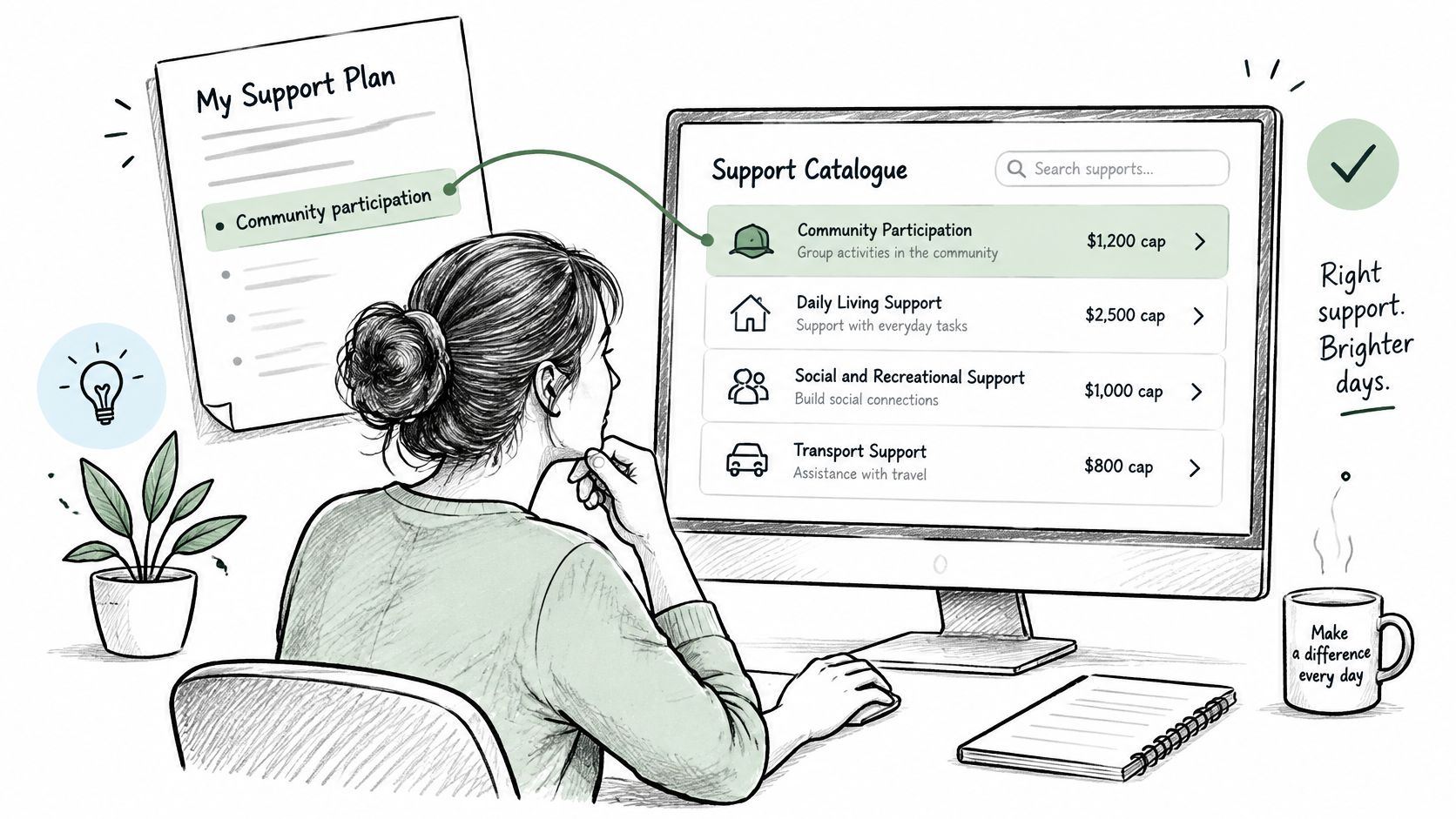
The NDIS Pricing Arrangements and Price Limits, formerly the NDIS Price Guide, introduced updated arrangements effective 1 July 2025 for the 2025–26 financial year. For supports subject to price limits, particularly NDIA-managed and plan-managed arrangements, providers can't charge above the applicable maximum, the NDIA can't pay an above-limit claim, and participants aren't entitled to reimbursement above that limit.
The name matters because this document does more than list prices. You need its claiming conditions alongside the Support Catalogue, including conditions relevant to support intensity, worker qualifications and delivery location.
Check the release, not the search result
The 2026–27 limits take effect on 1 July 2026. A saved screenshot can look perfectly clear while showing the wrong financial year or missing an amendment.
Before accepting a result from a navigator, check:
- Financial year and release: Read the document's title and version information.
- Effective date: Match the applicable arrangements to the service date.
- Supporting conditions: Open the relevant pricing provisions, not just the rate cell.
This video provides another way to approach the guide.
Keep a copy of the applicable document with your pricing records. That gives you a clear reference if a quote and a later invoice don't agree.
How to Locate a Support Item Step by Step
The NDIA's pricing arrangements guidance requires attention to the support item, unit, applicable price limit and claiming conditions. A reasonable-looking hourly charge can still be incorrectly priced or rejected if the service is mapped to the wrong item.
Use the following process before approving a roster or signing an agreement.
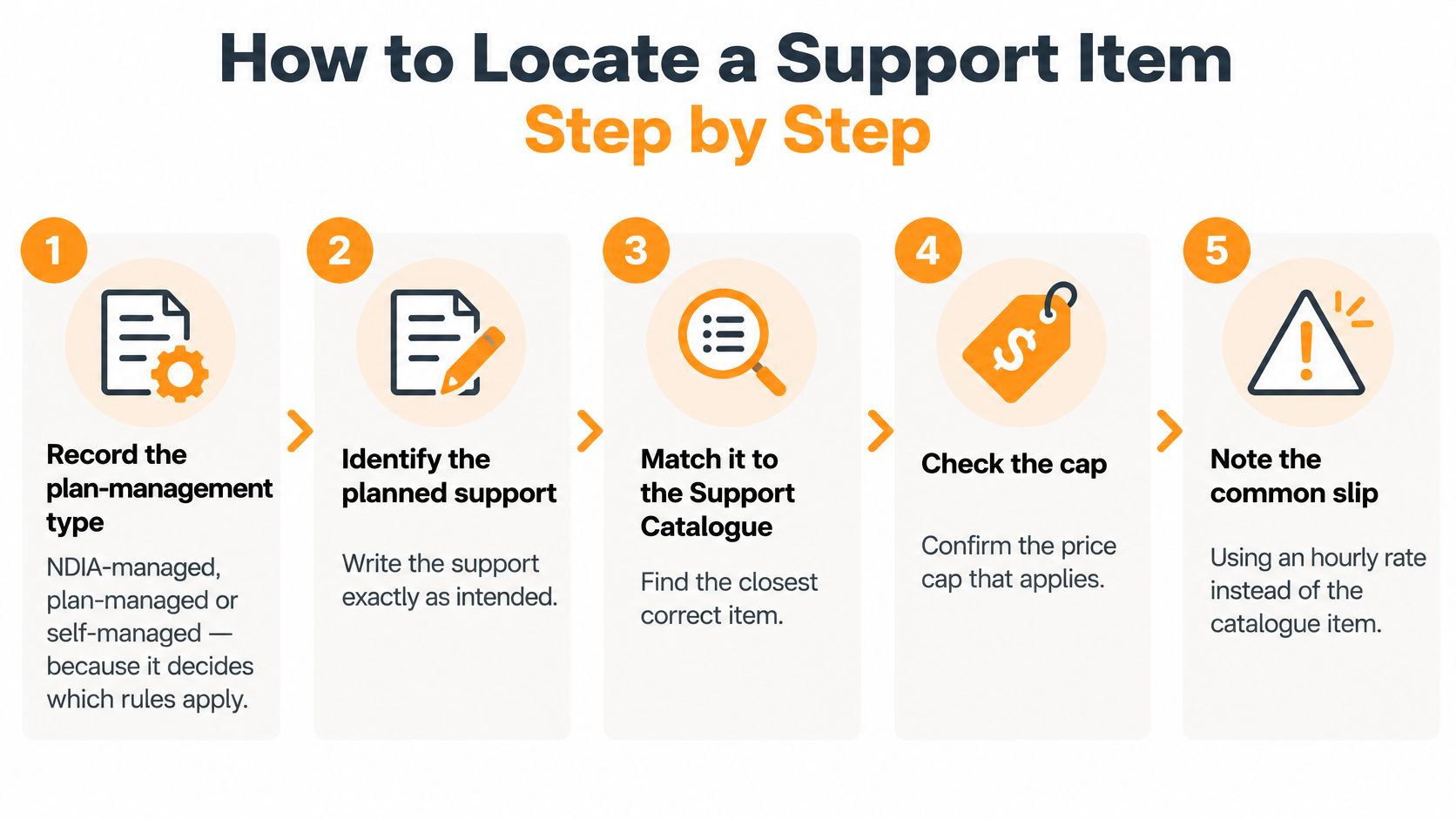
Record how the relevant funding is managed. Note whether the support is NDIA-managed, plan-managed or self-managed. Don't assume every part of a participant's plan uses the same management arrangement.
Write the support purpose in everyday language. For example, write “help with showering and dressing on weekday mornings” rather than “support worker”. A job title doesn't tell you which service is being purchased.
Record the delivery address and location classification. Use the actual place where the support will occur. Don't choose a remote price because the address feels far from a capital city.
Write down the day, start time and finish time. Those details help identify the relevant time band and any shift-crossing conditions. “Morning support” isn't precise enough for checking an invoice.
Separate travel and group delivery. Record whether the worker travels to deliver the support and whether other participants share the service. Don't bury either detail in a single unexplained hourly charge.
Search the current Support Catalogue by purpose. Read the full item description, confirm whether it's price-limited, and check the unit. An hourly item and a per-service item aren't interchangeable.
Apply the correct pricing column and conditions. Match the selected item to its location and delivery time, then compare the proposed charge with the ceiling. Don't use a nearby catalogue row because its description sounds similar.
Keep the evidence together. Retain the service agreement, roster and records supporting what was delivered. An item number alone won't explain a mismatch between scheduled and invoiced hours.
The visual checklist is useful when collecting the information before searching.
What a completed match looks like
Keep the result on a single booking line:
Catalogue item number | service description | unit | applicable cap | agreed rate | rostered hours
Add location, travel and group details beside it where relevant. This makes the booking usable for the participant, coordinator and person checking payment, rather than leaving each person to interpret a generic service description.
How Location, Travel and Group Size Change the Limit
A price limit is a ceiling, not a guaranteed rate. Check the applicable support item first, then account for location and group size. The provider's charge and the availability of a worker at that price also matter.
The official NDIS pricing schedule shows how limits can vary by location. For example, its dietitian assessment and training limits are $188.99 nationally, $264.59 remotely and $283.49 very remotely per hour. These figures apply to dietitian supports, not core supports such as personal care, so don't use them to price a personal-care booking.
Split the group amount correctly
For group support, the applicable limit is divided by the number of participants. The table applies that calculation to the standard weekday daytime limit used by the support hours calculator.
| Participants in group | Share of limit per participant | Maximum per participant at $73.58 |
|---|---|---|
| 1 (one-to-one) | Whole limit | $73.58 |
| 2 | Half | $36.79 |
| 3 | One-third | $24.53, rounded |
| 4 | One-quarter | $18.40, rounded |
These rounded figures illustrate the calculation. Check the applicable claiming and rounding requirements before invoicing. If attendance changes, recalculate the amount rather than adding a participant to an unchanged invoice.
Keep travel distinct from direct support
Provider travel and kilometres for NDIS travel and transport support are claimed under the NDIS Pricing Arrangements. Worker travel time and vehicle-related charges are separate components, so ask the provider to identify what each charge covers.
Check that the journey, worker time and any kilometre charge are permitted for the selected support and agreed delivery arrangement. A worker travelling farther may improve availability, but confirm the total booking cost before accepting the roster.
Recheck the estimate if the delivery address, travel arrangement or group attendance changes. Each can affect the amount claimed even when the advertised hourly rate stays the same.
Checking Invoices and Cultural Fit Against Your Plan
Invoice checking affects participants using several management arrangements. As at December 2025, 69% of participants were fully or partially plan-managed and 46% were fully or partially self-managed, according to the NDIS pricing consultation document. These groups overlap, so the percentages shouldn't be added together.
Plan-managed means a plan manager handles payments for the relevant funding. That doesn't remove the participant's need to understand what was delivered or identify a charge that doesn't match the agreement.
Apply the check to your management arrangement
- Self-managed example: You receive an invoice for household assistance. Compare the delivered tasks, service record and agreed charge before approving payment, using the rules applicable to your funding.
- Plan-managed example: A community-access invoice goes to your plan manager. Check that the outing occurred as recorded and flag a discrepancy before payment is approved.
- NDIA-managed example: The provider submits its claim to the NDIA. Compare the service record with the support you received and raise an incorrect entry promptly.
Use this checklist alongside the invoice rather than relying on the total alone.
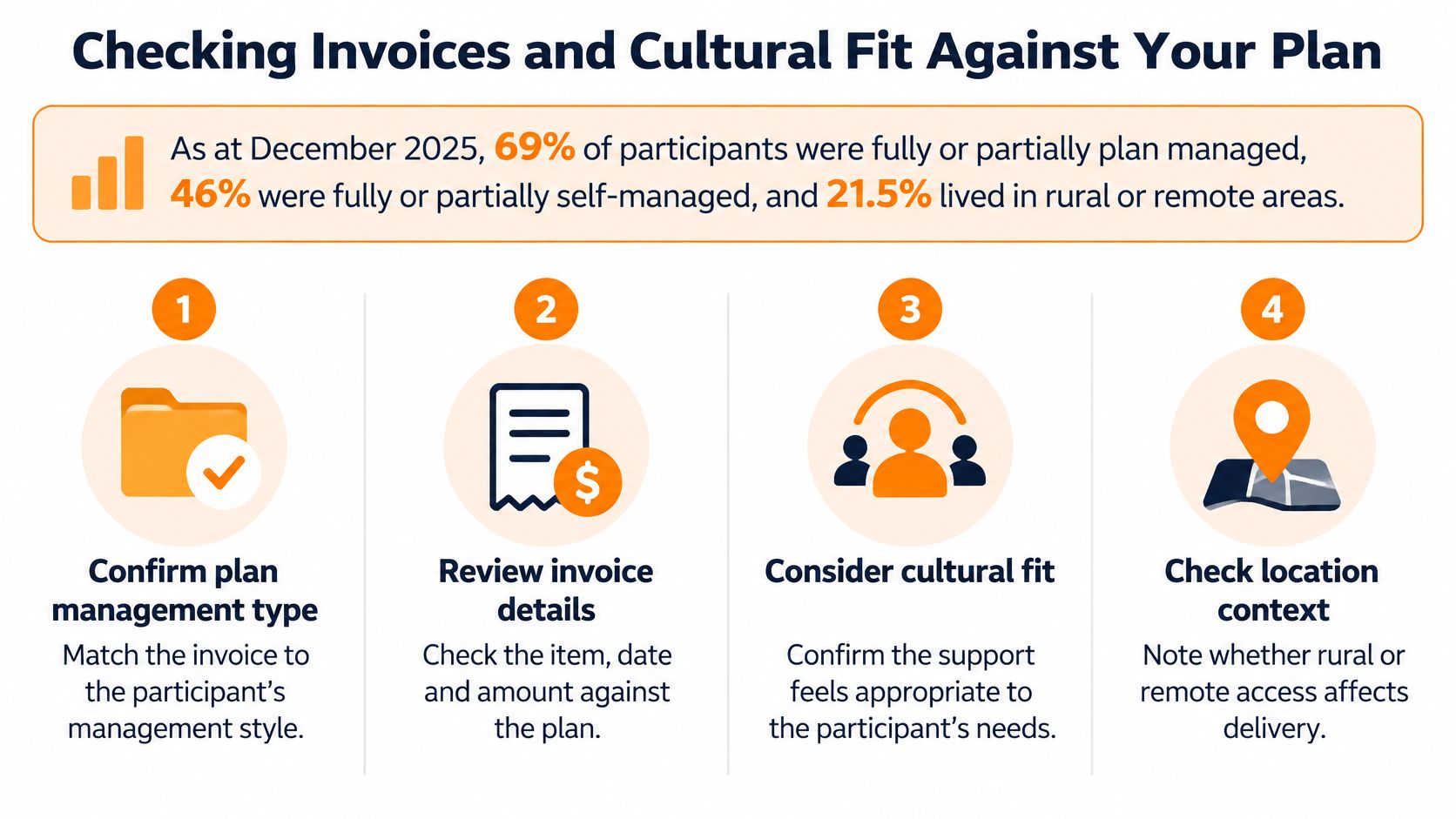
- Item and purpose: Does the item describe the actual support?
- Unit and attendance: Do the dates, times and quantities match the service record?
- Rate: Does the charge meet the agreement and any applicable cap?
- Additional charges: Are travel and cancellations separately identifiable and supported by the applicable conditions?
- Shared delivery: Is the group arrangement clear?
- Budget category: Is the support allocated to the appropriate part of the plan?
Check whether the arrangement works for you
A technically correct invoice doesn't tell you whether the worker communicates clearly or respects the participant's routines. With culturally appropriate disability support, we match language, culture and personality alongside practical support needs.
Personal care and meal preparation usually come from Assistance with Daily Life. Cultural matching doesn't replace the underlying support category or create a separate type of charge.
Before agreeing, ask which language will be used for explanations, agreements and invoices. Discuss food preferences, religious practices, privacy and family involvement directly, rather than assuming a shared language means every preference is understood.
Compare Quotes and Confirm Terms Before You Book
A published maximum isn't proof that a worker can be sourced at that price. The NDIA's 2026 pricing consultation considered thin markets in regional Australia, where limited provider availability complicates access to support. A navigator can identify a pricing ceiling; it can't establish local worker availability.
Say a participant in a regional town finds the appropriate catalogue item but can't find a suitable local worker. A worker travelling from another town may be an option, but the participant needs to compare the whole arrangement, including permitted travel charges and the practicality of maintaining the roster.
Compare the service, not just the headline price
A metropolitan quote and a regional quote aren't directly comparable unless they describe the same service. Check the item, unit, delivery time, location classification and shared-support arrangement before deciding which offers better value.
- Can the price be lower? Yes. Providers can charge below the national price limit, so the maximum shouldn't automatically become the agreed rate.
- Can travel be extra? Only where the applicable pricing rules permit it. A separate invoice line doesn't, by itself, make a charge allowable.
- Can a shortage justify exceeding the cap? Not where the support and management arrangement are subject to that cap. Check lawful delivery alternatives rather than accepting an unexplained surcharge.
- Does the worker suit the participant? Use practical questions to ask a support worker to assess communication, routines and task suitability alongside cost.
Put the decision in writing
Compare quotes using the same booking description, then check what each excludes. A cheaper direct-support rate may be less useful if the worker can't cover the required routine or the travel arrangement makes regular attendance difficult.
Our service agreement sets out supports and costs under NDIS pricing rules. Before signing any agreement, make sure the selected item, agreed rate, travel arrangements and cancellation terms are understandable and recorded.
Booking decision: Sign when you can explain what will be delivered, how it will be charged and what happens if the booking changes.
Keep the final quote and agreement together. If a proposed term is unclear, resolve it before the first shift rather than trying to reconstruct the agreement after an invoice arrives.
Enrichment Care provides personal care, community participation, household assistance and other core supports across Australia, with worker matching that considers language, culture and daily routines. Visit Enrichment Care to discuss your NDIS plan, proposed support schedule and worker preferences, and have the supports and costs documented before services begin.