NDIS Support Workers Near Me: How to Choose a Good Match
Searching for NDIS Support Workers Near Me? Learn how to check skills, language, cultural fit, costs and availability before your first shift.
The usual advice to choose the nearest available support worker skips the most important question: can that person deliver the support you need? Searching for NDIS support workers near me is a useful starting point, but an address won't tell you whether someone understands your communication, can follow your routines or has the skills to assist safely.
Use location to narrow the search, not to settle the decision. Filter by state or territory and exact availability, assess capability and personal fit, then choose the closest worker who meets every essential requirement.
How to Find a Support Worker Near You
Start with a written description of the support, rather than a general request for someone local. A worker might be available in your suburb but unable to cover your morning routine or help with the activity you want to attend.
Turn your needs into a useful shortlist
Write a short support list. Include personal care, community participation, life skills, cleaning, meal preparation or transport, together with the suburb or postcode and required days and hours. Describe the actual task, such as preparing breakfast alongside you, because broad service labels don't explain how support should work.
Add the details that make support workable. Note your routine, goals, language, religious practices, food preferences and interests. Separate essential requirements from preferences so you don't reject a capable worker over something you could comfortably negotiate.
Contact a service operating in your state or territory. Use its website or phone enquiry process and provide your location, exact hours and support list. At Enrichment Care, we start shortlisting as soon as we understand your needs, while the time needed to find a match depends on location, hours and how specific your preferences are.
Compare profiles, not just names. We learn about your needs, routine, language, culture and interests, then send profiles of suitable workers. Check each profile against your written requirements and identify anything that needs clarification before arranging a meeting.
Meet before supports begin. You meet your chosen worker at a meet and greet, and family members are welcome if you want them there. Use the conversation to discuss a normal shift and notice whether the worker listens to you, rather than speaking only to the people accompanying you.
Put the starting arrangements in writing. Confirm the start date, hours, contact person and first review date so everyone knows what's agreed. Keep unresolved questions visible rather than assuming they'll sort themselves out during the first shift.
The process is easier to follow when you keep the practical stages together.
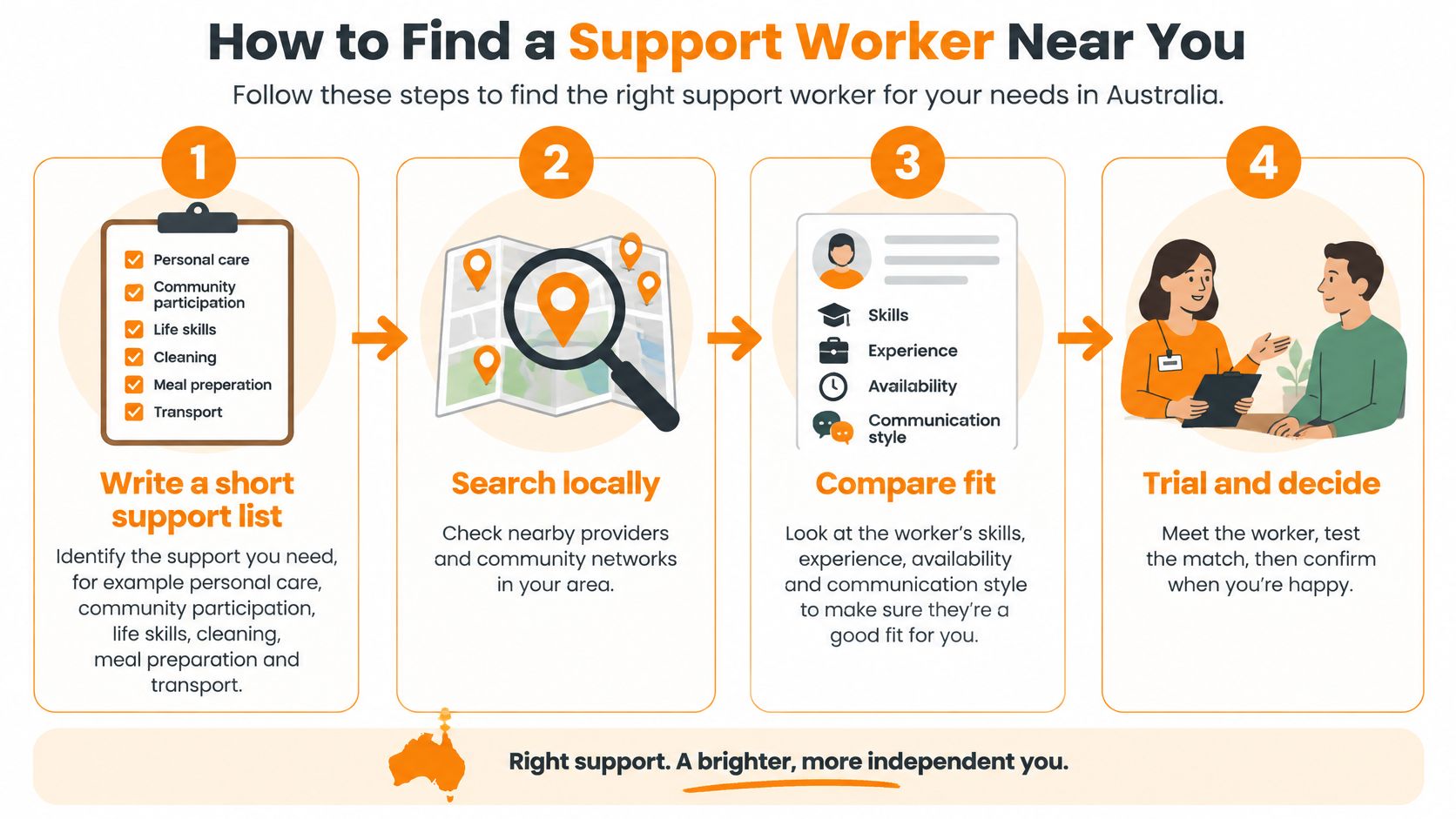
Aim to finish with a written support list, a small shortlist and a review date in the diary. If suitable profiles aren't available yet, ask which requirement is restricting the search before changing anything important.
What Your Plan Pays for Each Support
| Support type | Standard weekday daytime (2026–27 national limit) |
|---|---|
| Life skills development | $73.58 an hour |
| Personal care | Typically $73.58 an hour |
| Meal preparation | Typically $73.58 an hour |
| Travel and transport (worker time) | $73.58 an hour |
| NDIS cleaning (house cleaning and laundry) | $61.16 an hour |
These are 2026–27 national price limits, not a quote for your arrangement. Personal care and meal preparation usually come from Assistance with Daily Life, where the standard weekday daytime item sits at $73.58 an hour. The exact support item in your plan determines which limit applies, so confirm the item number before you budget.
You need an NDIS plan to use NDIS funding with us, and each support must fit the funding available under that plan. Our NDIS price limits guide sets out the current limits alongside the support items they attach to.
Match the task, budget and rate
Start with each block in your proposed weekly roster. Record what the worker will do, which budget category will fund it and the agreed rate, rather than treating every hour as interchangeable.
Culturally matched support is funded from the budget category for the support received. A Korean-speaking worker delivering personal care is funded as personal care, so matching by language or background does not create a separate rate or category.
For community participation, life skills and transport, confirm the relevant support item instead of choosing a category from the service name alone. Distinguish worker time spent supporting travel, charged at the hourly limit, from provider travel and vehicle-related charges. This distinction matters when you weigh up workers by distance, because a worker travelling from a neighbouring area can add provider travel to the cost of an otherwise suitable shift.
Budget check: A price limit is a ceiling, not a floor. Providers can charge below the national limit for a support type.
Higher limits apply for evenings, weekends, public holidays and remote areas. Provider travel and kilometres are claimed under the NDIS Pricing Arrangements, so the service agreement should list them separately rather than leaving you to infer them from an hourly rate.
Our support hours calculator shows what a weekly pattern costs at the applicable price limits and how far a Core budget will go. Use it to test the proposed roster before committing, then make sure the agreement states the rate for every block and any additional agreed charges.
Why the Closest Worker Is Not Always the Best Match
The closest worker isn't necessarily the best match, particularly when communication or disability-specific skills are essential. The National Disability Insurance Agency's published update reported more than 610,000 Australians receiving disability supports, while its cited jurisdictional figures recorded 230,427 active participant plans in NSW, representing 29.5% of all active plans nationally.
Participants need support beyond city centres, making the ability to arrange a suitable local roster more useful than the location of a provider's office. Our office is in Surry Hills, but outside that office we recruit and match workers who live near participants.
Compare practical suitability before choosing on distance.
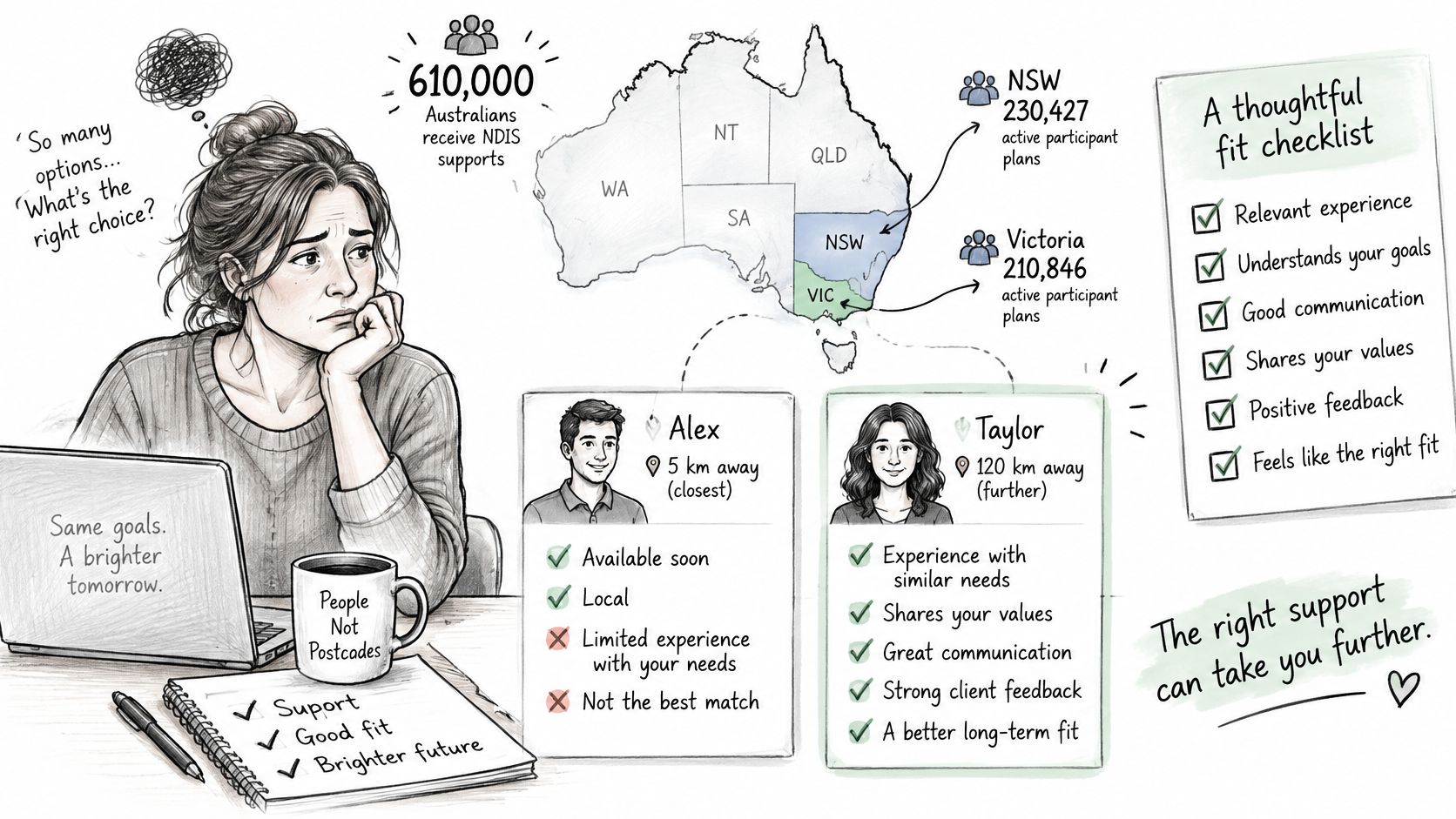
Say a nearby worker can cover your afternoons but not the morning personal-care routine you need. A worker travelling from a neighbouring area who understands your communication and can reliably cover mornings is the stronger candidate, provided the travel arrangement is workable.
Apply the same decision rule
- Filter for serviceability. Keep workers who can support you in your state or territory and cover the exact days and hours.
- Assess suitability. Compare capability, communication, cultural fit and continuity arrangements against the same checklist.
- Use distance to decide between suitable candidates. Choose someone who meets every essential requirement, then favour the closest match.
Proximity still matters. Consider the journey involved, potential travel charges and whether the worker can sustain the roster, rather than accepting a good personal match with an impractical commute.
This video offers another starting point for considering your support options.
We consider the days, times and location of support when matching nearby workers. That helps make locality part of a workable arrangement, rather than a promise based only on your postcode.
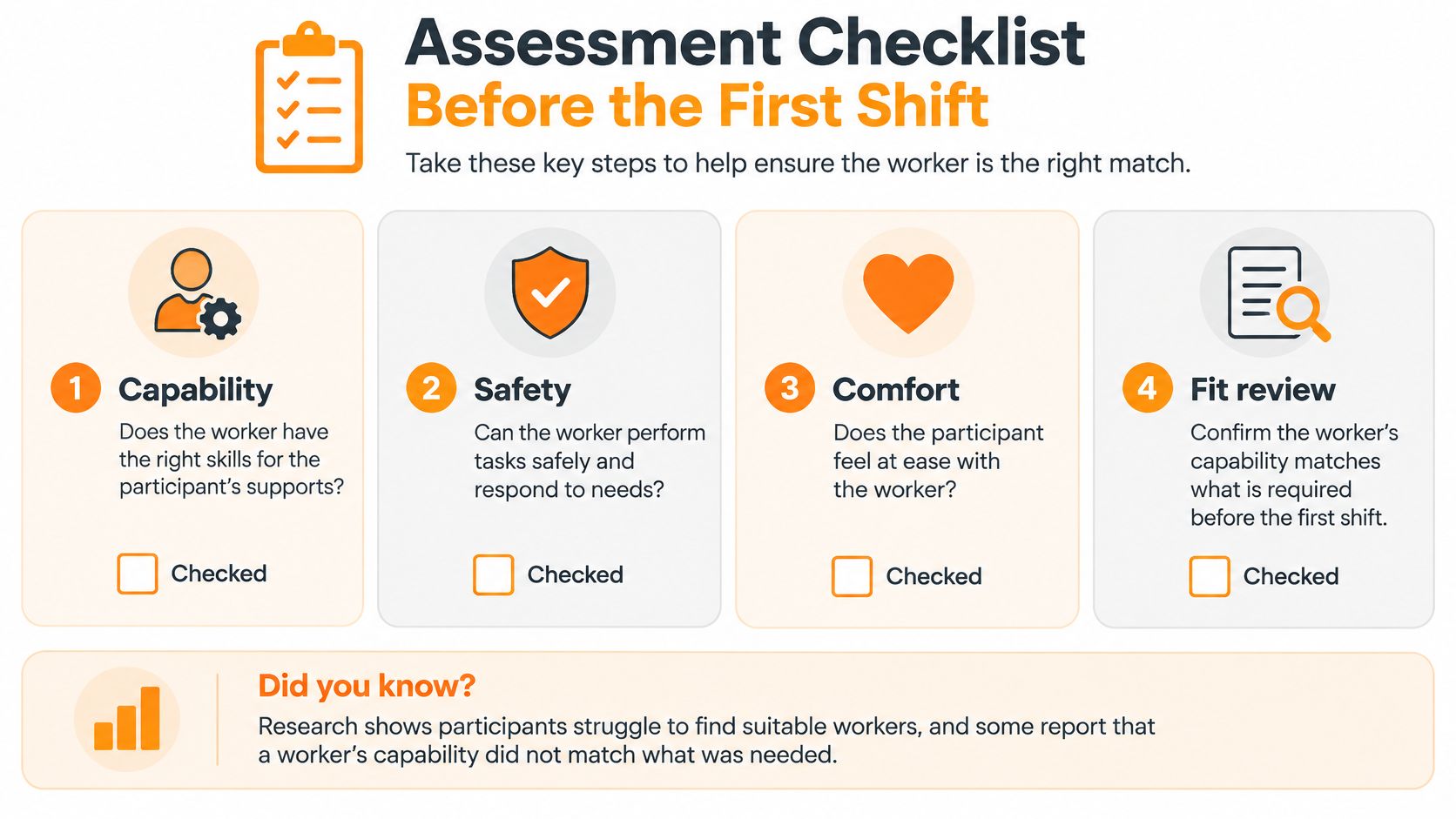
Assessment Checklist Before the First Shift
Capability is a safety question as well as a comfort question. An NDIS participant outcomes report records difficulty finding suitable support workers and accounts of workers whose capabilities didn't match participants' expectations.
Before rostering, describe the competencies the shift requires. These might include following personal-care procedures, using a communication device, assisting with mobility, respecting behaviour-support boundaries, preparing suitable meals or planning community access.
Test what the worker can actually do
Ask the worker to talk through an ordinary task and a foreseeable difficulty. For example, how would they respond if you needed more processing time, declined an outing or couldn't complete your usual transfer?
A useful answer explains how they would follow your established instructions, seek clarification and recognise the limits of their role. Confidence without a clear method isn't enough.
| Criterion | What to ask or check | Red flag |
|---|---|---|
| Disability experience | Which disabilities have you supported, and how did you adapt? | Vague answers or no relevant experience |
| Communication and language | Which languages do you speak, and how will we share updates? | Cannot explain support in your preferred language or communication method |
| Cultural and religious fit | How would you support prayer times, food preferences and family roles? | Dismisses your preferences |
| Routine and reliability | How do you handle punctuality, changes and shift handover? | No plan for late arrivals or shift changes |
| Community access confidence | How do you support public transport and outings? | Unsure about your transport needs |
| Screening and orientation | Which checks are current, and what orientation is completed? | Checks aren't confirmed or are out of date |
| Boundaries and incident reporting | How do you respond to a fall, complaint or boundary concern? | No clear reporting steps |
Use the checklist to distinguish friendliness from readiness for the role.
Verify checks and preserve your say
Every candidate should have the checks required for their particular role. Our support workers hold the required checks, including the NDIS Worker Screening Check, but screening doesn't replace checking whether someone can deliver your specific support.
For tasks involving equipment or a documented support procedure, confirm how the worker will receive participant-specific instruction before performing them. Don't use the first shift as an unsupervised test of an unfamiliar task.
Our guide to questions to ask a support worker can help you prepare a conversation that goes beyond qualifications. Include how you prefer to receive updates, who may receive information about you and how you'll raise concerns privately.
A worker can be personable and still be the wrong match. You don't have to disregard discomfort because their profile looks suitable.
Mark each criterion meets, needs clarification or doesn't meet, using the same standard for every candidate. Keep essential requirements separate from preferences: shared interests can strengthen rapport, but they can't compensate for an inability to provide essential support safely.
Cultural and Language Matching Outside Major Cities
Consider a Korean-speaking participant in a country town who needs help preparing meals and attending appointments. The nearest available worker doesn't speak Korean and assumes a family member can translate every instruction.
That arrangement may leave the participant dependent on someone else to explain everyday choices. The better response is to widen the workable catchment while keeping direct communication and relevant cultural practices among the essential criteria.
Widen the area without weakening the requirements
The NDIS Quality and Safeguards Commission's corporate reporting identifies workforce sustainability, capability and diversity as priorities. For a participant choosing support, those priorities translate into practical questions about who can communicate effectively and maintain the required routine.
We match participants with Korean-speaking workers for everyday Core supports and consider language, culture and personality across Australia. A regional enquiry still needs an individual matching process; national coverage doesn't mean a suitable worker is immediately available in every town.
Describe cultural needs in concrete terms. Explain prayer times, food preparation practices, preferred ways of discussing personal care and the family's role, rather than expecting a worker to infer everything from a shared language.
Our information on culturally appropriate disability support explains the matching considerations. Cultural familiarity should support your choices, not lead someone to assume that everyone from the same background wants identical care.
Put continuity into the arrangement
A wider catchment introduces travel and replacement questions. Request written confirmation of any travel charges, the expected matching lead time and what will happen if your preferred worker is unavailable.
Ask how a replacement will learn your communication method and essential routines. If no suitable backup is currently available, you need that explained clearly so you can plan around the gap rather than assume uninterrupted cover.
Before signing, put these questions to the provider:
- Language and practice: Can you match on my language and cultural practices, not just location?
- Travel costs: Is travel time included in the quoted arrangement or charged separately, and where is that recorded?
- Cancellations and replacements: What notice applies, and how will you arrange replacement support at short notice?
Don't assume a change of worker will happen without disruption. Agree how essential daily-living and community supports will be maintained during the transition.
Common Problems and How to Fix Them
A common practical obstacle is finding no suitable worker for the requested suburb and hours. That doesn't automatically mean you need to abandon a necessary requirement; first identify whether location, timing or a particular skill is restricting the match.
Once support begins, distinguish an isolated problem from an arrangement that isn't working. Record what happened, what support was affected and what needs to change, rather than relying on a general statement that the shift went badly.
| Problem | Likely cause | Fix |
|---|---|---|
| No worker found in your suburb | Few local workers for the hours needed | Widen the area, consider genuinely flexible days or hours, or request nearby workers |
| First worker doesn't suit | Skills, language or routine mismatch | Review the profile, clarify the mismatch and request a different worker |
| Regular worker unavailable | Leave or emergency | Request the backup worker and continuity plan in writing |
| Missed or cancelled shifts | Rostering gaps | Confirm the contact process, notice period and cancellation rule in the agreement |
| Support drifts from goals | No scheduled review | Set check-ins against your stated outcomes |
| Costs higher than expected | Different time-of-day rates, travel or unclear charges | Recalculate with the hours calculator and confirm each block's rate and additional charges |
Review outcomes, not just completed shifts
A full roster doesn't tell you whether support is helping you do what matters. The NDIS Outcomes Framework participant report recorded 83.7% of participants participating in activities that interest them, illustrating why the activity and its relevance belong in a support review.
Make your own review specific. If the aim is maintaining friendships, discuss whether you're reaching the people you want to see, not just whether the worker took you out of the house.
Keep a usable record: Note the concern, the agreed action, who will act and when you'll check the result.
You meet your preferred worker before supports start with us, and you can ask for a change at any time. You don't need to wait until an uncomfortable or unsuitable match becomes a crisis.
For an immediate safety concern, prioritise safety and seek appropriate urgent assistance rather than waiting for a routine review. For other problems, a documented action and a clear follow-up date give everyone something concrete to resolve.
Make the Final Call
Choose from workers who can cover your actual roster and meet your essential support requirements. Don't let pressure to fill an empty shift turn an unresolved safety or communication concern into an accepted compromise.
Confirm the arrangement before starting
Narrow the shortlist. Keep candidates who pass the location and availability filter, then compare their checklist results. Where something remains unclear, resolve it before treating the candidate as suitable.
Check the written agreement. Confirm that your plan funds the support, identify the budget line and record the rate for each block of hours. Check travel charges, cancellation terms and the contact process for a missed shift.
Centre the participant's decision. Arrange the meet and greet with family or another trusted person present only if the participant wants that support. Leave room for the participant to say no without having to defend their preference.
Among workers who meet every essential criterion, favour the closest workable match. Put an early review in the diary and use it to check comfort, reliability and whether support follows the agreed routine.
You can start through our website or call 1300 543 123. Have your support list ready so the enquiry begins with what you need, not just where you live.
Enrichment Care matches participants with nearby NDIS support workers according to their needs, routines, language, culture and interests. Visit Enrichment Care to share your location and required hours, review suitable worker profiles and arrange a meet and greet before support begins.