NDIS Travel Allowance Explained: Levels, Limits and Rules
Understand NDIS travel allowance levels, who qualifies, and how provider travel time and kilometres are charged. Check your service agreement first.
If your NDIS plan includes transport funding, does that mean every kilometre you travel is paid for? Not necessarily. The phrase NDIS travel allowance can hide an important difference between money for your own transport and charges for a support worker's travel.
Understanding that difference helps you plan outings, compare costs and question an invoice without guessing. The starting point is your plan, not the distance on the car's trip meter.
NDIS Transport Funding Levels at a Glance
The NDIS doesn't pay a flat travel allowance for every trip. What people commonly call a travel allowance is recurring transport funding, with an annual amount linked to the participant's circumstances.
The NDIS recurring supports guidance sets out the following indicative annual funding levels and their work, study and community-access conditions.
NDIS transport funding levels (indicative annual amounts)
| Level | Annual limit | Who it suits | Key condition |
|---|---|---|---|
| Level 1 | Up to $1,784 a year | Not working, studying or attending day programs | Wants to increase community access |
| Level 2 | Up to $2,676 a year | Part-time work or study, day programs, social or recreational activities | Works or studies up to 15 hours a week, or attends day programs |
| Level 3 | Up to $3,456 a year | Working or studying at least 15 hours a week, or looking for work | Disability prevents use of public transport |
These are indicative levels, not a promise that everyone in a particular situation receives the maximum. Your approved plan amount is the figure to use when organising your transport spending.
A budget rather than a kilometre counter
Think of recurring transport funding as an allocated budget, not a meter that adds money whenever you travel. Your participation circumstances help determine the funding level. Travelling further doesn't, by itself, move you into another level.
For example, someone travelling to a nearby day program and someone travelling further to a similar program may face very different expenses. Distance matters when assessing whether arrangements are practical, but it isn't the organising principle behind the indicative levels.
Budgeting rule: Start with the transport amount in your plan, then work out which travel arrangements it can reasonably support.
Keep transport funding distinct from other assistance you might need during an outing. Help with getting ready, participating in an activity or managing tasks in the community can involve different support arrangements. Our guide to NDIS core supports can help you identify those broader needs.
Before committing to regular bookings, confirm your approved transport amount, how it's paid and which expenses you'll meet from it. Don't build a travel schedule around the highest indicative amount just because your circumstances appear to match a table row.
Who Qualifies for NDIS Transport Funding
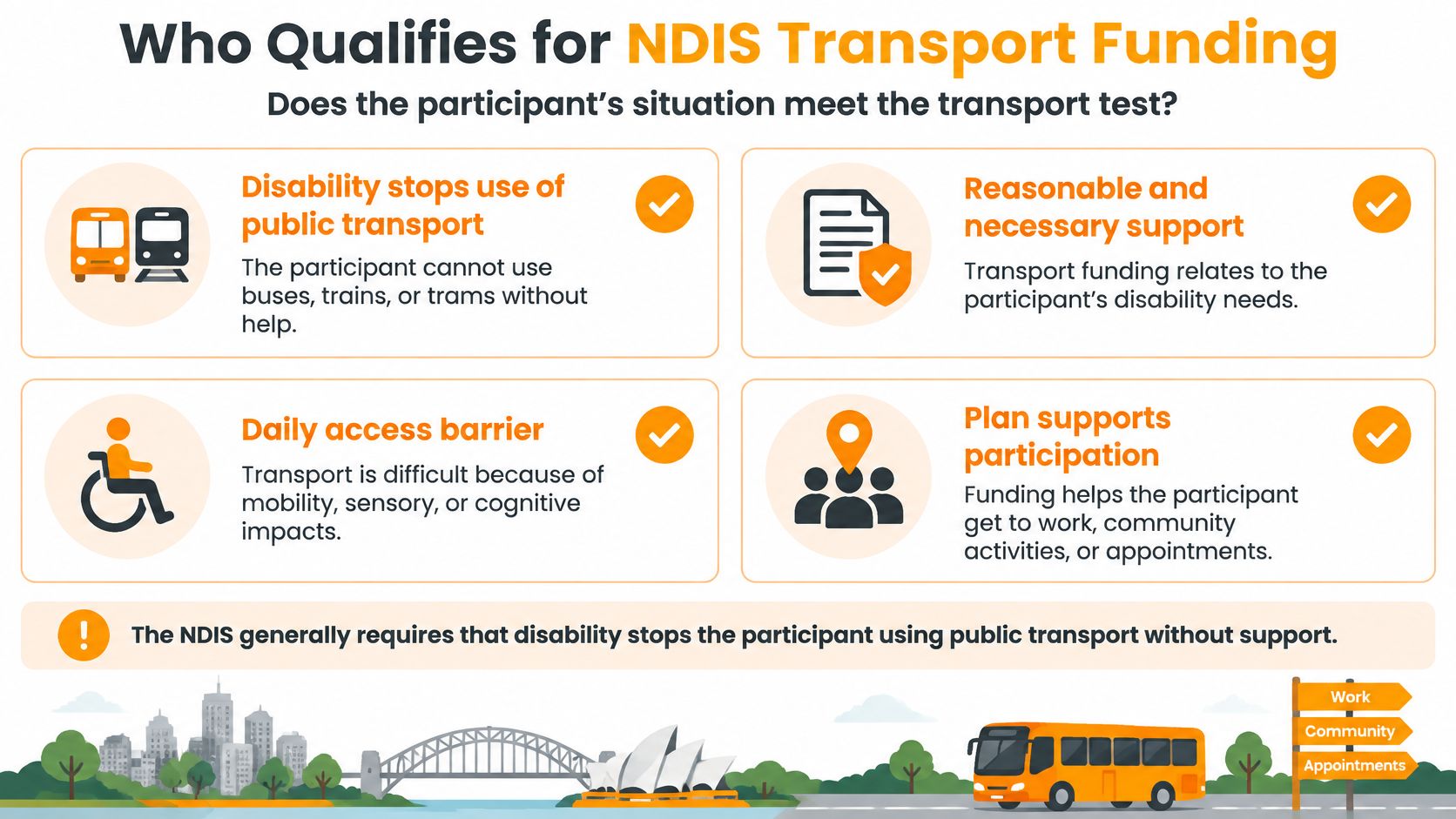
The central eligibility question is whether disability prevents you from using public transport without substantial difficulty. Having an NDIS plan doesn't automatically mean every transport expense qualifies.
Think of eligibility as checking the barrier before choosing the solution. A taxi might solve a travel problem, but the question is why that alternative is needed, not whether it would be more convenient.
Questions to prepare for your planning conversation
Is disability the reason public transport is difficult? Describe what happens when you try to use a bus, train or tram. Distance, limited services or cost alone don't explain the disability-related barrier.
What are your work or study commitments? Record your usual weekly hours and whether you're looking for work. Include the actual timetable rather than relying on labels such as casual employment or part-time study.
Do you attend a day program or want greater community access? Identify the activities you want to reach and what prevents you getting there. Being able to name the destination helps connect the request to participation.
Whose travel need is being addressed? Distinguish your journey to an activity or appointment from an ordinary family transport responsibility. Transport funding doesn't cover assistance for carers driving family members to ordinary commitments.
The checklist below provides a visual starting point. When describing your needs, focus on substantial difficulty, not just whether you can board a vehicle with someone's help.
Describe the journey, not just the diagnosis
Say a participant works part-time and has a vision impairment that prevents them safely identifying the right bus and navigating the interchange. Their employment pattern helps identify the relevant funding circumstances, but it doesn't replace the public-transport eligibility test.
A useful explanation describes the route, the task that becomes difficult and the consequence. For example, difficulty reading changing platform information is more informative than writing that train travel is stressful.
Before a planner meeting, prepare a short note covering usual destinations, weekly commitments and disability-related barriers. Include any assistance or alternatives you've tried and explain why they didn't reasonably meet your needs.
A family member's availability can be relevant context, but keep the request centred on the participant. Explain the access need rather than presenting the request only as reimbursement for a relative's driving.
Participant Transport and Provider Travel Are Different
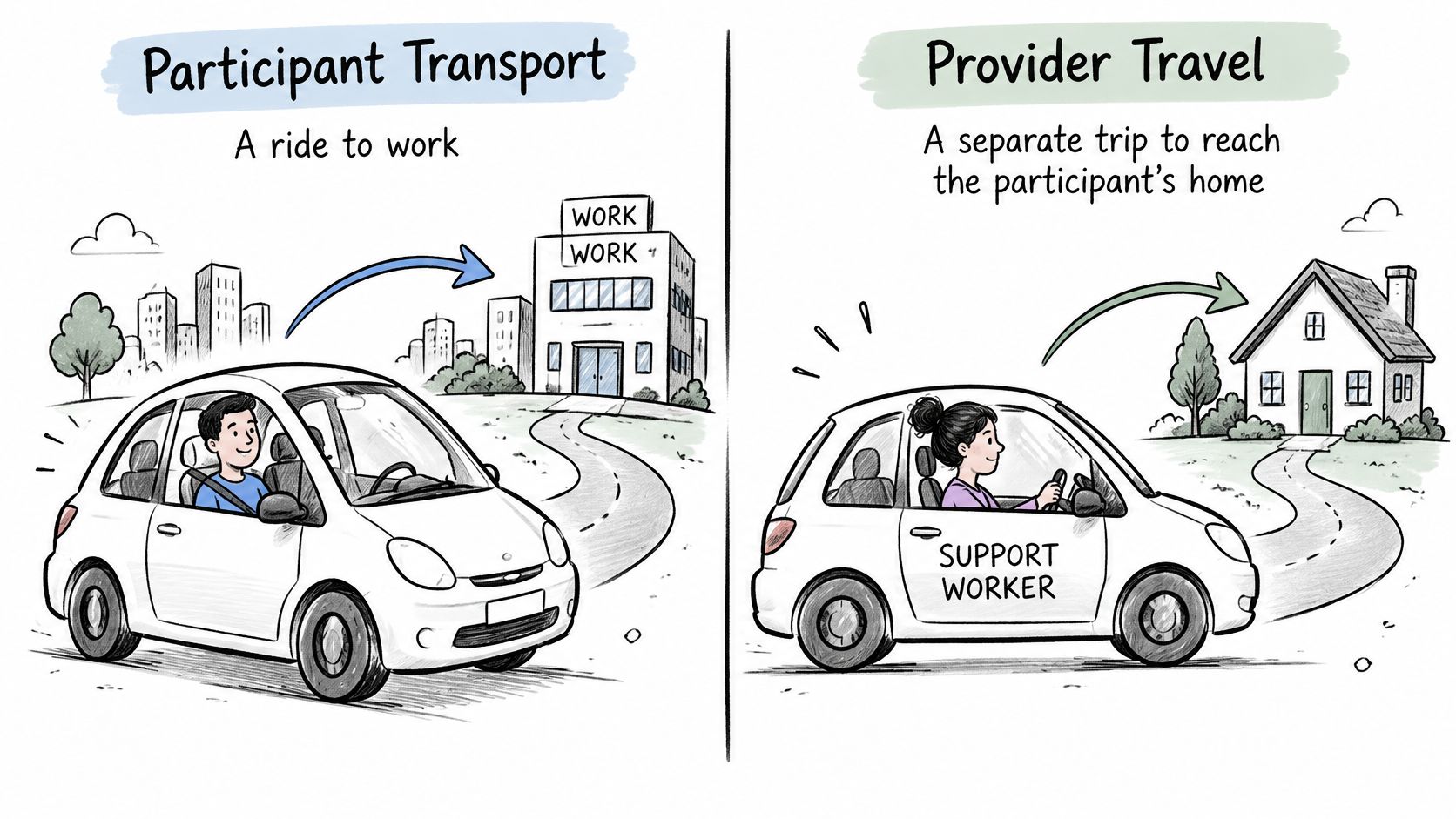
Participant transport is the ride you take. Provider travel is the worker's journey to reach you. Think of the difference between receiving a service and the person delivering it travelling to your address.
This illustration separates the journeys before any charges are calculated.
The NDIS Pricing Arrangements and Price Limits distinguish participant transport from provider travel and allow agreed support time and associated non-labour transport costs when a worker transports a participant during community participation. Participant journeys can include work, study, appointments, day programs and social activities.
Follow the worker through an outing
Say a worker drives to your home, supports you to attend a community art class and drives you home afterwards. The worker's journey to collect you is provider travel. Their assistance during the outing is support delivery, while the vehicle expenses associated with transporting you are a separate cost component.
That means an outing can involve more than a fare. There may be worker time, vehicle costs and expenses such as parking, each needing the appropriate treatment rather than being hidden inside a single unexplained total.
The distinction doesn't mean every possible charge is automatically payable. The support, agreement, applicable claim rules and funding arrangements still need to fit.
Ask what each charge represents before asking whether its amount is correct.
For practical questions about vehicle arrangements and assistance during journeys, read whether a support worker can drive you.
The video below offers another way to approach travel and transport support.
Read an invoice as a record of separate tasks
An invoice should let you recognise the journey and support you agreed to receive. A general description such as transport services doesn't tell you whether you're paying for the worker coming to you, your own trip or assistance during the activity.
Use these questions when checking a charge:
- Who travelled? Was the worker alone or accompanying you?
- What was the purpose? Was the journey to deliver support or part of your activity?
- What is being charged? Identify worker time, kilometres and other expenses separately.
This approach helps you query the correct part of an invoice instead of assuming all travel costs belong to the same allowance.
Provider Travel Time and Kilometre Rates
Time and kilometres measure different costs. A travel-time limit controls how much eligible worker travel time can be claimed. A vehicle rate concerns the cost of using the vehicle.
The NDIS pricing document covering provider travel gives the following limits, vehicle amounts and example agreed travel rate under the 2025–26 pricing rules.
Provider travel limits and rates under the 2025–26 pricing rules
| Item | Limit | Notes |
|---|---|---|
| Travel time, metropolitan and regional (MMM1–3) | Up to 30 minutes per participant | Claimable worker travel time |
| Travel time, remote (MMM4–5) | Up to 60 minutes per participant | Claimable worker travel time |
| Travel time, very remote (MMM6–7) | Negotiated with participant | Subject to applicable support-rate limits |
| Vehicle, non-modified | Up to $0.99 per km | Provider vehicle transport |
| Vehicle, accessible or bus | Up to $2.76 per km | Accessibility-modified vehicle or bus |
| Example agreed travel rate | $0.78 per km | Example rate in the pricing rules |
| Tolls, parking, public transport fares | Up to full cost | Claimed separately from core supports |
Apply the right rule to the right journey
The MMM classification identifies the location category used for travel-time arrangements. Confirm the applicable category rather than assuming that a place described locally as regional or remote falls into a particular pricing group.
For the first categories in the table, the cap limits eligible worker travel time per participant. For the negotiated category, an agreement still needs to stay within applicable support-rate limits. Negotiated doesn't mean unrestricted.
The vehicle rows concern transport delivered in a provider vehicle. The example agreed travel rate serves a different purpose and shouldn't be treated as a universal reimbursement amount or swapped automatically with a provider-vehicle rate.
Likewise, up to full cost for parking or fares means the actual eligible expense, not a standard surcharge. Keep the receipt so the amount can be checked.
Work through the calculation
For a hypothetical unmodified-vehicle journey, multiply the agreed eligible kilometres by the applicable vehicle rate. Then check worker time separately, rather than assuming the kilometre calculation includes the worker's assistance.
For worker travel to a metropolitan participant, compare the recorded journey duration with the applicable time cap. If the worker's journey exceeds that cap, the extra driving time doesn't automatically become claimable from that participant.
Non-labour provider travel costs should use the relevant Provider Travel non-labour costs item, not be bundled into the underlying support claim. Clear itemisation makes it possible to check both the calculation and its purpose.
These are historical pricing-period figures, not a guarantee of the rates applying to your next booking. Check the arrangements in force on the service date and consult our NDIS price limits guide when reviewing a new agreement.
How to Charge and Record Transport Costs
A useful transport record works like an itemised shopping receipt. You should be able to identify what was delivered, why it was needed and how the total was calculated.
The NDIS transport funding guidance states that recurring transport funding is paid fortnightly in advance to the participant and that participants should use the least expensive transport option that reasonably meets their disability-related needs. Cheaper isn't suitable if it doesn't meet those needs.
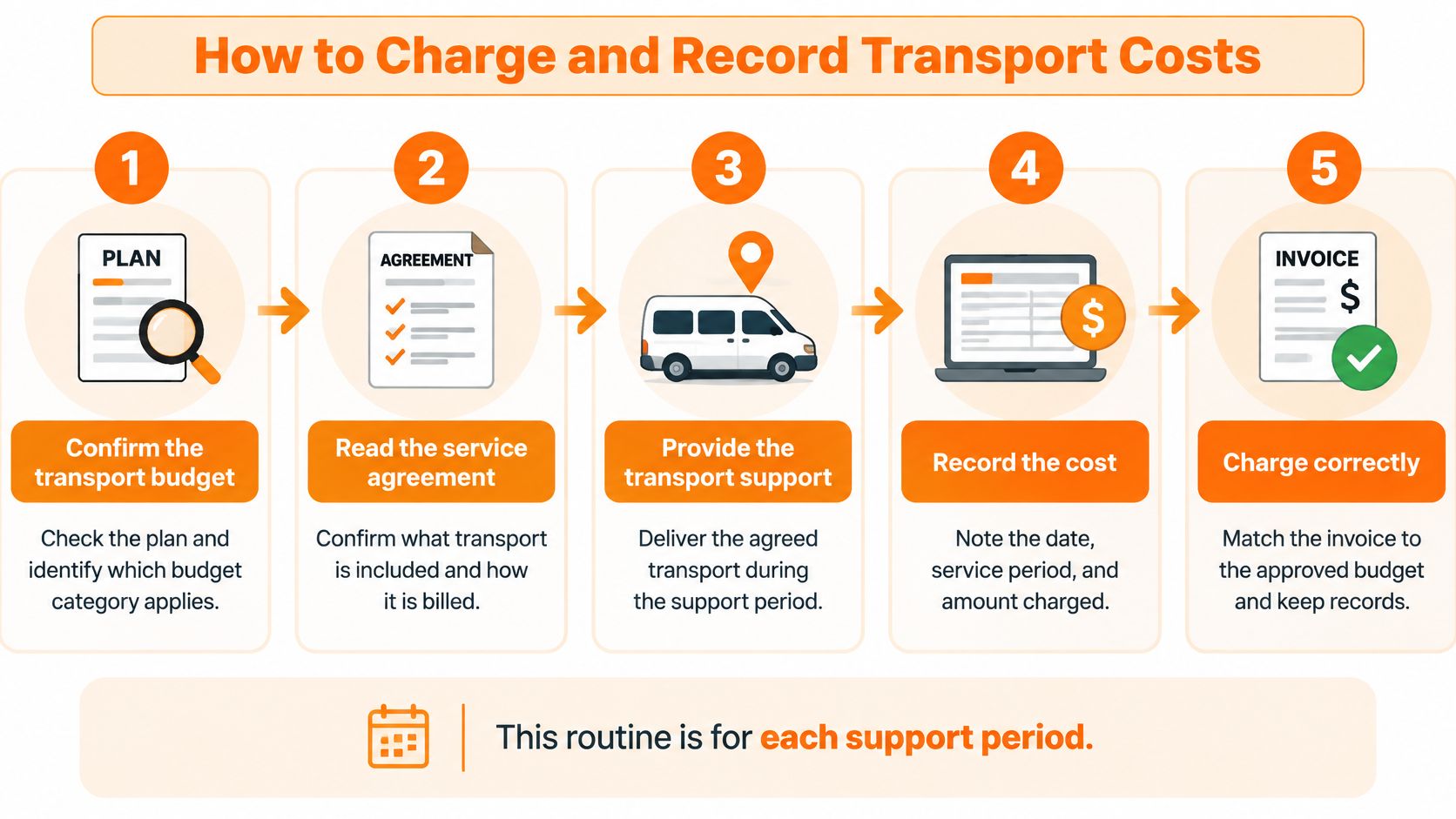
A routine for each support period
Confirm the available funding. Read the plan and identify the budget category and payment arrangements that apply to the journey. Don't assume an amount shown elsewhere in the plan is available for the expense you're considering.
Read the transport clauses. Check whether the agreement covers delivering transport, accompanying you or coordinating a booking. Our service agreement sets out supports and costs under NDIS pricing rules, so use it to establish what's included before travel occurs.
Track spending against the allocation. Set a monthly budget check and include upcoming regular journeys, not just invoices already received. Money arriving in advance can otherwise appear available even though it's needed for future commitments.
Record the trip details. Keep the participant's name, service date, purpose, travel time, kilometres and vehicle type together. Leaving out the vehicle type makes it harder to check whether the selected rate matches the service.
Explain the transport choice. Note why the option reasonably meets the disability-related need, especially if a less expensive alternative wouldn't work. For example, record an accessibility requirement rather than writing only that a car was preferred.
Keep expenses identifiable. Retain receipts for tolls, parking and fares, with a clear connection to the relevant journey. Bundling them into an hourly charge makes reconciliation difficult and can lead to an invoice needing correction.
Check before submitting and reconcile afterwards. Confirm the plan-management requirements and match the claim to the agreed service and available funding. At month end, compare trip records, invoices and payments so an error doesn't carry into later billing.
The flowchart summarises the main stages of that routine.
Keep a record you can actually use
A spreadsheet, accessible notes app or paper folder can work. Choose a format you or your nominee can maintain consistently, and keep receipts alongside the trip entry rather than in an unrelated message thread.
Before paying: You should be able to match the invoice to a real journey, an agreed charge and the relevant funding arrangement.
If something doesn't match, identify the specific entry and request an explanation or correction. A clear question about a journey or receipt is easier to resolve than a general objection to the monthly total.
When the Transport Budget Falls Short
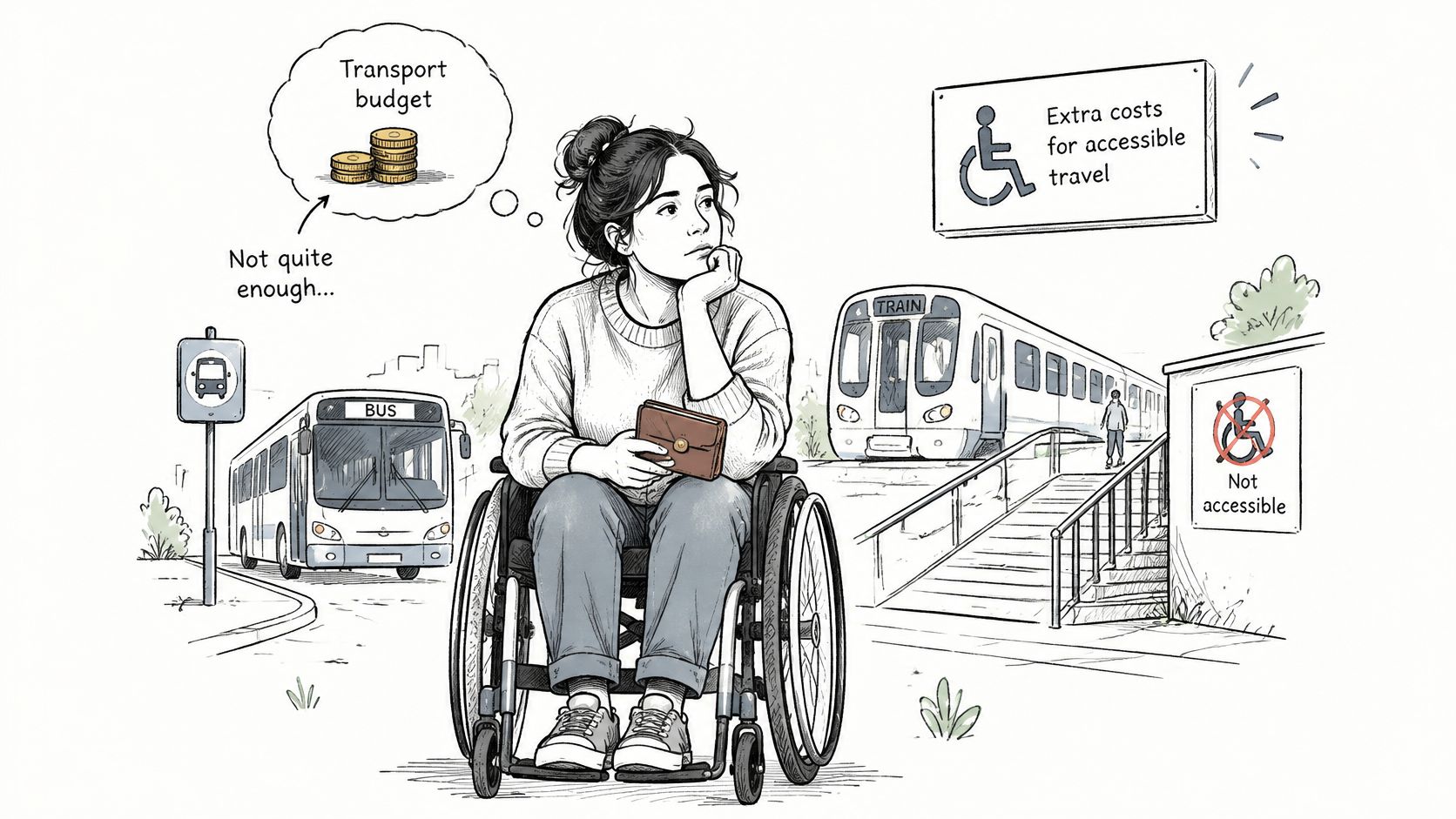
An approved transport amount doesn't necessarily mean your actual travel needs will fit comfortably within it. Equally, exhausting the budget doesn't automatically authorise more spending.
The NDIS material discussing transport support boundaries and taxi subsidies identifies uncertainty about participants who can use public transport in some circumstances but not others. It also describes an automatic transport-funding increase for participants with high out-of-pocket taxi costs from 3 November 2025, alongside NDIS funding of taxi subsidy scheme costs.
Changing capacity needs a clear explanation
The intermittent-use boundary remains unclear. Someone may manage a familiar route when rested but be unable to make the return journey after fatigue, pain or sensory overload.
Think of public-transport capacity as the ability to complete a particular journey under particular conditions, not a yes-or-no label. Document what changes, how it affects the journey and why the available alternative is necessary.
The image below reflects the practical access barriers that a budget conversation needs to address.
Transport budget situations and next steps
| Situation | What to check | Next step |
|---|---|---|
| Budget used up before the plan year ends | Trip pattern against the annual amount | Raise a plan review with the planner or coordinator |
| Capacity changes with fatigue, pain or sensory overload | Dated notes showing when public transport is not possible | Share the notes at the next plan review |
| High out-of-pocket taxi costs | Taxi receipts and any state or territory taxi subsidy | Ask whether the automatic increase applies |
| Regular trips to regional or remote services | Distance, travel time and frequency of appointments | Ask the planner whether the budget reflects the distance |
| Weather or safety risks on public transport | Documented risk and alternatives already tried | Record the risk and request a reassessment |
Don't assume a taxi increase applies to everyone
The announcement shouldn't be read as a blanket increase for every participant who takes taxis. Public-facing information doesn't clearly settle how high costs are assessed or exactly how each state or territory subsidy interacts with an individual plan.
Check whether an increase has been applied and how the subsidy affects your out-of-pocket amount. Keep the original fare, subsidy and amount you paid distinguishable in your records.
For a review conversation, bring dated notes, receipts and a trip log. Include occasions when you could use public transport as well as those when you couldn't, so the explanation shows the pattern clearly.
Requesting a review or reassessment is a way to have the need considered, not a guarantee of additional funding. While awaiting advice, discuss workable alternatives before committing to expenses you may have to meet yourself.
Check Transport Terms Before Your First Trip
Ask for the transport terms in writing before agreeing to support. Start with these questions: is the worker delivering transport or only coordinating travel, how will time and kilometres be itemised, and where will tolls, parking and fares appear?
Written terms are like agreeing on the ingredients before ordering a meal. They help you understand what's included and what attracts a separate charge, rather than discovering the distinction after the service.
Make the agreement easy to check
At Enrichment Care, our service agreement sets out supports and costs under NDIS pricing rules. Provider travel and kilometres for travel and transport are claimed under the NDIS Pricing Arrangements, so check that those entries are identifiable rather than hidden within the core-support rate.
- Confirm your plan. Check that it's active and identify the transport funding and other relevant support budgets.
- Read the agreement. Match the transport clauses to the questions about delivery, time, kilometres and expenses.
- Request a sample invoice. Check how travel time, kilometres, vehicle type and supporting receipts will be presented.
- Name the budget checker. Agree in writing who'll monitor the balance each month and raise any discrepancy.
Don't use a support-hours estimate as the total cost of an outing. Our support hours calculator covers support hours only and doesn't include travel or other costs.
Before the first booking, ask for any unclear transport terms to be explained in writing. That gives you a practical basis for deciding whether the arrangement fits your needs and budget.
Enrichment Care offers travel and transport support to help NDIS participants reach work, study, appointments and time with friends. Visit Enrichment Care to discuss your plan and request written transport terms before your first trip, including how worker travel, kilometres and other expenses will be charged.