Respite Care Toowoomba: Options and Eligibility
Respite Care Toowoomba explained: options for NDIS participants and carers, how to check eligibility, what funding covers and urgent help.

You're up for the third time before dawn, your own medical appointment is tomorrow, and the person you care for can't be left alone while you go. You don't need a lecture on self-care. You need someone reliable to step in, a clear answer on who pays, and a plan that won't fall apart if one worker is sick.
That's the key question behind respite care Toowoomba families ask about. It's rarely, "Where's a list of providers?" It's, "Who is running out of capacity in this house, what kind of break would help, and will the funding we have cover it?" Start with those three questions, and the right option usually becomes much clearer.
Respite Options in Toowoomba at a Glance
Most households only need one or two rows from this table. Find your row first, then read the detail for that row. Don't try to become an expert on every pathway.
| Option | Who it suits | How it is funded | Where to start |
|---|---|---|---|
| NDIS short-term accommodation | Participants who need a stay in a different place | NDIS plan funding, up to 14 days at a time | Support coordinator or NDIS planner |
| NDIS in-home or community respite | Participants who need a worker to step in at home or out in the community | NDIS plan core supports | Provider or support coordinator |
| Family-arranged respite | Households wanting a known relative or friend to provide the break | Plan funds possible, but approval is not guaranteed | Planner, before any booking is made |
| Carer Gateway support | Carers needing a break, advice or short-term help | Government carer programs | Carer Gateway |
| Aged care respite | Older people receiving aged care and their carers | Aged care funding assessed through My Aged Care | My Aged Care |
| Emergency or crisis respite | Carers who become suddenly unwell or unavailable | Crisis pathway first, funding sorted after safety | Call 000 if anyone is in immediate danger |
Three Questions That Pick Your Row
First, who's the support for? An NDIS participant, an older person in aged care, and a carer with neither link start in different places, even if the daily tasks look identical.
Second, when do you need it? A break planned weeks ahead is a plan question. A break needed tonight is a crisis question. Families get stuck when they use a planned pathway for an urgent problem, or panic-book something urgent when they had time to plan.
Third, where should the break happen? Some participants relax better in their own home with a familiar worker. Others enjoy a short stay somewhere else, with different activities and people. Neither is better. The right choice depends on routines, communication needs, and what gives the carer a genuine rest.
Quick Reading Tips
- Planned break, NDIS participant: Start with eligibility and what's already in the plan.
- Sudden break needed: Go straight to the urgent pathway table further down.
- Carer without an NDIS or aged care link: Carer Gateway is usually your first call, because it supports carers directly.
If you can't name which funding system you're in, don't book anything yet. That one answer changes who approves the break and who pays for it.
What Respite Care Means for Carers and Participants
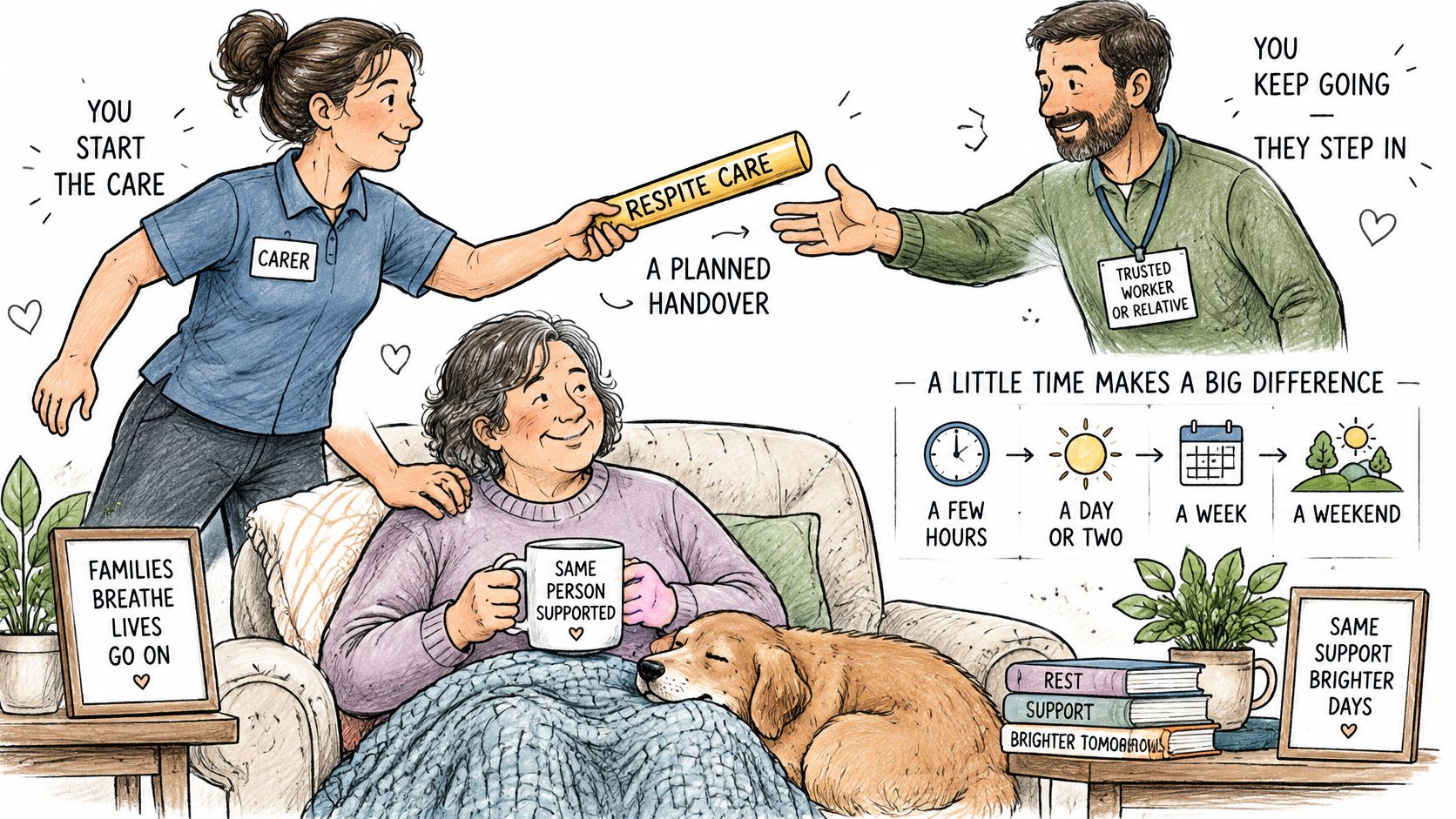
Think of respite like a relay race. The carer carries the baton most of the time, then hands it to a trusted worker, centre, or relative for a few hours, a weekend, or longer. Then the carer takes it back, rested enough to keep going. Nobody has quit the race. The team has just shared the running.
Say a mother in Highfields supports her adult son with showering, meals, medication prompts, and getting to appointments. A worker comes on Saturday morning, follows his usual routine, and takes him to a community activity he already enjoys. She sleeps, sees a friend, and does the grocery shop without rushing. That's respite, even though nobody stayed overnight anywhere.
Three Kinds in Plain Terms
- Planned respite: Booked weeks ahead, often regular, like every second Saturday.
- Short-term respite: A stay of several days away from home, or a block of extra support at home.
- Emergency respite: Help arranged quickly when the carer is suddenly unwell or unavailable.
Good respite protects the participant too. Routines continue, familiar people stay involved where possible, and community contact doesn't stop just because the usual carer is resting. A break that leaves the participant distressed hasn't really given anyone a rest.
This isn't a small local issue. The Toowoomba profile of need for assistance reports that in the 2021 Census, 12,181 residents of the Toowoomba Regional Council area, 7.0% of the population, reported needing help with day-to-day activities because of a severe or profound disability. That was up from 9,427 residents, or 5.9%, in 2016, and higher than the 6.3% recorded across regional Queensland.
At kitchen-table level, those figures mean thousands of households where one family member often carries most of the daily support with self-care, mobility, or communication. When that one person gets sick, works extra shifts, or burns out, the whole arrangement wobbles.
Respite is a planned pause in care, not a withdrawal of it.
How to Check Your NDIS Eligibility for Respite
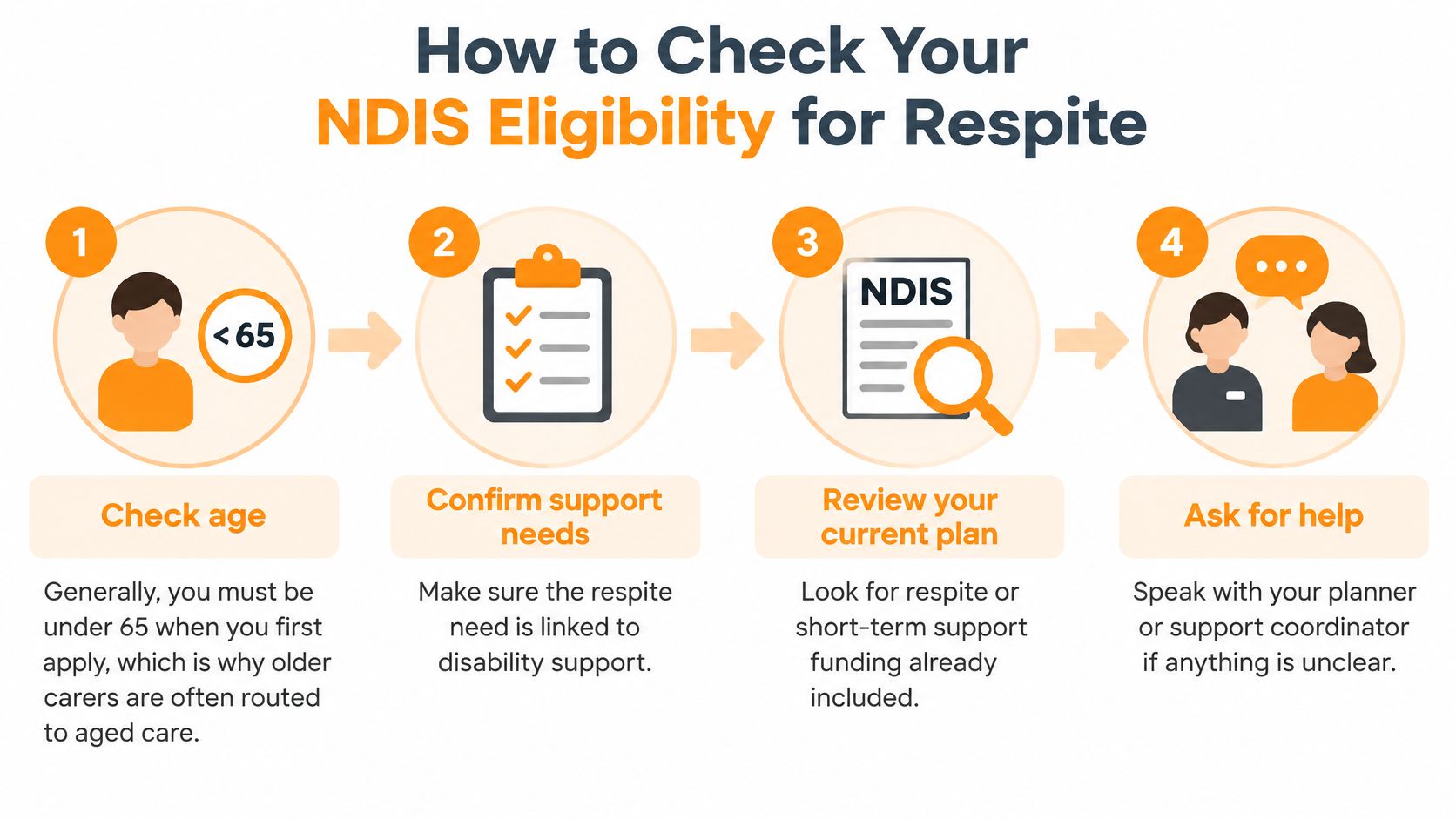
Eligibility confuses families because two different questions get mixed together. First, can the person access the NDIS at all? Second, does their plan include funding that can be used for a break? You need a yes to the first before the second matters.
The Steps in Order
Check age. Generally, you must be under 65 when you first apply. That's why many older carers and older people with disability are routed to aged care instead. It's not a judgement on need. It's how the two systems divide responsibility.
Confirm residency. The applicant needs to be an Australian citizen, a permanent visa holder, or an eligible protected visa holder living in Australia. If residency is unclear, sort that out before gathering medical evidence, because it can stop an application early.
Confirm the disability and its impact. The disability must be permanent or likely to be permanent, and it must substantially limit daily life. That includes communication, mobility, self-care, decision-making, or social participation. The key word is impact. Two people can share a diagnosis and have very different support needs.
Gather evidence that shows daily life. Collect recent diagnosis letters, specialist reports, and allied health reports. Add clear notes on what help is needed each day, how often, and what happens without it. The NDIS decides on evidence, not on a diagnosis label alone, so a report that describes real mornings, mealtimes, and outings is far more useful than a one-line letter.
Lodge the access request. You can apply online, call the NDIS on 1800 800 110, or work through a local area coordinator or support coordinator. If paperwork feels overwhelming, ask for help at this stage rather than guessing. Our NDIS eligibility checker can help you think through the basic questions before you lodge anything.
Wait for the decision, then check the plan. Access alone doesn't create a respite budget. Once a plan is approved, ask the planner directly whether it contains respite or short-term support funding, and under which category. Get that answer in plain language. "You have core funding" isn't the same as "you can book a short stay."
If you don't meet the criteria, change pathway. Don't keep reapplying without new evidence. Move to Carer Gateway for carer support, or check aged care through My Aged Care if age is the reason.
Two Edge Cases Worth Knowing
A diagnosis alone doesn't guarantee access. Families are often shocked by this, but it explains why detailed functional evidence matters so much.
A plan with no obvious respite budget isn't always the end of the story. If caring arrangements have changed, or the current plan can't sustain the household, you can ask about a plan review or change. Bring evidence of what's changed, not just a statement that you're tired, even though that tiredness is real.
If There's No NDIS Plan
If the person you care for has no plan or isn't eligible, start with Carer Gateway, which supports carers directly and can offer short-term help and advice. At the same time, check whether the person may be eligible for aged care support through My Aged Care. You don't need to solve the funding puzzle alone before asking for help.
What Respite Funding Covers and What It Does Not
The NDIS home and living guidance describes short-term accommodation as care in another place for up to 14 days at a time. That 14-day cap is the anchor for most respite planning, but it doesn't tell you what a stay includes or what counts as everyday spending you still pay yourself.
Funding works like a permission slip, not a blank cheque. Each type of break sits in a different position, so read the table carefully before you book anything.
| Break type | Typical use | Funding position | What to confirm |
|---|---|---|---|
| NDIS short-term accommodation | A stay in a different place for up to 14 days at a time | Funded when it's in the plan and delivered under NDIS pricing | Whether meals, activities and worker accommodation are included |
| Family-arranged respite | A relative or friend provides the break | Not guaranteed; the planner needs to agree to the arrangement | Written approval before any booking |
| Support worker in the home | Personal care or household help while the carer rests at home | Core supports, if funded in the plan | Hours available and the worker's start date |
| Community participation | Outings and activities for the participant | Core supports, if linked to plan goals | Whether the outing connects to a goal in the plan |
| Holiday or leisure travel | Trips taken for enjoyment rather than care | Generally not funded as respite | Whether the planner agrees before you book |
| Interstate respite | Stay in another state when no suitable local option exists | Possible where the plan allows it | Whether the planner agrees before arrangements are made |
A Worked Example Families Recognise
Say you want your daughter to stay four nights with her aunt near Toowoomba so you can recover from surgery. It sounds sensible, cheaper than a provider, and your daughter knows her aunt well. A planner can still say no, because NDIS funding follows what's written in the plan rather than what looks reasonable on paper.
That doesn't mean family arrangements are always refused. It means the approval sits with the plan, not with how sensible the idea feels. Ask first, and treat any answer that isn't written down as unfinished business.
Before booking, ask these questions and keep the answers:
- Is the 14-day limit per stay or per plan period in this plan?
- Are meals and activities included, or are they everyday costs you pay yourself?
- Is the support person's accommodation funded, if a worker needs to stay over?
- Has the planner approved this exact arrangement in writing?
Practical rule: If it's not approved in writing, treat it as not approved. A friendly phone call won't carry much weight if a claim is questioned later.
Distance creates a second trap. A Toowoomba family may find the nearest suitable option sits hours away or across the state border, and the instinct is to book it and explain later. Resist that. The plan needs to allow travel or an interstate stay before you commit, so raise it with the planner first and get the answer in writing.
A short stay isn't the only way to get a break. The NDIS core supports information explains how everyday supports such as personal care and community participation can give a carer breathing room at home. For some households that's simpler than arranging accommodation; for others, only time away lets the carer properly switch off.
Local Respite Centres and Where Demand Sits
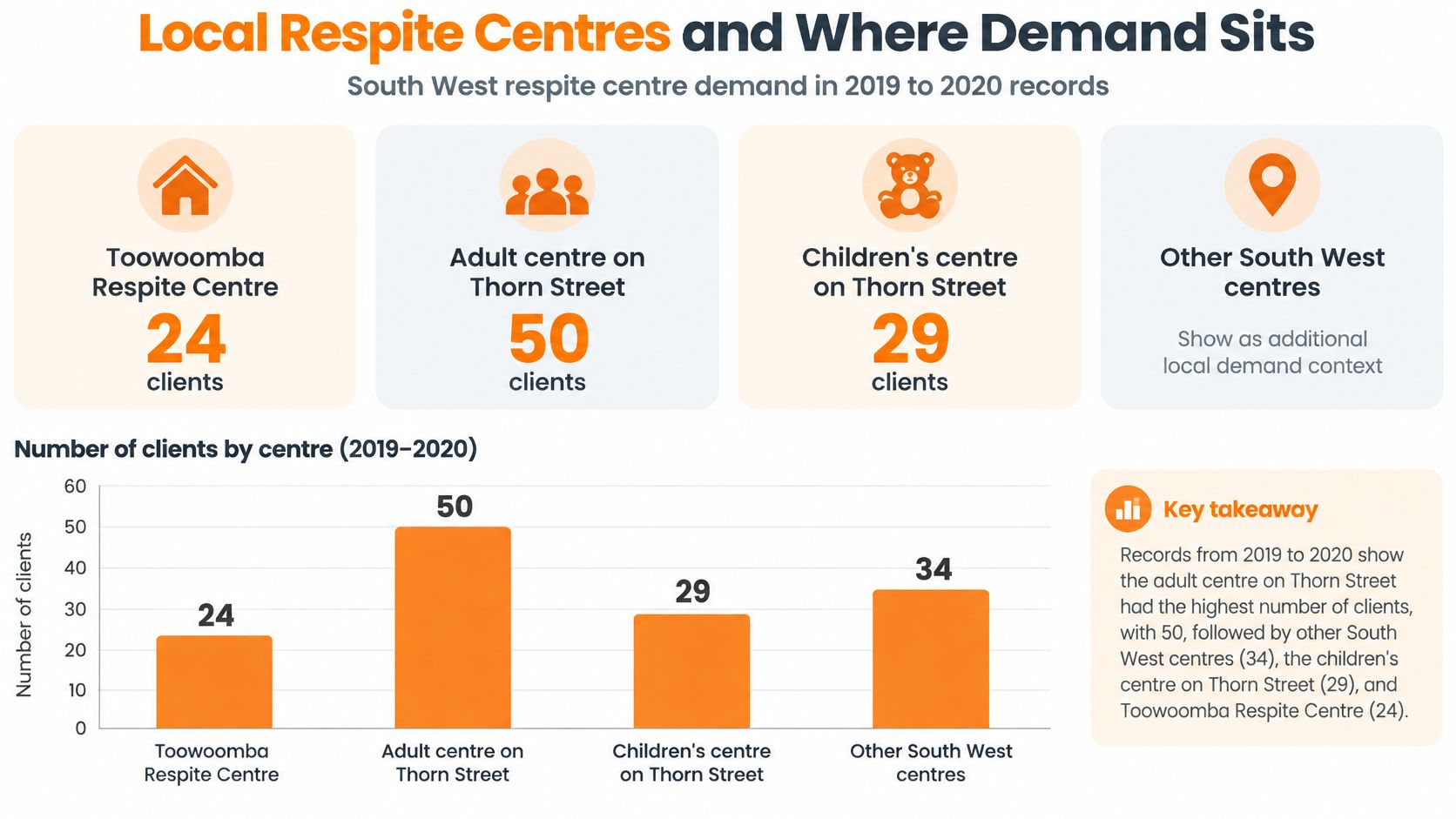
Toowoomba has a history of centre-based respite, but historic client counts aren't a booking guarantee. Confirm current opening hours, eligibility, and availability before you rely on any centre.
The Queensland Government response on departmental respite centres recorded 351 clients across 11 departmental centre-based respite centres statewide in 2019-20, including the South West centres listed below.
| Centre | Service area | Clients recorded |
|---|---|---|
| Toowoomba Respite Centre | South West | 24 |
| Adult centre, Thorn Street | South West | 50 |
| Children's centre, Thorn Street | South West | 29 |
| Robertson Road centre | South West | 2 |
| Statewide total, 11 centres | Queensland | 351 |
Demand now sits across a wide catchment, not just the city. The NDIS participant-by-LGA dataset reports 6,243 active participants in Toowoomba Regional Council as at 31 March 2026, compared with 5,919 one year earlier, with 1,327 participants in Southern Downs Regional Council and 1,059 in Western Downs Regional Council.
For a household in Warwick, Dalby, or a smaller town, that spread matters. A centre stay may involve long travel, and an in-home worker may need to be recruited locally rather than sent from Toowoomba. Ask early whether a local option exists. Our locations information is a starting point for checking service coverage, but the rostering questions matter more than a map pin.
Three Rostering Questions to Ask
- Travel distance: How far will workers travel to reach the participant, and is travel time built into the shift?
- Named backup: Is a backup worker identified before the first break, not invented on the day someone is sick?
- Same worker across areas: Will the same worker cover Toowoomba and surrounding shires, or will the participant meet someone new each time?
Outside our Surry Hills office, we recruit and match workers who live near the participant. Whoever you choose, insist on the same principle. Long travel plus no backup is how short breaks get cancelled.
Urgent Respite When a Carer Suddenly Cannot Cope
Emergency help and planned NDIS respite aren't interchangeable. In a crisis, you secure safety first, then sort out which funding system should have paid. Waiting for a plan decision while nobody can safely provide care tonight isn't a plan.
There's a local demand signal worth understanding carefully. The Carevo listing for respite care in Toowoomba City reports 36 care requests in the previous 90 days, with 50% marked urgent, across NDIS, aged-care and privately funded users. That's marketplace data, not an official population statistic, but it shows urgent need isn't rare or limited to one funding type.
Route by Situation, Not by Guesswork
| Situation | First step | Who to contact |
|---|---|---|
| Someone is in immediate danger | Call 000 now | Emergency services |
| Carer becomes unwell tonight | Ask for same-day advice and short-term help | Carer Gateway |
| Usual support worker unavailable this weekend | Request a backup worker from the provider | Provider or support coordinator |
| Plan has no suitable respite funding | Ask for a plan review or change | NDIS planner or local area coordinator |
| Older person in aged care needs a break | Ask about respite in their aged care arrangement | My Aged Care |
Have This Ready Before You Call
A short, written summary speeds up every urgent conversation and reduces mismatches:
- Diagnosis and current medications, including who gives them and when
- Communication needs, such as devices, gestures, or words the person uses for pain or toilet needs
- Cultural or language preferences, including food and personal care preferences
- Preferred or familiar worker's name, if there is one
- Emergency contacts and the GP's details
For participants with complex communication, behavioural, medical, or cultural needs, speed alone isn't success. A fast but poorly matched placement can increase distress for everyone. Say clearly what won't work, not just what you hope for. "He needs a female worker for showering" or "She becomes distressed with new people after dark" is useful, specific information.
In a crisis, the best question isn't "Who's cheapest?" It's "Who can safely follow this person's routine tonight?"
Confirm Your Respite Plan Before the Next Break
Do this checklist this week, while things are calm enough to think. A plan written during a crisis is usually shorter, riskier, and harder to fund.
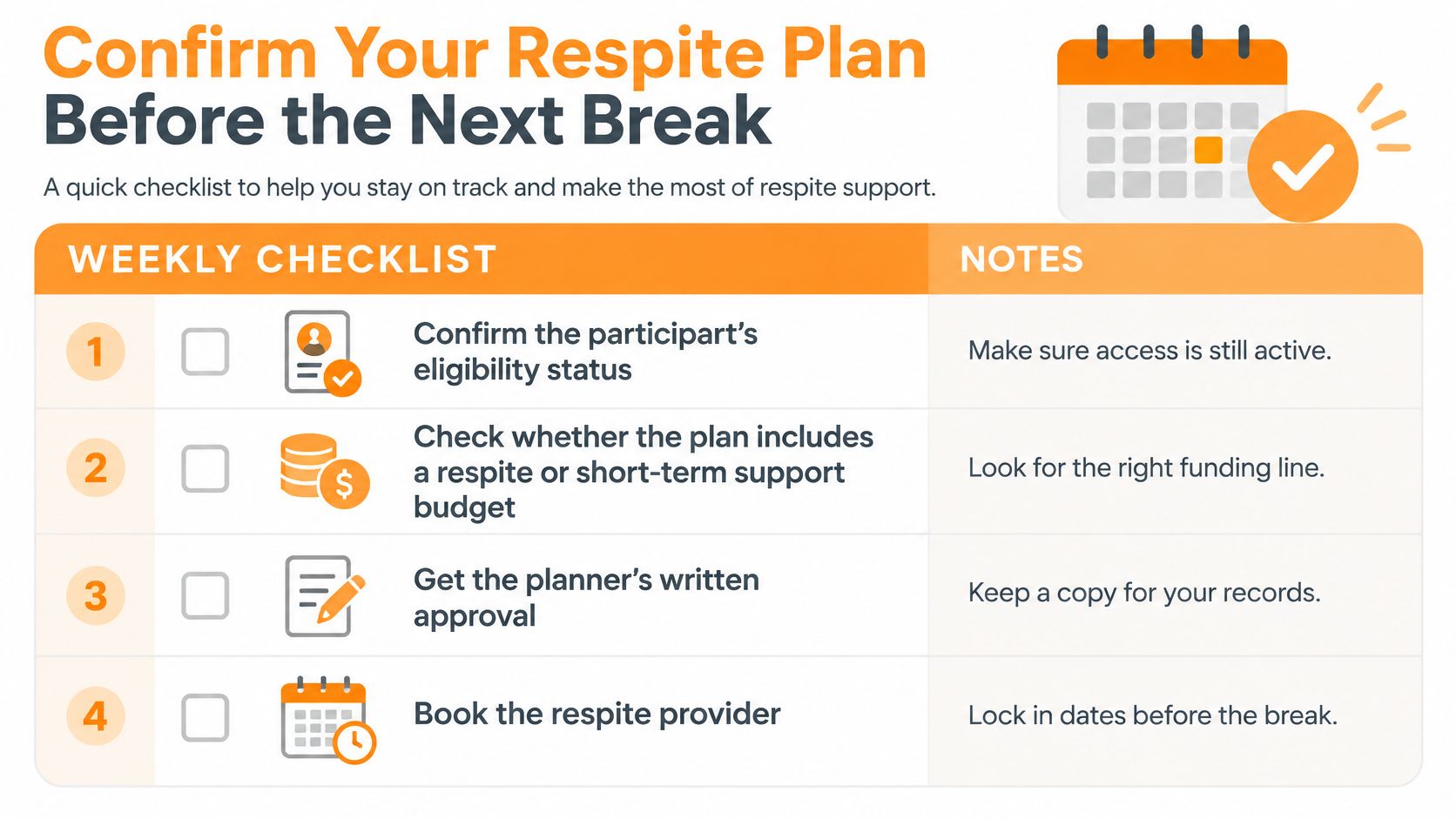
- Eligibility status: Confirm the participant's NDIS access or aged care status is current.
- Budget line: Check whether the plan includes a respite or short-term support budget, and name the category.
- Written approval: Get the planner's written approval before any family-arranged stay.
- Backup worker: Name a backup worker and make sure they've met the participant if possible.
- Preferences on record: Write down communication, language, cultural, food, and routine preferences.
- Crisis contact: Agree who to call first, second, and third if the carer can't cope.
One practical option is to talk with us at Enrichment Care. We arrange NDIS core supports and can send worker profiles so your household can choose and meet a worker before the first shift. To get started, families can call us on 1300 543 123 or send an enquiry, and we'll send worker profiles that match what they're looking for.
If you'd prefer another provider, a support coordinator, or a local area coordinator, use the same checklist with them. The checklist prepares a strong request. It doesn't guarantee approval, because the NDIS planner or support coordinator makes final funding decisions. That's exactly why written answers matter.
If you're organising respite care in Toowoomba and want in-home or community core supports from a worker your family has chosen and met first, talk to us about a roster that fits the participant's routines, language, and preferences. Visit Enrichment Care or call 1300 543 123 to request worker profiles and plan the next break before it becomes urgent.
Created with the Outrank tool