Support Worker Agency Perth: How to Choose
Use a support worker agency Perth shortlist only after screening, a meet and greet, a backup worker and a 2026 NDIS rate in the agreement.
Choosing the agency that can start fastest sounds sensible, especially when you're already stretched. But the first available worker isn't necessarily the person who can communicate comfortably, respect your routines and keep returning on the days you need. When choosing a support worker agency in Perth, judge the proposed arrangement by continuity and participant control, not just the start date.
That doesn't mean waiting indefinitely for a perfect match. It means knowing which checks can't be skipped, which preferences allow flexibility and what happens when your usual worker is away.
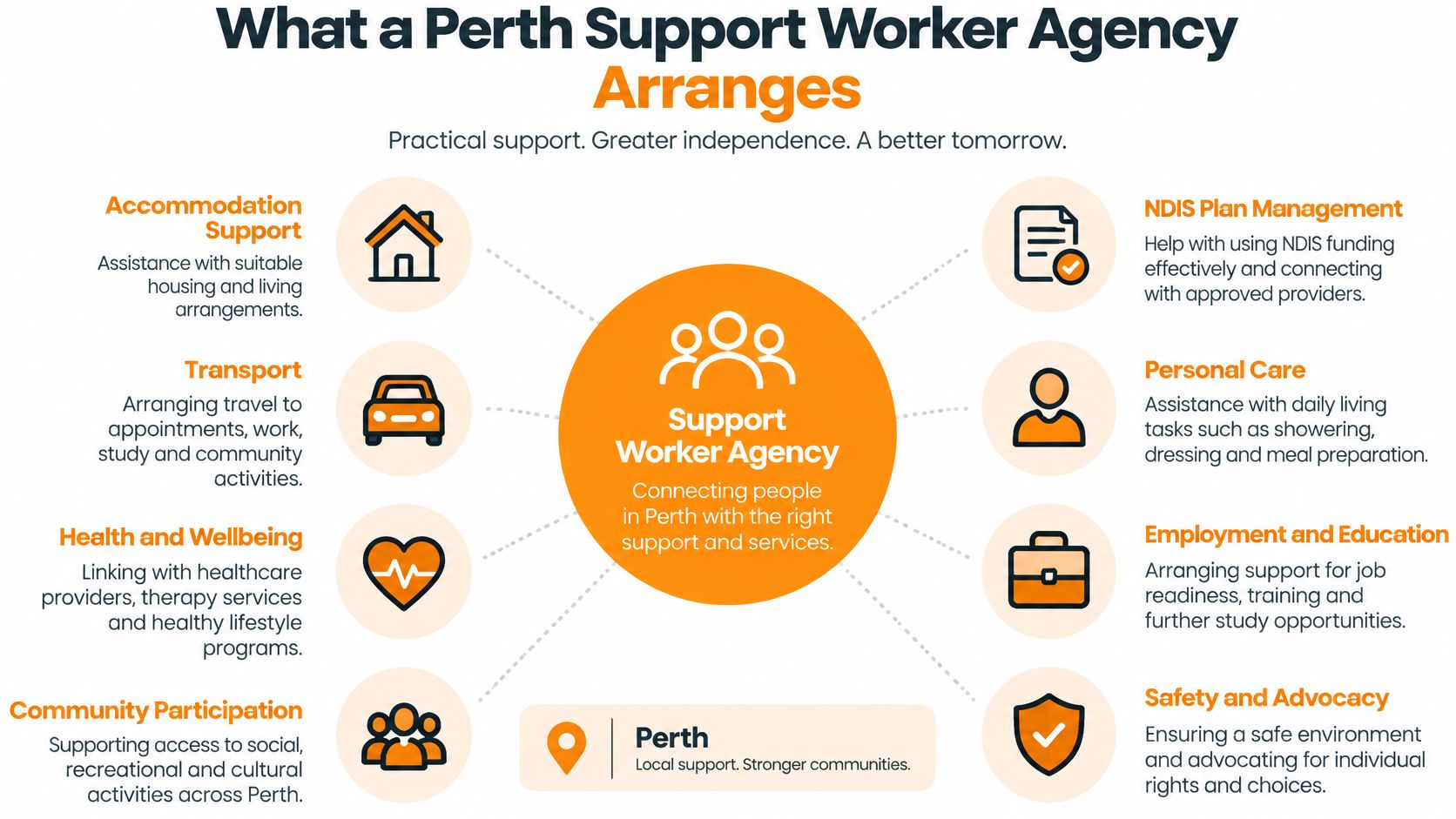
What a Perth Support Worker Agency Arranges
A worker's name on a roster fills a vacancy. A suitable match fills a role in someone's life. Think of the agency as a casting desk: the task isn't just finding someone free, but finding someone whose skills, communication and availability suit the person's home and routine.
The market is substantial. The NDIS Western Australia quarterly report recorded 62,955 active participants with approved plans at 31 March 2025, excluding children accessing early connections, and 25,761 active providers in the March 2025 quarter. Those are statewide figures, not a count of Perth support-worker agencies or workers available for your preferred hours.
Support tasks and agency responsibilities
An agency recruits, checks, matches and rosters workers. The worker provides the agreed assistance, which might involve helping someone shower, prepare a meal, practise shopping skills or get to a community activity.
At Enrichment Care, we arrange personal care, community participation, life skills, cleaning, meal preparation and transport. For meals and household tasks, workers can work alongside the participant or complete tasks on their behalf where needed.
The distinction between doing for and doing with matters. Someone who wants to learn meal preparation needs a different approach from someone who needs dinner prepared while they conserve energy. A task list alone won't tell a worker which approach the participant wants.
Judge the arrangement, not the agency label
Use these tests when comparing a proposed service:
- Suitability: Can the worker perform the actual tasks and communicate in a way the participant understands?
- Repeat availability: Can that person sustain the required days and times, rather than cover an opening shift?
- Participant control: Can the participant decline a proposed worker or request a change without an unclear handover?
An agency should make the answers concrete through worker profiles, introductory meetings, written arrangements and review processes. A broad service list or a promise to cover Perth doesn't establish that a suitable worker is available in your suburb.
Practical rule: Compare the roster you could live with over time, not the speed of the first introduction.
Checks That Prove a Worker Is Suitable
The decision isn't whether someone is free this week. It's whether you have enough information to welcome that person into your home and rely on their support.
The NDIS guidance on support workers confirms that participants can choose who supports them, that workers may work independently or for a company, and that screening and a service agreement are important checks. Treat the following table as a go or no-go scorecard: don't sign while an important answer is missing.
Suitability checks before a Perth support worker starts
| Check | Sound answer | Why it matters |
|---|---|---|
| Plan management | Agency, plan or self-managed rules confirmed before shortlisting | The wrong management type can block the provider |
| Worker screening | Current NDIS Worker Screening Check and role checks sighted | A clear check is a safeguard, not proof of personal fit |
| Worker profiles | Shortlisted profiles show suburb, language, interests and hours | The person can compare options before a shift is booked |
| Meet and greet | Preferred worker met before supports start, family welcome | Fit is judged in person, not from a roster gap |
| Backup and continuity | Usual worker named, plus a known backup path | Illness does not mean a new stranger every time |
| Preferences on file | Language, culture, food, faith, gender and routine written down | Informal promises disappear when the roster changes |
| Service agreement | Support item, unit, rate, travel, cancellation and funding source stated | Stops reliance on a generic hourly estimate |
Start at the top. Confirm how your plan is managed and whether the proposed provider meets the requirements for that arrangement. There's little value in meeting a worker before establishing that the provider can deliver and claim the agreed support.
Next, separate screening from competence. Our support workers hold the checks required for their role, including the NDIS Worker Screening Check. You should still establish how the proposed worker will carry out your particular tasks, especially where equipment, communication support or disability-specific skills are involved.
Turn a profile into a useful conversation
A profile should help you compare real options, not just describe someone as friendly and caring. Check the worker's available hours against your appointment times and personal-care routine. Ask how they would respond if you declined an activity or needed instructions explained differently.
Use these questions to ask a support worker to prepare for that conversation. At the meeting, give the participant space to answer; family involvement should assist their judgement, not replace it.
For backup arrangements, seek more than an assurance that someone will cover. Establish who coordinates replacement support, whether a potential backup can be introduced and what happens if no suitable replacement is available. Don't assume a named backup has been secured until that's confirmed.
Finally, put preferences and costs into writing. Record what the worker will do, what they won't do and how changes will be agreed. A short delay to resolve an unanswered suitability check can be more useful than a quick start followed by an avoidable breakdown.
How Matching Becomes a Stable Roster
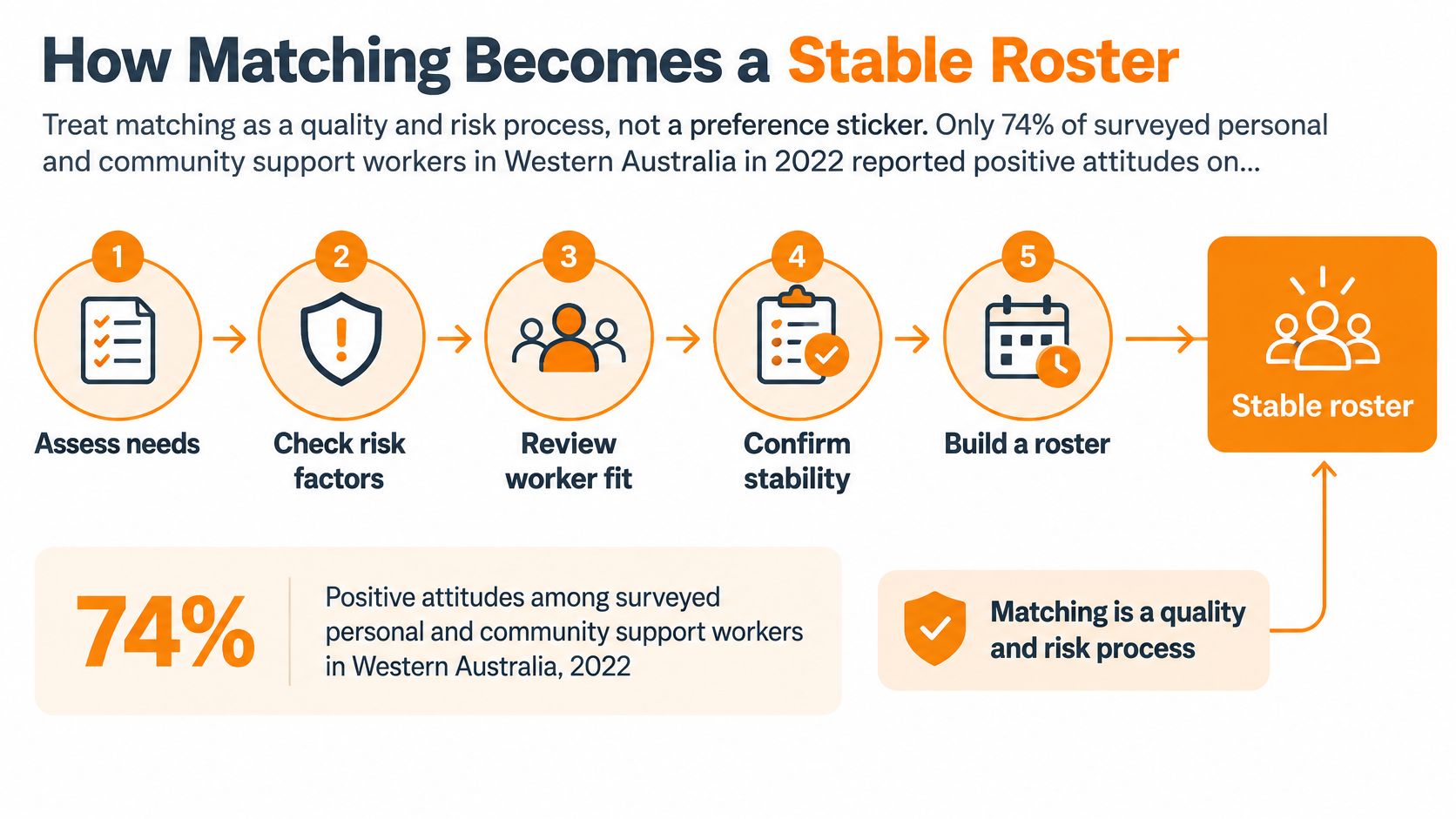
A job title doesn't establish how a worker will respond to the person they support. The Australian Institute of Health and Welfare disability-outcomes reporting found that 74% of surveyed personal and community support workers in Western Australia in 2022 reported positive attitudes related to disability confidence and responding positively to people with disability.
That finding supports a careful matching process, not a judgement about any individual worker. The practical question is how an agency checks the person's approach, competence and ability to maintain the proposed roster.
A matching process with clear decision points
Learn the person's needs. We begin with the participant's routine, language, culture and interests, alongside the support tasks. Include communication methods, things that cause distress and how the participant prefers someone to offer help.
Check competence and workable travel. Shortlist workers who can perform the required support and live close enough to sustain the service window. Say a worker's preceding shift finishes across the metropolitan area: accepting the next booking without realistic travel time could mean missing an appointment pickup.
Send profiles for consideration. We send suitable worker profiles to the participant. Support coordinators and local area coordinators can also refer participants to us and receive profiles for them to consider.
Meet before supports begin. Participants meet their preferred worker at a meet and greet, and family members are welcome. Use an everyday example, such as preparing lunch or planning an outing, to discuss how the worker would assist.
Resolve a poor fit before committing. If the introduction doesn't feel right, we find someone else. Agreeing reluctantly because a worker is available can leave the participant uncomfortable about raising concerns later.
Review and rematch when needed. We use regular check-ins, and participants can request a different worker when circumstances or preferences change. Identify a contact person and a clear reason to review, such as changed health needs, repeated lateness or difficulty communicating.
Make continuity useful, not restrictive
Shared language can reduce misunderstandings about consent, personal care and changes in behaviour. Familiar workers also spend less time learning where equipment is kept or how someone expresses discomfort. Our explanation of how routine builds stability explores the practical value of predictable support.
But consistency shouldn't mean staying with an unsuitable person. For community shifts, agree on the response to a late cancellation before an outing is booked, including who contacts the participant and whether an alternative can safely proceed.
Requesting a rematch is a normal part of managing support. The aim is a dependable relationship, not keeping the same name on the roster at any cost.
Culture and Language Beyond Weekday Hours
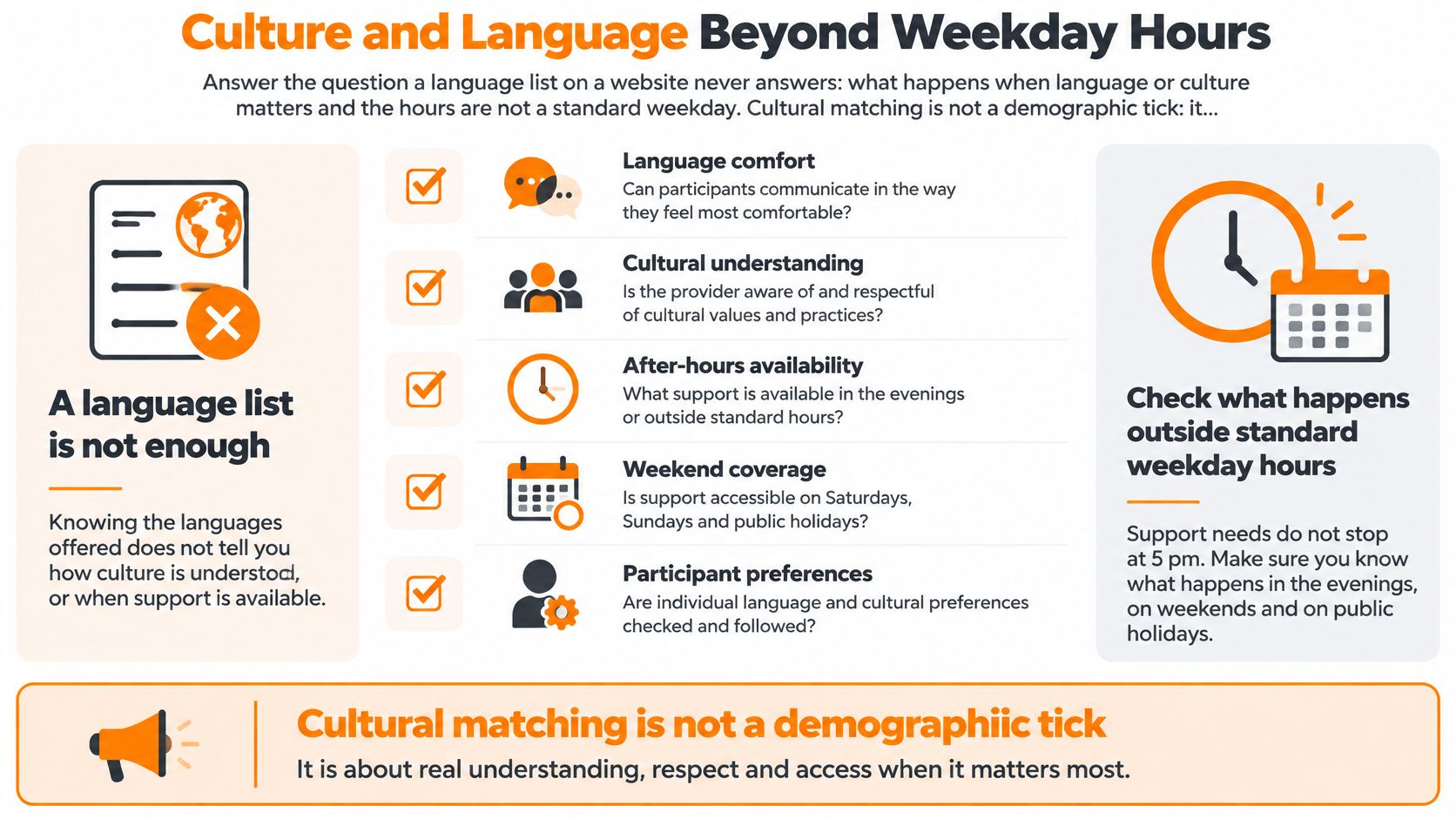
A perfect language-and-culture match may not be available for the exact evening or weekend hours you need. The useful response isn't to dismiss the preference or promise every requirement can be met. It's to distinguish essential requirements from alternatives the participant accepts.
Cultural responsiveness also involves more than recruitment. The WA Department of Communities Multicultural Action Plan reports that 18.1% of its employees were from culturally and linguistically diverse backgrounds in its 2025 workforce snapshot, above its 15.5% target, alongside commitments to cultural competency and workforce representation. That's public-sector workforce evidence, not a measure of language-matched disability-worker availability in Perth.
Separate essential requirements from preferences
Write down what an unfamiliar worker would need to understand before entering the home. Don't assume that sharing a language means sharing a religion, food practice or view about family involvement.
- Communication essentials: Identify the language or communication method needed for the participant to understand choices and express consent. Consider whether an interpreter is still needed for complex discussions.
- Personal-care boundaries: Record any gender preference, privacy requirements and practices that the participant considers essential.
- Faith and food: Explain requirements around Ramadan, church attendance, meal preparation or handling particular foods.
- Acceptable alternatives: State whether another language, communication aid or different service time would be acceptable. The participant should approve the alternative, rather than have it chosen during a staffing shortage.
We match workers to the participant's language, culture and personality, including Korean-speaking workers for everyday core supports. Our approach to culturally appropriate disability support considers practical routines as well as language.
Test the after-hours fallback
Say a participant needs evening meal assistance and prefers a worker who speaks their first language. If that worker is absent, an acceptable fallback might be a familiar worker who understands the food requirements and uses an agreed communication method. It isn't acceptable to assume the participant will understand an unfamiliar replacement.
For personal care and medication-related routines, establish how the participant will understand what's proposed and communicate refusal or concern. A family member's availability shouldn't be assumed as the default solution.
Community access requires the same respect for choice. The worker can assist with travel, prompts or physical support, but the participant decides where to go and what to do. Attendance at a cultural event shouldn't become a worker-selected outing because it's easier to organise.
A competent, participant-approved backup can be more useful than cancelling while waiting for an ideal match. But a fallback is only workable if it preserves safety, communication and the person's essential boundaries.
What Award Costs Mean for Perth Rosters
A support worker's award wage isn't the price of an hour of support. An agency also has to account for the employment and operating costs involved in making that hour available.
The NDIS Disability Support Worker Cost Model for 2025–26 incorporates wages, shift loadings, leave, superannuation, allowances, supervision, utilisation, workers' compensation, overheads and margin, and assumes 12.00% superannuation. Its indicative award rates and approximate cumulative direct costs per worked hour are set out below.
Award base and modelled loaded cost, 2025–26
| Classification | Award base | Loaded direct cost |
|---|---|---|
| Disability Support Worker Level 1 | $36.75 an hour | about $50.54 an hour |
| Disability Support Worker Level 2 | $38.19 an hour | about $52.52 an hour |
| Disability Support Worker Level 3 | $39.77 an hour | about $54.69 an hour |
| Disability Support Worker Level 4 | $47.97 an hour | about $65.97 an hour |
These are cost-model figures, not participant quotes. The loaded direct-cost column also shouldn't be mistaken for the complete provider price: the model includes further considerations beyond direct employment costs.
An agency needs to allow for paid time that can't be billed directly to a participant, such as supervision and some gaps between services. Recruitment, travel arrangements and cancellation exposure also affect whether it can sustain a proposed roster.
Check the service window before accepting the match
Nights, Saturdays, Sundays and public holidays can involve different award loadings and applicable NDIS price limits. That makes the actual service window a budget decision, not a detail to settle after choosing a worker.
For example, a participant might need help getting ready for a weekend activity. A generic weekday quote won't establish what that recurring arrangement will cost. Keep the required start time, duration and day together when requesting the written quote.
Confirm these details before accepting:
- Support item and unit: Identify what support is being delivered and how it's measured.
- Agreed rate: Establish the rate for the actual day and time, rather than treating the price limit as an automatic charge.
- Travel and transport: Separate worker time, provider travel and kilometres so the participant can understand what may be claimed.
- Cancellations and funding: Record the cancellation terms and which funding source will pay for the support.
We claim provider travel and kilometres under the NDIS Pricing Arrangements. Providers can charge less than the national price limit, so the relevant question is the agreed rate, not merely the maximum permitted amount.
Budget check: A worker isn't a confirmed match until their availability and the written cost both fit the required service window.
NDIS pricing arrangements are published for each financial year. Check the arrangements applicable to the proposed service dates rather than treating a historical cost-model table or an undated online estimate as the current participant price. If you change the roster, have the revised costs confirmed too.
Write the Brief and Request a Shortlist
Start with your suburb and the hours you need, not a request for an unnamed perfect worker. Outside our Surry Hills office, we recruit and match workers who live near the participant. Coverage therefore depends on finding the right person, and we'll check your suburb when you contact us.
Finding a worker can take longer when location, service hours and specific preferences narrow the options. We start shortlisting once we understand the participant's needs, but there isn't a universal start time we can promise.
A brief you can use this week
Prepare these lines before calling or sending an enquiry:
- Where and when: My suburb is [suburb], and I need support on [days] during [times]. These hours are fixed, or I can accept [alternative].
- What matters: I need help with [tasks]. My essential language, communication, cultural or personal-care requirements are [requirements], and I'm comfortable with [fallback].
- How to proceed: My plan is [management type], and [participant, family member, support coordinator or LAC] is arranging the introduction. If the meeting isn't a good fit, I want another profile considered before support starts.
Add anything that affects safe delivery, including relevant equipment, access to the home and whether transport is part of the shift. You don't need a polished document. A clear description is more useful than broad labels such as flexible support or culturally sensitive care.
Choose a workable next step
You can find a support worker through our website or call 1300 543 123. Once profiles arrive, compare the actual availability and skills against your brief, rather than choosing on a friendly biography alone.
Proceed to an introduction when a profile meets the essentials. Confirm the written support arrangement when you understand the tasks, costs and cancellation terms, and have a satisfactory answer about absence cover.
If the only advantage of a proposed match is that the worker can start immediately, decline it and request another profile. A fast start isn't a reason to skip a suitability check.
Enrichment Care offers Perth participants locally matched support workers for daily living and community participation, with profiles and a meet and greet before supports begin. Visit Enrichment Care to send your suburb, required hours and essential preferences, and request a shortlist you can assess for a sustainable match.